Department of Neurosurgery and Brain Repair, Center of Excellence for Aging and Brain Repair, University of South Florida College of Medicine, Tampa, FL, USA.
Neuroimmunology Research R&D-31, VA Portland Health Care System, Portland, OR, USA.
CNS Neurosci Ther. 2020 Jul;26(7):663-669. doi: 10.1111/cns.13369. Epub 2020 Mar 31.
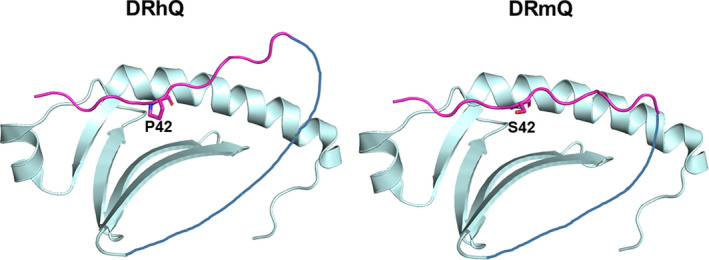
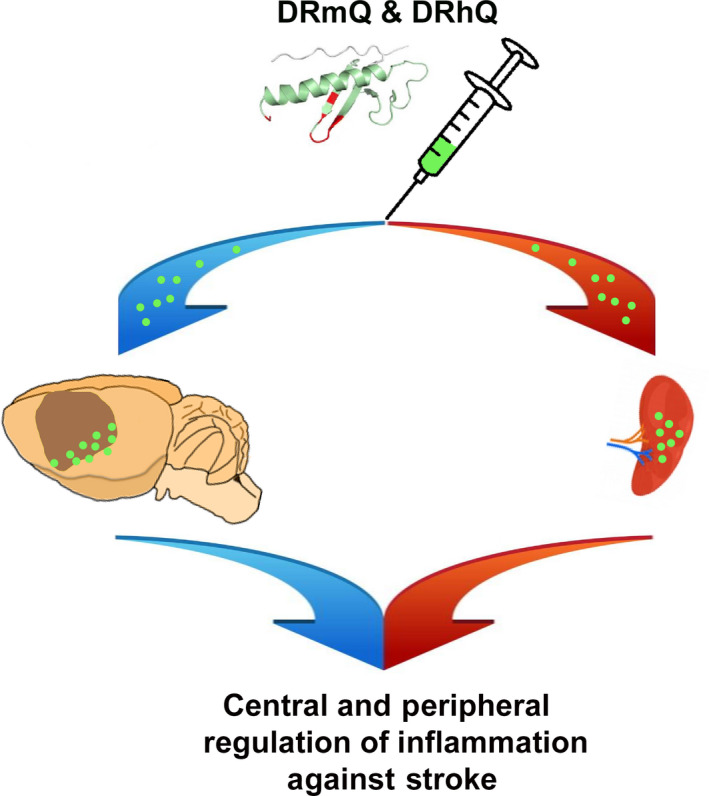
Pathological progression of stroke in the peripheral and central nervous systems (PNS and CNS) is characterized by multiple converging signalling pathways that exacerbate neuroinflammation-mediated secondary cell death. This creates a need for a novel type of immunotherapy capable of simultaneously lowering the synergistic inflammatory responses in the PNS and CNS, specifically the spleen and brain. Previously, we demonstrated that partial major histocompatibility complex (MHC) class II constructs can be administered subcutaneously to promote histological and behavioural effects that alleviate common symptoms found in a murine model of transient stroke. This MHC class II manipulates T cell cytokine expression in both PNS and CNS, resulting in dampened inflammation. In our long-standing efforts towards translational research, we recently demonstrated that a potent next generation mouse-based partial MHC class II construct named DRmQ (DRa1 -mMOG-35-55) similarly induces neuroprotection in stroke rats, replicating the therapeutic effects of the human homolog as DRhQ (DRa1 -human (h)MOG-35-55) in stroke mice. Our preclinical studies showed that DRmQ reduces motor deficits, infarct volume and peri-infarct cell loss by targeting inflammation in this second species. Moreover, we provided mechanistic support in both animal studies that partial MHC class II constructs effectively modulate the spleen, an organ which plays a critical role in modulating secondary cell death. Together, these preclinical studies satisfy testing the constructs in two stroke models, which is a major criterion of the Stroke Therapy Academic Industry Roundtable (STAIR) criteria and a key step in effectively translating this drug to the clinic. Additional translational studies, including dose-response and larger animal models may be warranted to bring MHC class II constructs closer to the clinic.
中风在周围和中枢神经系统(PNS 和 CNS)中的病理进展的特点是多种汇聚的信号通路,这些信号通路加剧了神经炎症介导的继发性细胞死亡。这就需要一种新型的免疫疗法,能够同时降低 PNS 和 CNS 中协同炎症反应,特别是脾脏和大脑中的反应。以前,我们证明了部分主要组织相容性复合物(MHC)II 类构建物可以通过皮下给药来促进组织学和行为学效应,从而缓解在短暂性中风的小鼠模型中发现的常见症状。这种 MHC II 类在 PNS 和 CNS 中调节 T 细胞细胞因子表达,从而减轻炎症。在我们长期的转化研究努力中,我们最近证明了一种强大的基于下一代小鼠的部分 MHC II 类构建物 DRmQ(DRa1 -mMOG-35-55)同样可以在中风大鼠中诱导神经保护作用,复制了 DRhQ(DRa1 -人类(h)MOG-35-55)在中风小鼠中的治疗效果。我们的临床前研究表明,DRmQ 通过靶向第二种物种中的炎症来减少运动缺陷、梗塞体积和梗塞周围细胞丢失。此外,我们在动物研究中提供了机制支持,表明部分 MHC II 类构建物可以有效地调节脾脏,脾脏在调节继发性细胞死亡中起着关键作用。总之,这些临床前研究满足了在两种中风模型中测试这些构建物的要求,这是中风治疗学术产业圆桌会议(STAIR)标准的主要标准之一,也是将这种药物有效地转化为临床的关键步骤。可能需要进行更多的转化研究,包括剂量反应和更大的动物模型,以使 MHC II 类构建物更接近临床。