Graham Amanda L, Papandonatos George D, Jacobs Megan A, Amato Michael S, Cha Sarah, Cohn Amy M, Abroms Lorien C, Whittaker Robyn
Innovations Center, Truth Initiative, Washington, DC, United States.
Mayo Clinic College of Medicine and Science, Rochester, MN, United States.
J Med Internet Res. 2020 Apr 2;22(4):e17734. doi: 10.2196/17734.
Smoking remains a leading cause of preventable death and illness. Internet interventions for smoking cessation have the potential to significantly impact public health, given their broad reach and proven effectiveness. Given the dose-response association between engagement and behavior change, identifying strategies to promote engagement is a priority across digital health interventions. Text messaging is a proven smoking cessation treatment modality and a powerful strategy to increase intervention engagement in other areas of health, but it has not been tested as an engagement strategy for a digital cessation intervention.
This study examined the impact of 4 experimental text message design factors on adult smokers' engagement with an internet smoking cessation program.
We conducted a 2×2×2×2 full factorial screening experiment wherein 864 participants were randomized to 1 of 16 experimental conditions after registering with a free internet smoking cessation program and enrolling in its automated text message program. Experimental factors were personalization (on/off), integration between the web and text message platforms (on/off), dynamic tailoring of intervention content based on user engagement (on/off), and message intensity (tapered vs abrupt drop-off). Primary outcomes were 3-month measures of engagement (ie, page views, time on site, and return visits to the website) as well as use of 6 interactive features of the internet program. All metrics were automatically tracked; there were no missing data.
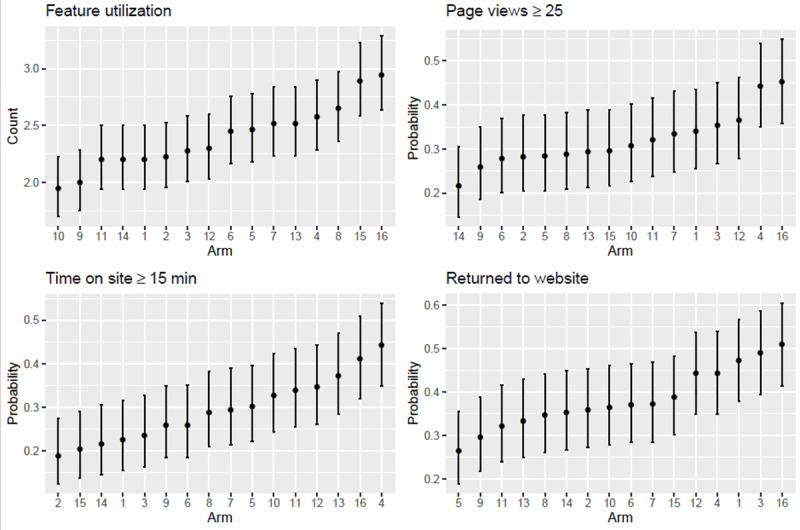
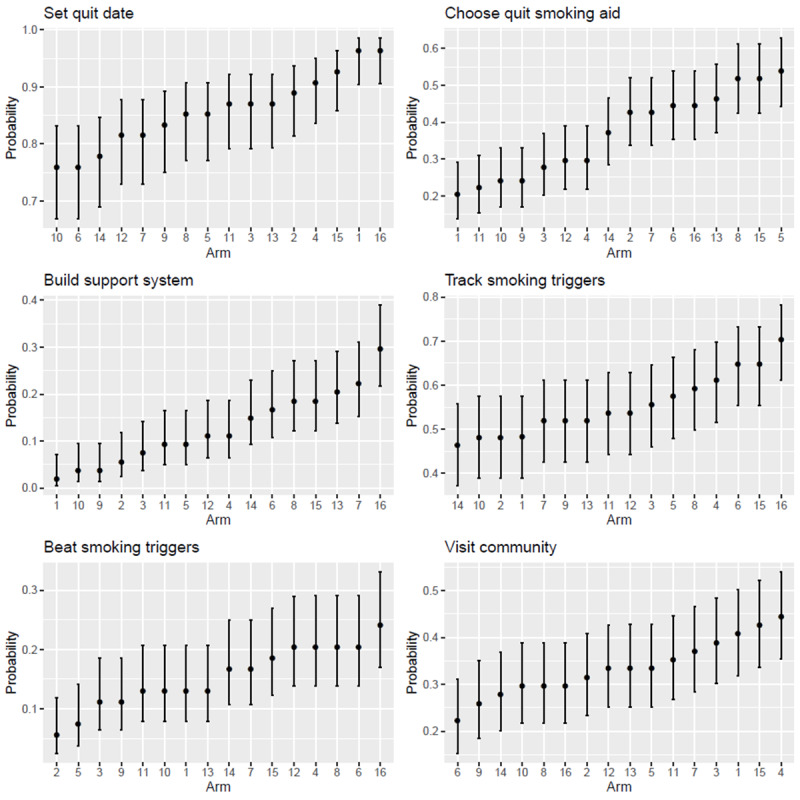
Main effects were detected for integration and dynamic tailoring. Integration significantly increased interactive feature use by participants, whereas dynamic tailoring increased the number of features used and page views. No main effects were found for message intensity or personalization alone, although several synergistic interactions with other experimental features were observed. Synergistic effects, when all experimental factors were active, resulted in the highest rates of interactive feature use and the greatest proportion of participants at high levels of engagement. Measured in terms of standardized mean differences (SMDs), effects on interactive feature use were highest for Build Support System (SMD 0.56; 95% CI 0.27 to 0.81), Choose Quit Smoking Aid (SMD 0.38; 95% CI 0.10 to 0.66), and Track Smoking Triggers (SMD 0.33; 95% CI 0.05 to 0.61). Among the engagement metrics, the largest effects were on overall feature utilization (SMD 0.33; 95% CI 0.06 to 0.59) and time on site (SMD 0.29; 95% CI 0.01 to 0.57). As no SMD >0.30 was observed for main effects on any outcome, results suggest that for some outcomes, the combined intervention was stronger than individual factors alone.
This factorial experiment demonstrates the effectiveness of text messaging as a strategy to increase engagement with an internet smoking cessation intervention, resulting in greater overall intervention dose and greater exposure to the core components of tobacco dependence treatment that can promote abstinence.
ClinicalTrials.gov NCT02585206; https://clinicaltrials.gov/ct2/show/NCT02585206.
INTERNATIONAL REGISTERED REPORT IDENTIFIER (IRRID): RR2-10.1136/bmjopen-2015-010687.
吸烟仍然是可预防死亡和疾病的主要原因。鉴于网络戒烟干预措施覆盖面广且已证实有效,其有潜力对公众健康产生重大影响。鉴于参与度与行为改变之间的剂量反应关联,确定促进参与的策略是数字健康干预措施的首要任务。短信是一种已证实的戒烟治疗方式,也是提高其他健康领域干预措施参与度的有力策略,但尚未作为数字戒烟干预措施的参与策略进行测试。
本研究探讨了4个实验性短信设计因素对成年吸烟者参与网络戒烟计划的影响。
我们进行了一项2×2×2×2全因子筛选实验,864名参与者在注册免费网络戒烟计划并加入其自动短信计划后,被随机分配到16种实验条件中的一种。实验因素包括个性化(开/关)、网络与短信平台之间的整合(开/关)、根据用户参与度动态调整干预内容(开/关)以及信息强度(逐渐减少与突然下降)。主要结局是3个月的参与度指标(即页面浏览量、网站停留时间和网站回访次数)以及网络计划6个互动功能的使用情况。所有指标均自动跟踪;无缺失数据。
检测到整合和动态调整的主效应。整合显著增加了参与者对互动功能的使用,而动态调整增加了使用的功能数量和页面浏览量。单独的信息强度或个性化未发现主效应,尽管观察到与其他实验特征的一些协同相互作用。当所有实验因素都起作用时,协同效应导致互动功能使用频率最高,参与度高的参与者比例最大。以标准化均值差(SMD)衡量,对互动功能使用的影响在建立支持系统方面最高(SMD 0.56;95%CI 0.27至0.81)、选择戒烟辅助工具方面(SMD 0.38;95%CI 0.10至0.66)以及跟踪吸烟触发因素方面(SMD 0.33;95%CI 0.05至0.61)。在参与度指标中,最大影响在于总体功能利用率(SMD 0.33;95%CI 0.06至0.59)和网站停留时间(SMD 0.29;95%CI 0.01至0.57)。由于未观察到任何结局的主效应的SMD>0.30,结果表明对于某些结局,联合干预比单独的个体因素更强。
这项析因实验证明了短信作为一种提高网络戒烟干预措施参与度的策略的有效性,从而导致更高的总体干预剂量以及更多地接触可促进戒烟的烟草依赖治疗核心成分。
ClinicalTrials.gov NCT02585206;https://clinicaltrials.gov/ct2/show/NCT02585206。
国际注册报告识别码(IRRID):RR2-10.1136/bmjopen-2015-010687。