Saleem Maham, Kühne Lisa, De Santis Karina Karolina, Christianson Lara, Brand Tilman, Busse Heide
Department of Prevention and Evaluation, Leibniz Institute for Prevention Research and Epidemiology - BIPS, Bremen, Germany.
Leibniz Science Campus Digital Public Health, Bremen, Germany.
JMIR Ment Health. 2021 Dec 20;8(12):e30000. doi: 10.2196/30000.
Digital interventions offer a solution to address the high demand for mental health promotion, especially when facing physical contact restrictions or lacking accessibility. Engagement with digital interventions is critical for their effectiveness; however, retaining users' engagement throughout the intervention is challenging. It remains unclear what strategies facilitate engagement with digital interventions that target mental health promotion.
Our aim is to conduct a scoping review to investigate user engagement strategies and methods to evaluate engagement with digital interventions that target mental health promotion in adults.
This scoping review adheres to the PRISMA (Preferred Reporting Items for Systematic Reviews and Meta-Analyses) guidelines for scoping reviews. The search was conducted in 7 electronic databases from inception to April 2020. The inclusion criteria for studies were as follows: adult (aged ≥18 years) users of digital interventions for mental health promotion from the general population; any digital intervention for mental health promotion; and user engagement strategies described in the intervention design. We extracted the following data items: study characteristics, digital intervention (type and engagement strategy), evaluation of engagement strategy (method and result specifying whether the strategy was effective at facilitating engagement), and features of engagement (extent of use and subjective experience of users).
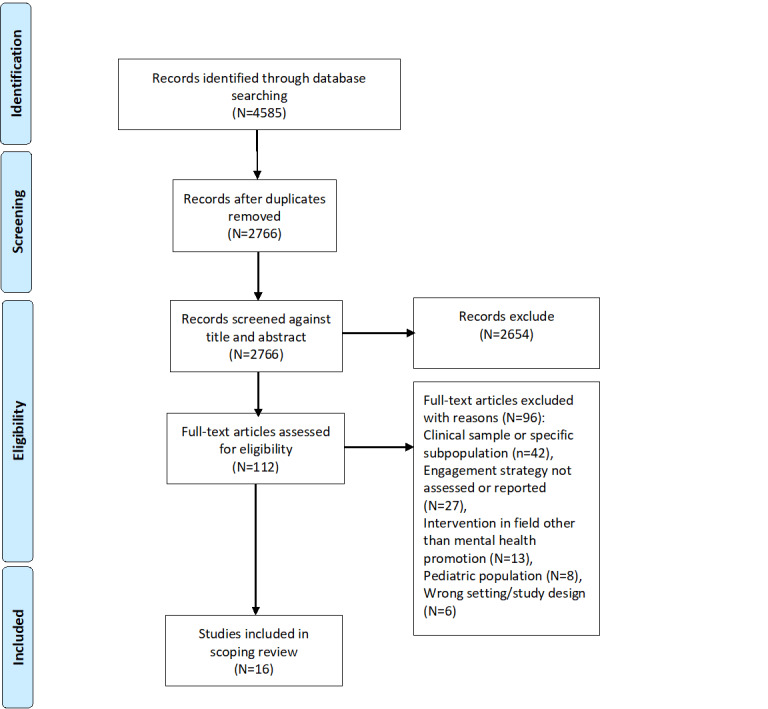
A total of 2766 studies were identified, of which 16 (0.58%) met the inclusion criteria. The 16 studies included randomized controlled trials (6/16, 37%), studies analyzing process data (5/16, 31%), observational studies (3/16, 19%), and qualitative studies (2/16, 13%). The digital interventions for mental health promotion were either web based (12/16, 75%) or mobile app based (4/16, 25%). The engagement strategies included personalized feedback about intervention content or users' mental health status; guidance regarding content and progress through e-coaching; social forums, and interactivity with peers; content gamification; reminders; and flexibility and ease of use. These engagement strategies were deemed effective based on qualitative user feedback or responses on questionnaires or tools (4/16, 25%), usability data (5/16, 31%), or both (7/16, 44%). Most studies identified personalized support in the form of e-coaching, peer support through a social platform, personalized feedback, or joint videoconference sessions as an engaging feature.
Personalized support during the intervention, access to social support, and personalized feedback seem to promote engagement with digital interventions for mental health promotion. These findings need to be interpreted with caution because the included studies were heterogeneous, had small sample sizes, and typically did not address engagement as the primary outcome. Despite the importance of user engagement for the effectiveness of digital interventions, this field has not yet received much attention. Further research is needed on the effectiveness of different strategies required to facilitate user engagement in digital interventions for mental health promotion.
数字干预为满足心理健康促进的高需求提供了一种解决方案,尤其是在面临身体接触限制或缺乏可及性的情况下。参与数字干预对于其有效性至关重要;然而,在整个干预过程中保持用户的参与度具有挑战性。目前尚不清楚哪些策略有助于促进针对心理健康促进的数字干预的参与度。
我们的目的是进行一项范围综述,以调查用户参与策略以及评估针对成年人心理健康促进的数字干预的参与度的方法。
本范围综述遵循PRISMA(系统评价和Meta分析的首选报告项目)范围综述指南。检索从数据库建立至2020年4月在7个电子数据库中进行。纳入研究的标准如下:来自普通人群的成年(年龄≥18岁)心理健康促进数字干预用户;任何心理健康促进数字干预;以及干预设计中描述的用户参与策略。我们提取了以下数据项:研究特征、数字干预(类型和参与策略)、参与策略评估(方法和结果,指明该策略在促进参与方面是否有效)以及参与特征(使用程度和用户主观体验)。
共识别出2766项研究,其中16项(0.58%)符合纳入标准。这16项研究包括随机对照试验(6/16,37%)、分析过程数据的研究(5/16,31%)、观察性研究(3/16,19%)和定性研究(2/16,13%)。心理健康促进的数字干预要么基于网络(12/16,75%),要么基于移动应用程序(4/16,25%)。参与策略包括关于干预内容或用户心理健康状况的个性化反馈;通过电子辅导对内容和进展的指导;社交论坛以及与同伴的互动;内容游戏化;提醒;以及灵活性和易用性。基于定性的用户反馈或问卷或工具上的回答(4/16,25%)、可用性数据(5/16,31%)或两者(7/16,44%),这些参与策略被认为是有效的。大多数研究将电子辅导形式的个性化支持、通过社交平台的同伴支持、个性化反馈或联合视频会议作为有吸引力的特征。
干预期间的个性化支持、获得社会支持以及个性化反馈似乎能促进对心理健康促进数字干预的参与度。由于纳入的研究具有异质性、样本量小且通常未将参与度作为主要结果,这些发现需要谨慎解释。尽管用户参与度对数字干预的有效性很重要,但该领域尚未受到太多关注