Department of Anaesthesiology, Beijing Hospital, National Center of Gerontology, Institute of Geriatric Medicine, Chinese Academy of Medical Science, Beijing, P.R. China.
Department of Anaesthesiology, Beijing Changping Hospital, Beijing, P.R. China.
Sci Rep. 2020 Apr 1;10(1):5745. doi: 10.1038/s41598-020-62716-2.
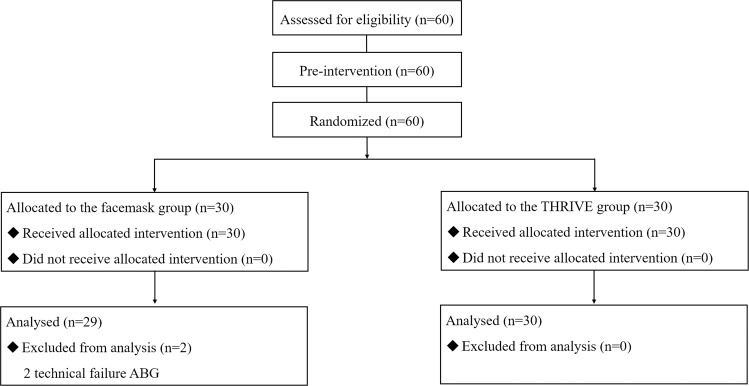
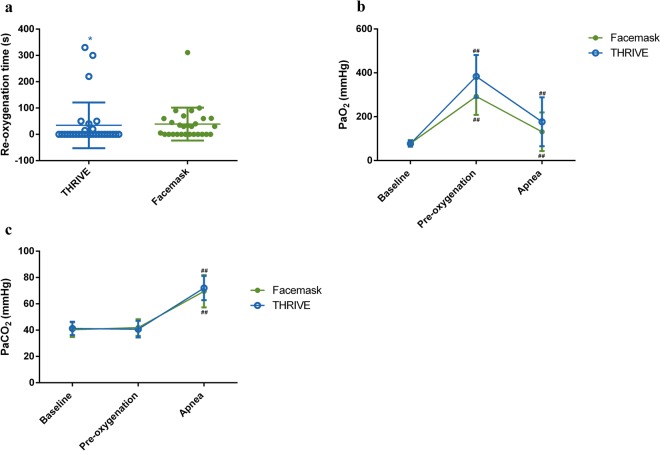
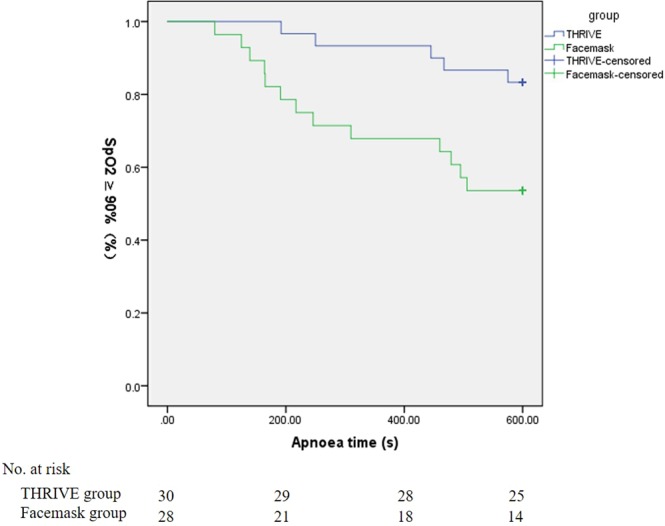
Transnasal humidified rapid insufflation ventilator exchange (THRIVE) may be effective in delaying hypoxia, but the efficacy of THRIVE for oxygenation in elderly patients under general anaesthesia has not been assessed. This study assessed whether THRIVE prolonged the apnoea time in the elderly patients after induction. This was a single centre, two-group, randomized controlled trial. 60 patients (65 to 80 years of age) with American Society of Anesthesiologists (ASA) grades I ~ III who required tracheal intubation or the application of a laryngeal mask under general anaesthesia were randomly allocated to receive oxygenation using THRIVE (100% oxygen, 30~70 litres min) or a facemask (100% oxygen, 10 litres min) during the pre-oxygenation period and during apnoea. The apnoea time, which was defined as the time from the cessation of spontaneous breathing until the SpO decreased to 90% or the apnoea time reached 10 minutes was recorded as the primary outcome. No significant differences were found on the baseline characteristics between the groups. The apnoea time was significantly increased (P < 0.01) in the THRIVE group. The median (interquartile range) apnoea times were 600 (600-600) s in the THRIVE group and 600 (231.5-600) s in the facemask group. No significant differences were found in the PaO, PaCO and vital parameters between the THRIVE and facemask groups. No increased occurrence of complications, including haemodynamic instability, resistant arrhythmia or nasal discomfort, were reported in both the THRIVE group and the facemask group. THRIVE prolongs the apnoea time in elderly patients. THRIVE may be a more effective method for pre-oxygenation than a facemask in the elderly without pulmonary dysfunction.
经鼻高流量湿化氧疗通气交换(THRIVE)可能有助于延缓缺氧,但尚未评估 THRIVE 在全身麻醉下老年患者中的氧合作用。本研究评估了 THRIVE 是否可以延长老年患者诱导后呼吸暂停时间。这是一项单中心、两分组、随机对照试验。纳入了 60 名(年龄 6580 岁)ASA 分级 IIII 级的患者,这些患者需要在全身麻醉下进行气管插管或应用喉罩。患者在预充氧期间和呼吸暂停期间,分别随机分配至 THRIVE 组(100%氧气,30~70 升/分钟)或面罩组(100%氧气,10 升/分钟)接受氧合。呼吸暂停时间定义为自主呼吸停止至 SpO 降至 90%或呼吸暂停时间达到 10 分钟的时间,作为主要结局进行记录。两组间的基线特征无显著差异。THRIVE 组的呼吸暂停时间显著延长(P<0.01)。THRIVE 组的中位数(四分位间距)呼吸暂停时间为 600(600-600)秒,面罩组为 600(231.5-600)秒。THRIVE 组和面罩组的 PaO、PaCO 和生命体征参数无显著差异。THRIVE 组和面罩组均未报告并发症发生率增加,包括血流动力学不稳定、抵抗性心律失常或鼻不适。THRIVE 可延长老年患者的呼吸暂停时间。THRIVE 可能是一种比面罩更有效的老年患者预充氧方法,尤其适用于无肺部功能障碍的老年患者。