Department of Chemistry, Faculty of Medical Sciences in Zabrze, Medical University of Silesia, Katowice, Poland.
Arch Immunol Ther Exp (Warsz). 2020 Apr 1;68(2):9. doi: 10.1007/s00005-020-00573-7.
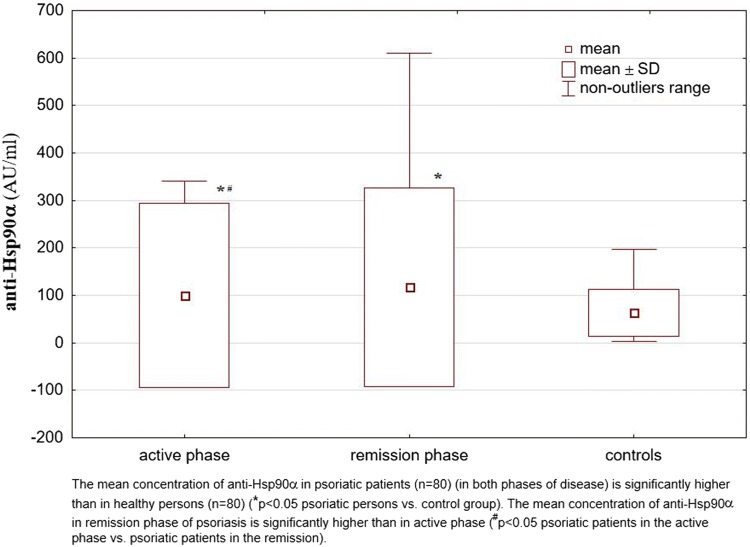
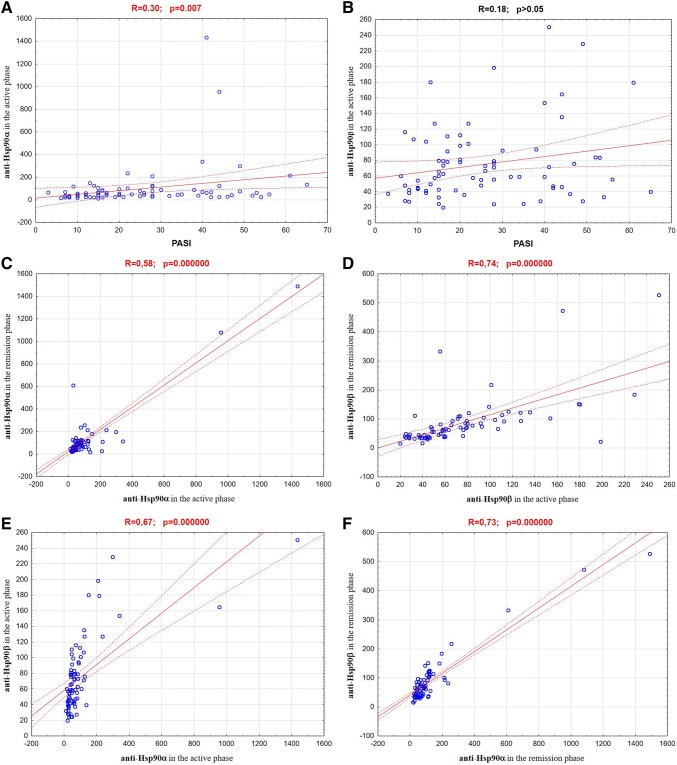
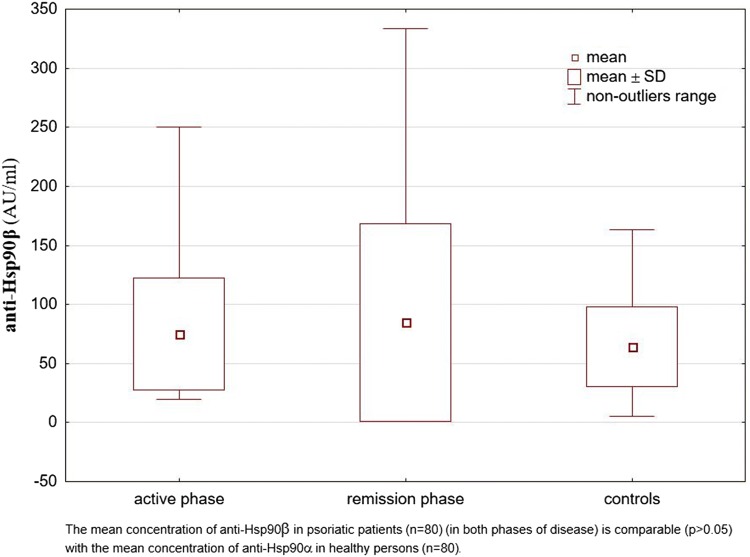
One of many hypotheses of psoriasis pathogenesis supposes an overexpression of heat shock proteins (Hsps) in different skin layers and systemic immunologic response to them. Hsp90 is one of the most abundant chaperone in eukaryotic cells. The number of studies concerning the role of Hsp90 and anti-Hsp90 antibodies in etiopathogenesis of various diseases is also constantly expanding. Still, there are not many reports concerning potential involvement of this Hsp family or anti-Hsp90 immunization in pathomechanism of psoriasis. The aim of the study was the estimation of anti-Hsp90α and anti-Hsp90β IgG antibodies in the sera of the psoriatic patients at different phases of disease activity in comparison to the sera of healthy individuals. The study material consisted of sera from psoriasis patients (n = 80) in active phase and in the remission phase and healthy individuals (n = 80). Concentrations of anti-Hsp90α and anti-Hsp90β IgG antibodies were determined using ELISA technique. In the patients with psoriasis (both in the active phase of the disease and in the remission phase) concentrations of anti-Hsp90α antibodies were significantly higher than in healthy individuals and they correlated positively with psoriasis area severity index values. The mean concentrations of anti-Hsp90β antibodies in the psoriatic patients and healthy controls were comparable. The obtained results indicate an existence of increased immunological response to Hsp90α in psoriasis. It may suggest the role of the extracellular form of this chaperone and/or anti-Hsp90α antibodies in etiopathogenesis of this dermatosis. The inhibition of Hsp90α may represent a novel therapeutic approach to treat psoriasis.
银屑病发病机制的众多假说之一假设在不同皮肤层和全身免疫反应中热休克蛋白 (Hsp) 的过度表达。Hsp90 是真核细胞中最丰富的伴侣之一。关于 Hsp90 和抗 Hsp90 抗体在各种疾病发病机制中的作用的研究数量也在不断增加。然而,关于这种 Hsp 家族或抗 Hsp90 免疫接种在银屑病发病机制中的潜在参与的报道并不多。本研究旨在评估银屑病患者在疾病活动的不同阶段与健康个体相比血清中的抗 Hsp90α 和抗 Hsp90β IgG 抗体。研究材料包括处于活动期和缓解期的银屑病患者(n=80)和健康个体(n=80)的血清。使用 ELISA 技术测定抗 Hsp90α 和抗 Hsp90β IgG 抗体的浓度。在银屑病患者(疾病活动期和缓解期)中,抗 Hsp90α 抗体的浓度明显高于健康个体,并且与银屑病面积严重指数值呈正相关。银屑病患者和健康对照组抗 Hsp90β 抗体的平均浓度相当。研究结果表明,银屑病患者存在针对 Hsp90α 的免疫反应增强。这可能表明这种伴侣的细胞外形式和/或抗 Hsp90α 抗体在这种皮肤病的发病机制中的作用。抑制 Hsp90α 可能代表一种治疗银屑病的新方法。