Cambridge Institute of Therapeutic Immunology and Infectious Disease, Jeffrey Cheah Biomedical Centre, Cambridge Biomedical Campus, University of Cambridge, Cambridge, UK.
Department of Medicine, University of Cambridge School of Clinical Medicine, Addenbrooke's Hospital, Cambridge, UK.
EMBO Mol Med. 2020 May 8;12(5):e12112. doi: 10.15252/emmm.202012112. Epub 2020 Apr 1.
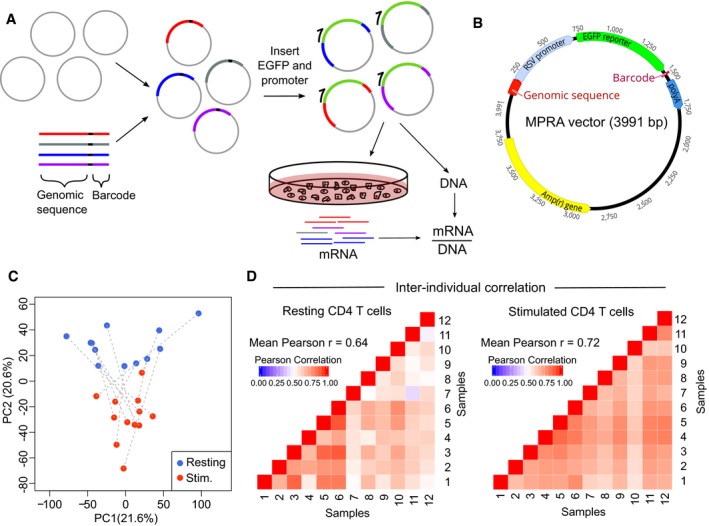
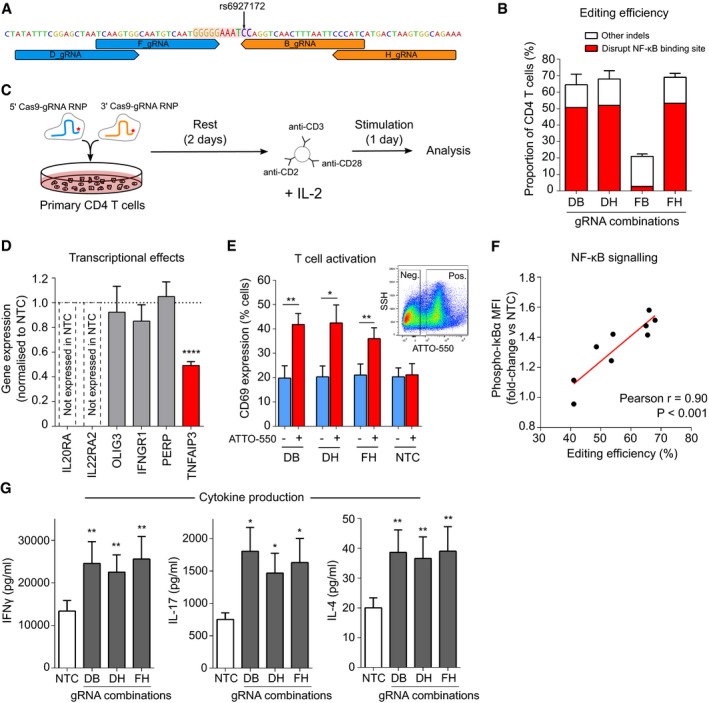
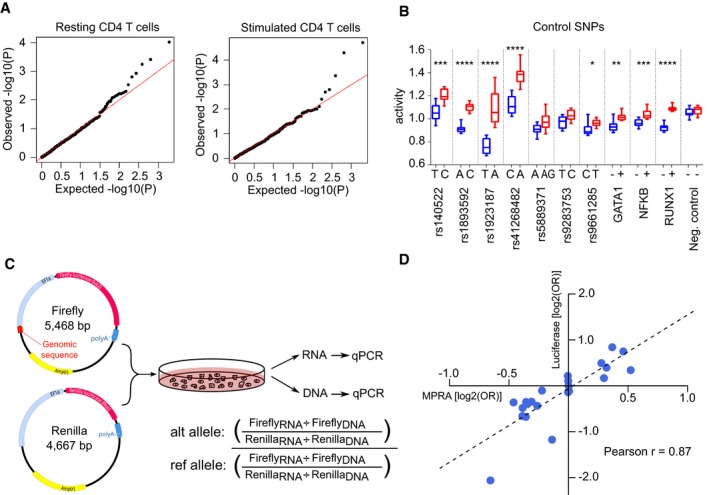
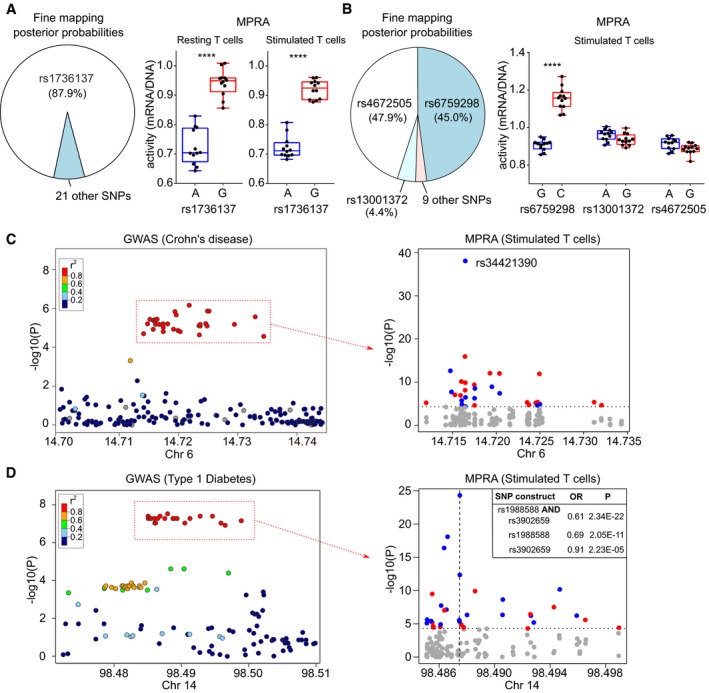
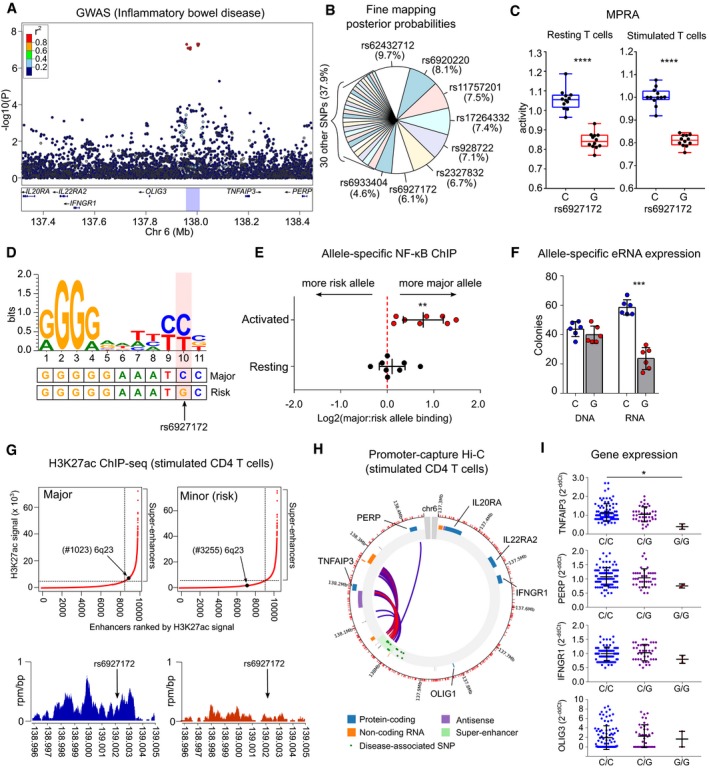
Deriving mechanisms of immune-mediated disease from GWAS data remains a formidable challenge, with attempts to identify causal variants being frequently hampered by strong linkage disequilibrium. To determine whether causal variants could be identified from their functional effects, we adapted a massively parallel reporter assay for use in primary CD4 T cells, the cell type whose regulatory DNA is most enriched for immune-mediated disease SNPs. This enabled the effects of candidate SNPs to be examined in a relevant cellular context and generated testable hypotheses into disease mechanisms. To illustrate the power of this approach, we investigated a locus that has been linked to six immune-mediated diseases but cannot be fine-mapped. By studying the lead expression-modulating SNP, we uncovered an NF-κB-driven regulatory circuit which constrains T-cell activation through the dynamic formation of a super-enhancer that upregulates TNFAIP3 (A20), a key NF-κB inhibitor. In activated T cells, this feedback circuit is disrupted-and super-enhancer formation prevented-by the risk variant at the lead SNP, leading to unrestrained T-cell activation via a molecular mechanism that appears to broadly predispose to human autoimmunity.
从 GWAS 数据中推导出免疫介导疾病的机制仍然是一项艰巨的挑战,尝试识别因果变异通常受到强连锁不平衡的阻碍。为了确定是否可以从其功能效应中识别出因果变异,我们改编了一种大规模平行报告基因检测方法,用于原代 CD4 T 细胞,该细胞类型的调节 DNA 最富集免疫介导疾病 SNPs。这使得候选 SNP 的影响可以在相关的细胞环境中进行检查,并产生可测试的疾病机制假设。为了说明这种方法的强大功能,我们研究了一个与六种免疫介导疾病相关但不能进行精细映射的基因座。通过研究主要的表达调节 SNP,我们发现了一个 NF-κB 驱动的调节回路,该回路通过动态形成一个超级增强子来限制 T 细胞激活,从而上调 TNFAIP3(A20),这是一种关键的 NF-κB 抑制剂。在激活的 T 细胞中,该反馈回路被位于主要 SNP 的风险变体破坏,超级增强子形成受阻,导致 T 细胞不受限制地激活,这种分子机制似乎广泛导致人类自身免疫。