Department of Neurology, Radboud University Medical Center, Donders Institute for Brain Cognition and Behaviour, Nijmegen, The Netherlands.
School of Medicine, Division of Rheumatology, Johns Hopkins University, Baltimore, Maryland.
Muscle Nerve. 2020 Jun;61(6):783-788. doi: 10.1002/mus.26875. Epub 2020 Apr 11.
The diagnosis of inclusion body myositis (IBM) can be challenging, and its presentation can be confused with other forms of myositis or neuromuscular disorders. In this study we evaluate the ability of quantitative muscle ultrasound to differentiate between IBM and mimicking diseases.
Patients 50 years of age and older were included from two specialty centers. Muscle echogenicity and muscle thickness of four characteristically involved muscles in IBM were measured and compared with polymyositis (PM)/dermatomyositis (DM), other neuromuscular disorders, and healthy controls.
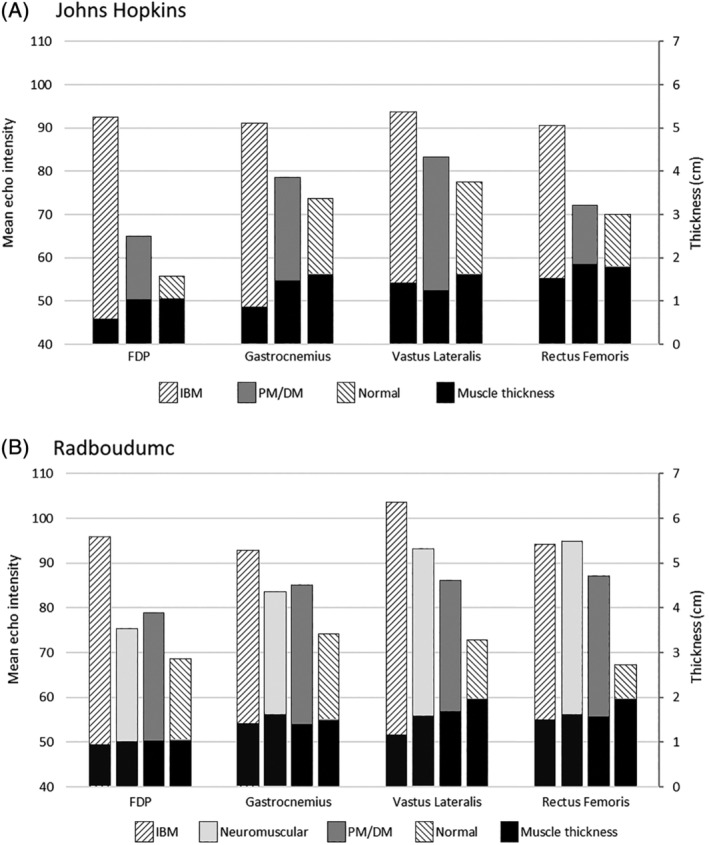
Echogenicity was higher and muscle thickness generally lower in all four muscles in IBM compared with PM/DM and normal controls. When comparing IBM with the comparator groups, the flexor digitorum profundus was the most discriminative muscle.
Ultrasound appears to be a good test to differentiate established IBM from PM/DM and neuromuscular controls, with value as a diagnostic tool for IBM.
包涵体肌炎(IBM)的诊断具有一定挑战性,其表现可能与其他类型的肌炎或神经肌肉疾病相混淆。本研究评估了定量肌肉超声在 IBM 与类似疾病之间的鉴别能力。
从两个专业中心纳入年龄 50 岁及以上的患者。测量 IBM 中四个特征性受累肌肉的肌肉回声和肌肉厚度,并与多发性肌炎(PM)/皮肌炎(DM)、其他神经肌肉疾病和健康对照组进行比较。
与 PM/DM 和正常对照组相比,IBM 患者的所有 4 块肌肉的回声均较高,而肌肉厚度普遍较低。与对照组相比,IBM 患者的指深屈肌最具鉴别性。
超声似乎是一种很好的测试方法,可将已确诊的 IBM 与 PM/DM 和神经肌肉对照组区分开来,可作为 IBM 的诊断工具。