Department of Neurology, Max Planck Institute for Human Cognitive and Brain Sciences, Leipzig, Germany.
Subproject A1, CRC 1052 "Obesity Mechanisms", University of Leipzig, Leipzig, Germany.
Hum Brain Mapp. 2020 Jun 15;41(9):2490-2494. doi: 10.1002/hbm.24959. Epub 2020 Apr 2.
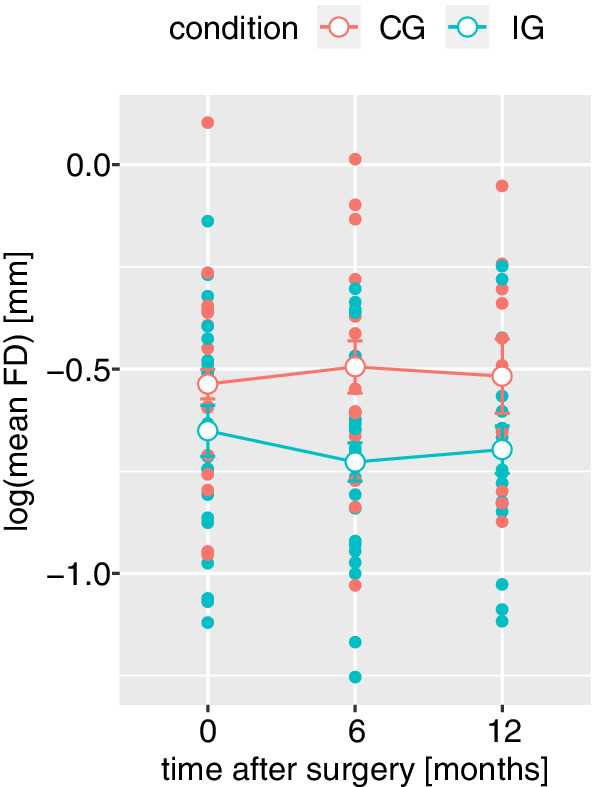
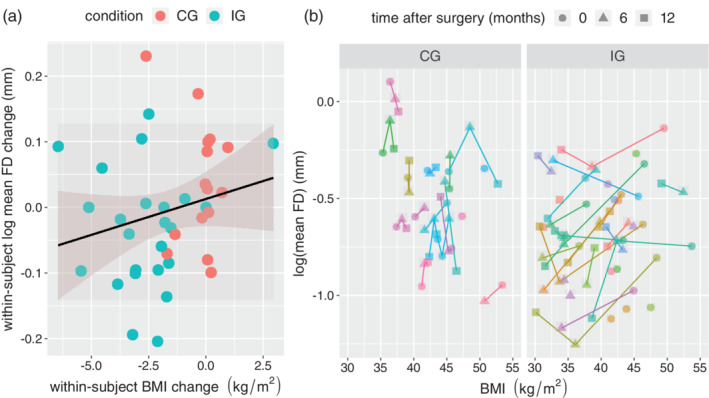
Head motion during magnetic resonance imaging (MRI) induces image artifacts that affect virtually every brain measure. In parallel, cross-sectional observations indicate a correlation of head motion with age, psychiatric disease status and obesity, raising the possibility of a systematic artifact-induced bias in neuroimaging outcomes in these conditions, due to the differences in head motion. Yet, a causal link between obesity and head motion has not been tested in an experimental design. Here, we show that a change in body mass index (BMI) (i.e., weight loss after bariatric surgery) systematically decreases head motion during MRI. In this setting, reduced imaging artifacts due to lower head motion might result in biased estimates of neural differences induced by changes in BMI. Overall, our finding urges the need to rigorously control for head motion during MRI to enable valid results of neuroimaging outcomes in populations that differ in head motion due to obesity or other conditions.
在磁共振成像(MRI)期间头部运动会产生影像伪影,几乎会影响到每个大脑测量指标。与此同时,横断面观察表明,头部运动会与年龄、精神疾病状态和肥胖相关,这增加了在这些情况下,由于头部运动的差异,神经影像学结果存在系统的伪影诱导偏差的可能性。然而,肥胖与头部运动之间的因果关系尚未在实验设计中得到检验。在这里,我们表明,体重指数(BMI)的变化(即,减肥手术后)会系统地降低 MRI 期间的头部运动。在这种情况下,由于头部运动减少而减少的成像伪影可能会导致由于 BMI 变化引起的神经差异的估计出现偏差。总的来说,我们的发现促使人们需要在 MRI 期间严格控制头部运动,以便在由于肥胖或其他情况而导致头部运动不同的人群中,获得神经影像学结果的有效结果。