Department of Chemistry and Biochemistry, Mendel University in Brno, Brno, Czech Republic.
Central European Institute of Technology, Brno University of Technology, Brno, Czech Republic.
PLoS Comput Biol. 2020 Apr 2;16(4):e1007449. doi: 10.1371/journal.pcbi.1007449. eCollection 2020 Apr.
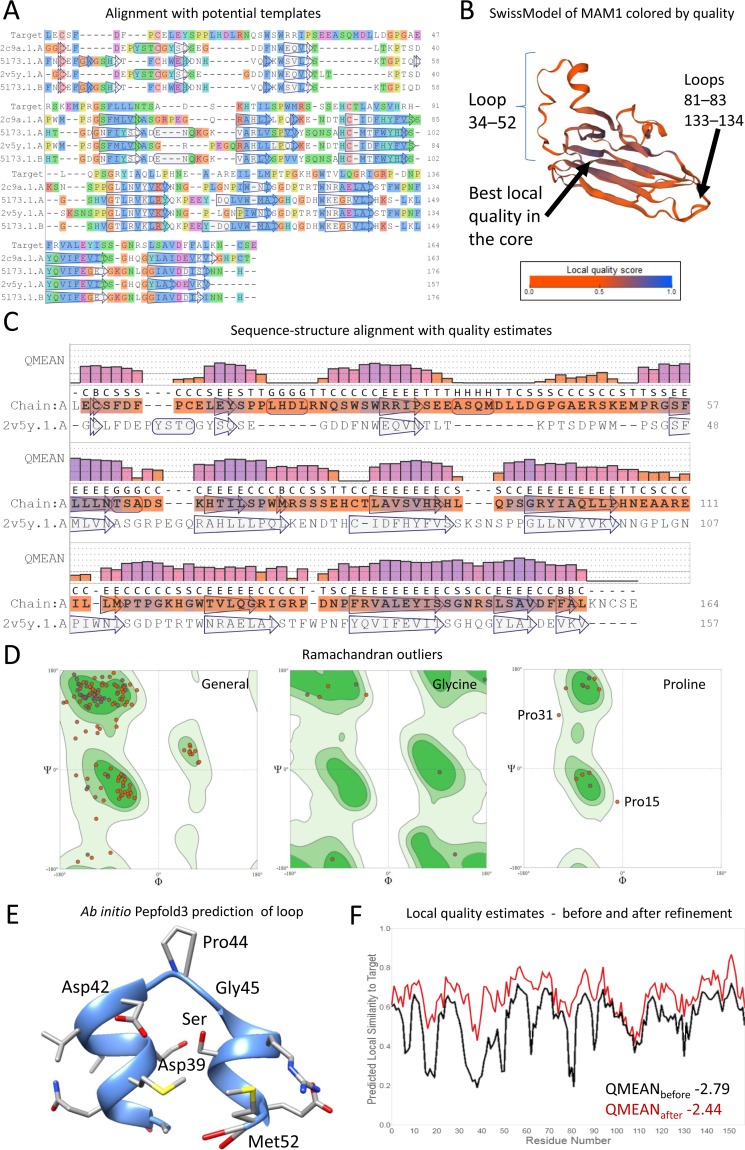
The purpose of this quick guide is to help new modelers who have little or no background in comparative modeling yet are keen to produce high-resolution protein 3D structures for their study by following systematic good modeling practices, using affordable personal computers or online computational resources. Through the available experimental 3D-structure repositories, the modeler should be able to access and use the atomic coordinates for building homology models. We also aim to provide the modeler with a rationale behind making a simple list of atomic coordinates suitable for computational analysis abiding to principles of physics (e.g., molecular mechanics). Keeping that objective in mind, these quick tips cover the process of homology modeling and some postmodeling computations such as molecular docking and molecular dynamics (MD). A brief section was left for modeling nonprotein molecules, and a short case study of homology modeling is discussed.
本快速指南的目的是帮助那些几乎没有或没有比较建模背景但热衷于通过遵循系统的良好建模实践,使用负担得起的个人计算机或在线计算资源为其研究生成高分辨率蛋白质 3D 结构的新手建模人员。通过现有的实验 3D 结构存储库,建模人员应该能够访问和使用构建同源模型的原子坐标。我们还旨在为建模人员提供一个理由,即制作一个简单的原子坐标列表,以便进行符合物理原理(例如,分子力学)的计算分析。考虑到这一目标,这些快速提示涵盖了同源建模的过程和一些后建模计算,如分子对接和分子动力学 (MD)。还为非蛋白质分子建模留出了一个简短的部分,并讨论了一个同源建模的案例研究。