Parkes H, Collis P, Baildam A, Ralphs D, Lyons B, Howell A, Craig R
Cancer Research Campaign Tumour Endocrinology Group, Medical Molecular Biology Unit, University College and Middlesex School of Medicine, London, UK.
Br J Cancer. 1988 Dec;58(6):715-22. doi: 10.1038/bjc.1988.296.
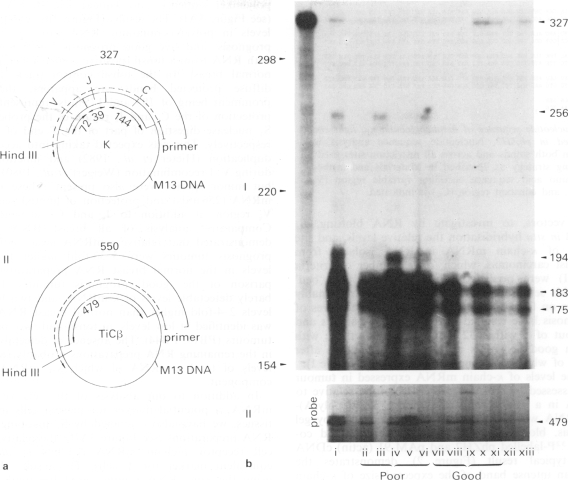
In order to identify potential markers of prognosis in breast cancer, representative cDNA libraries were constructed using RNA isolated from primary breast tumour tissue associated with good and poor prognosis. Cross-screening of these libraries repeatedly identified cloned mRNA species associated with the immune system, in particular B-cells, in libraries derived from tumours of poor prognosis. We have used one of these a kappa IV light chain cDNA probe, in two complementary studies to investigate the relationship between immunoglobin gene expression and prognosis. The results obtained using a combination of S1 mapping, RNA blotting and in situ hybridisation demonstrate that the presence of plasma cells, as defined by infiltrating cells which express high levels of immunoglobulin kappa-chain mRNA, is associated with a poor prognosis.
为了鉴定乳腺癌潜在的预后标志物,利用从预后良好和不良的原发性乳腺肿瘤组织中分离的RNA构建了代表性cDNA文库。对这些文库进行交叉筛选,在来自预后不良肿瘤的文库中反复鉴定出与免疫系统相关的克隆mRNA种类,尤其是B细胞。我们使用其中一个κIV轻链cDNA探针,进行了两项互补研究,以探讨免疫球蛋白基因表达与预后之间的关系。使用S1作图、RNA印迹和原位杂交相结合的方法获得的结果表明,由表达高水平免疫球蛋白κ链mRNA的浸润细胞所定义的浆细胞的存在与预后不良相关。