Department of Biomedical Informatics, College of Medicine, The Ohio State University, 320B Lincoln Tower, 1800 Cannon Dr., Columbus, OH, 43210, USA.
BMC Med Genomics. 2020 Apr 3;13(Suppl 5):45. doi: 10.1186/s12920-020-0682-5.
Initially characterized as axon guidance factors, semaphorins also have been implicated to have critical roles in multiple physiological and developmental functions, including the regulation of immune responses, angiogenesis, organ formation, and the etiology of multiple forms of cancer. Moreover, their contribution in immunity and the regulation of tumour microenvironment is becoming increasingly recognized. Here, we provide a comprehensive analysis of class-3 semaphorins, the only secreted family of genes among veterbrate semaphorins, in terms of their expression profiles and their association with patient survival. We also relate their role with immune subtypes, tumour microenvironment, and drug sensitivity using a pan-cancer study.
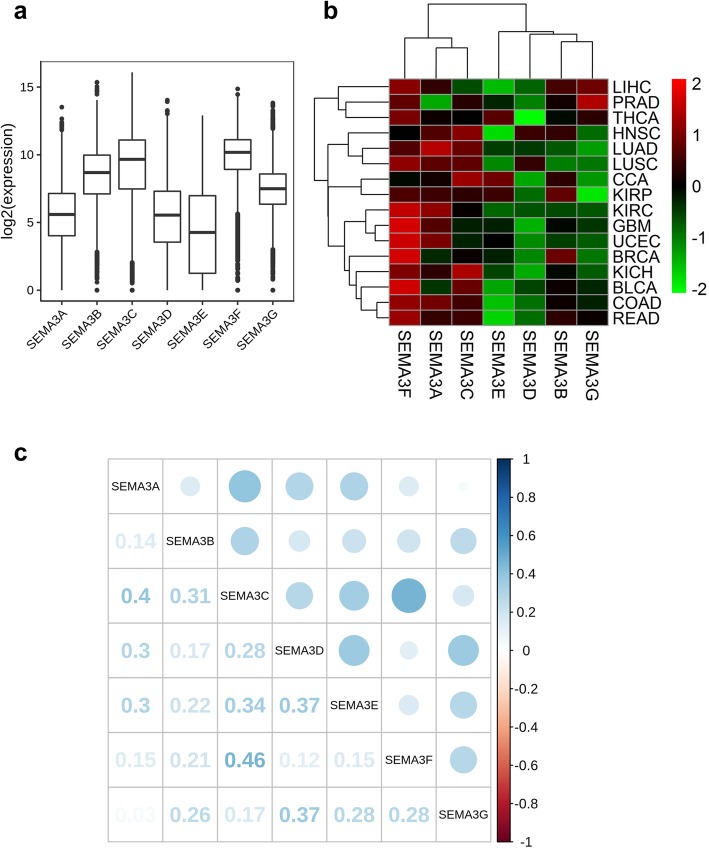
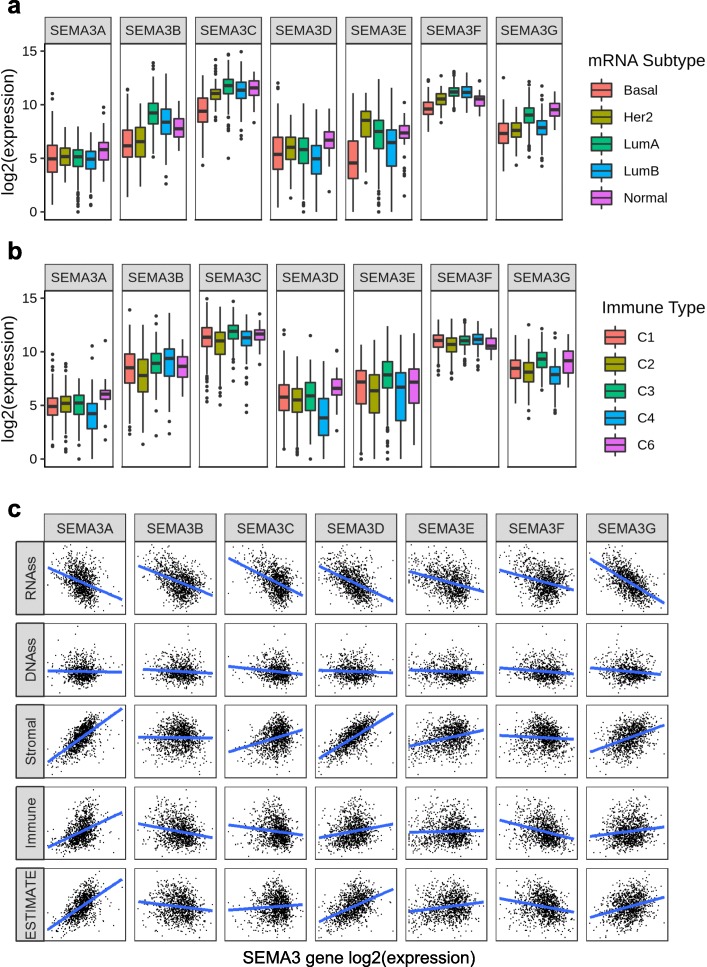
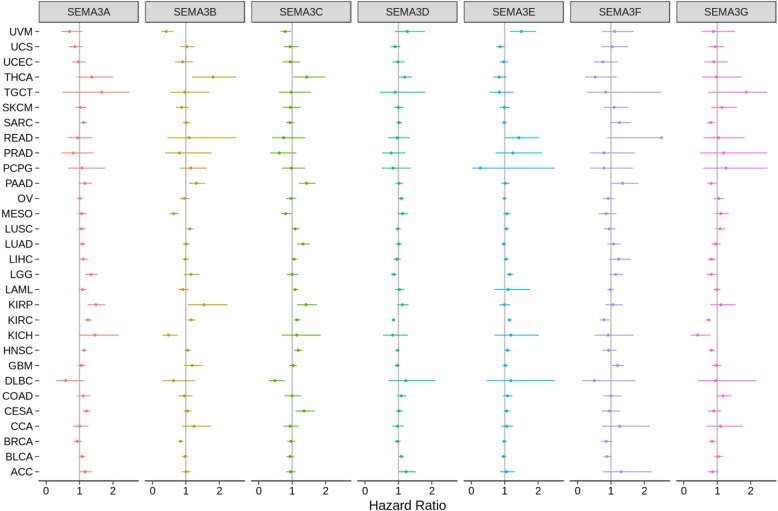
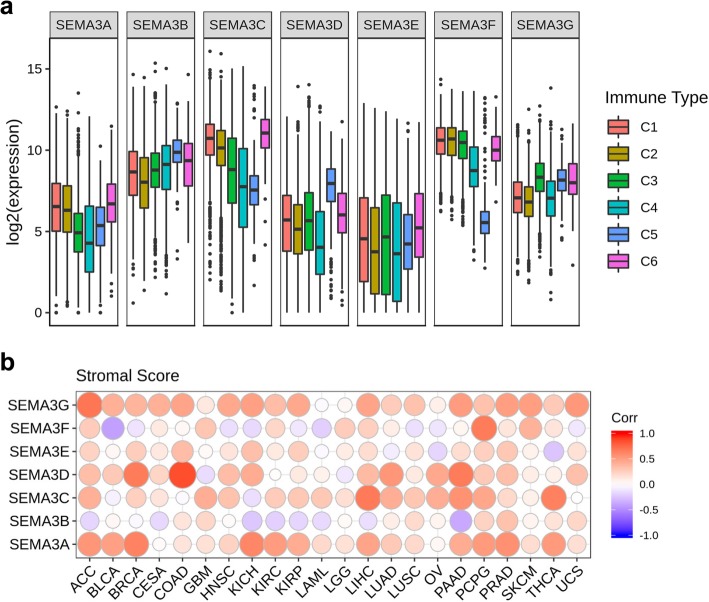
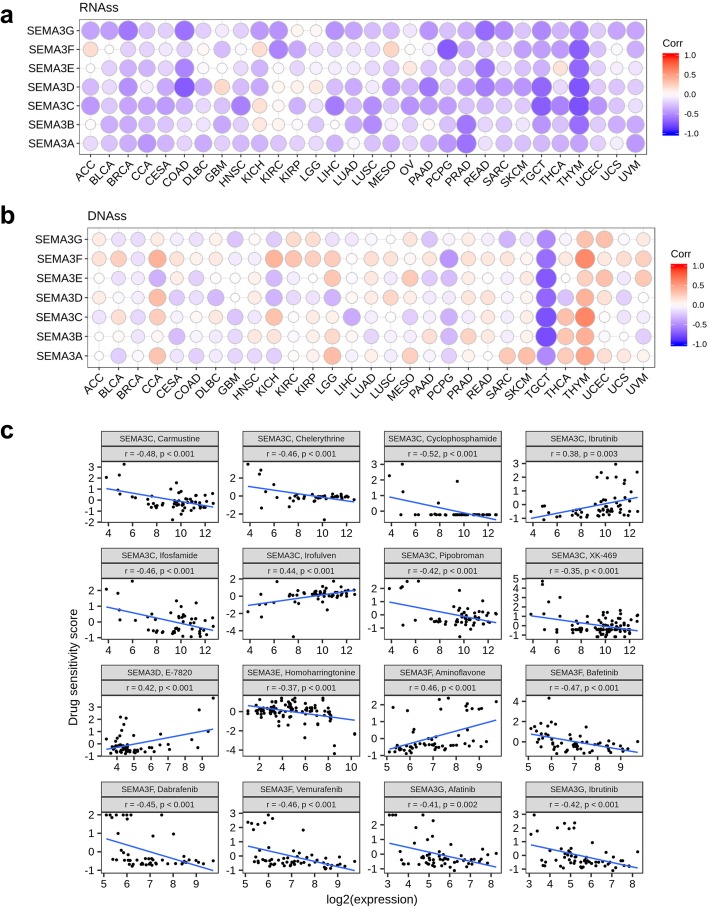
Expression profiles of class-3 semaphorins (SEMA3s) and their association with patient survival and tumour microenvironment were studied in 31 cancer types using the TCGA pan-cancer data. The expression of SEMA3 family varies in different cancer types with striking inter- and intra- cancer heterogeneity. In general, our results show that SEMA3A, SEMA3C, and SEMA3F are primarily upregulated in cancer cells, while the rest of SEMA3s are mainly down-regulated in the tested tumours. The expression of SEMA3 family members was frequently associated with patient overall survival. However, the direction of the association varied with regards to the particular SEMA3 isoform queried and the specific cancer type tested. More specifically, SEMA3A and SEMA3E primarily associate with a poor prognosis of survival, while SEMA3G typically associates with survival advantage. The rest of SEMA3s show either survival advantage or disadvantage dependent on cancer type. In addition, all SEMA3 genes show significant association with immune infiltrate subtypes, and they also correlate with level of stromal cell infiltration and tumour cell stemness with various degrees. Finally, our study revealed that SEMA3 genes, especially SEMA3C and SEMA3F may contribute to drug induced cancer cell resistance.
Our systematic analysis of class-3 semaphorin gene expression and their association with immune infiltrates, tumour microenvironment and cancer patient outcomes highlights the need to study each SEMA3 member as a separate entity within each specific cancer type. Also our study validated the identification of class-3 semaphorin signals as promising therapeutic targets in cancer although further laboratory validation still needed.
最初被认为是轴突导向因子,神经信号素也被认为在多种生理和发育功能中具有关键作用,包括免疫反应、血管生成、器官形成以及多种形式癌症的病因的调节。此外,它们在免疫和肿瘤微环境调节中的作用正越来越受到重视。在这里,我们根据表达谱及其与患者生存的关系,对脊椎动物神经信号素中唯一分泌型家族的 3 类神经信号素进行了全面分析。我们还使用泛癌研究来研究它们与免疫亚型、肿瘤微环境和药物敏感性的关系。
使用 TCGA 泛癌症数据,研究了 31 种癌症类型中 3 类神经信号素(SEMA3s)的表达谱及其与患者生存和肿瘤微环境的关系。SEMA3 家族的表达在不同的癌症类型中变化很大,具有显著的肿瘤内和肿瘤间异质性。总的来说,我们的结果表明 SEMA3A、SEMA3C 和 SEMA3F 主要在上皮癌细胞中上调,而其余 SEMA3s 在检测到的肿瘤中主要下调。SEMA3 家族成员的表达常与患者总生存期相关。然而,特定 SEMA3 同工型的相关性方向和特定癌症类型的测试结果有所不同。更具体地说,SEMA3A 和 SEMA3E 主要与生存预后不良相关,而 SEMA3G 通常与生存优势相关。其余的 SEMA3s 则根据癌症类型表现出生存优势或劣势。此外,所有 SEMA3 基因均与免疫浸润亚型显著相关,并且与基质细胞浸润和肿瘤细胞干性程度也具有不同程度的相关性。最后,我们的研究表明,SEMA3 基因,特别是 SEMA3C 和 SEMA3F,可能导致药物诱导的癌细胞耐药。
我们对 3 类神经信号素基因表达及其与免疫浸润、肿瘤微环境和癌症患者预后的关系进行了系统分析,强调需要在每个特定的癌症类型中,将每个 SEMA3 成员作为一个独立的实体进行研究。我们的研究还验证了将 3 类神经信号素信号鉴定为癌症有希望的治疗靶点,尽管仍需要进一步的实验室验证。