Department of Human Genetics, Sylvester Comprehensive Cancer Center, University of Miami Miller School of Medicine, Miami, Florida 33136, USA.
Laboratory for Molecular Cancer Biology, Oncology Department, KULeuven, 3000 Leuven, Belgium.
Genes Dev. 2020 May 1;34(9-10):637-649. doi: 10.1101/gad.333864.119. Epub 2020 Apr 2.
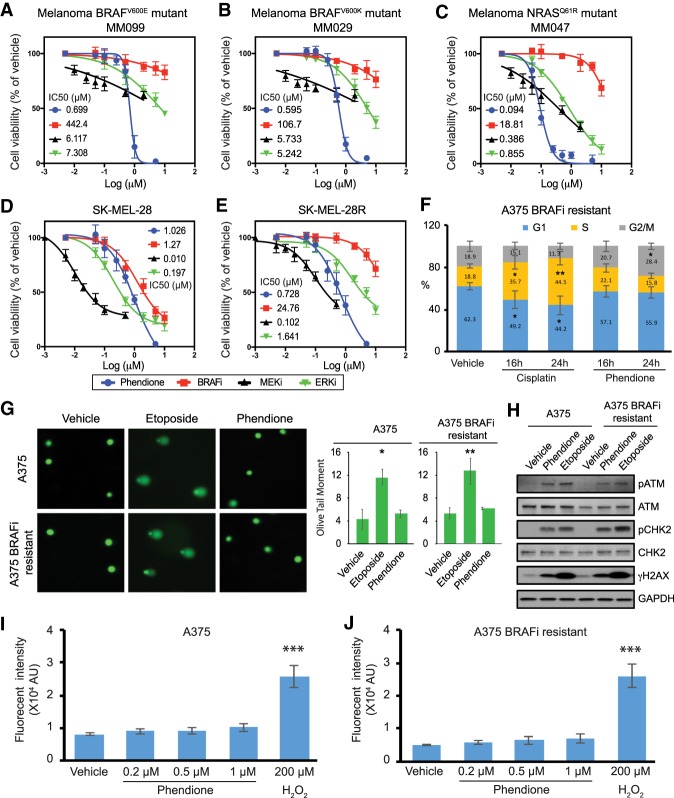
The emergence of drug resistance is a major obstacle for the success of targeted therapy in melanoma. Additionally, conventional chemotherapy has not been effective as drug-resistant cells escape lethal DNA damage effects by inducing growth arrest commonly referred to as cellular dormancy. We present a therapeutic strategy termed "targeted chemotherapy" by depleting protein phosphatase 2A (PP2A) or its inhibition using a small molecule inhibitor (1,10-phenanthroline-5,6-dione [phendione]) in drug-resistant melanoma. Targeted chemotherapy induces the DNA damage response without causing DNA breaks or allowing cellular dormancy. Phendione treatment reduces tumor growth of BRAF-driven melanoma patient-derived xenografts (PDX) and diminishes growth of NRAS-driven melanoma, a cancer with no effective therapy. Remarkably, phendione treatment inhibits the acquisition of resistance to BRAF inhibition in BRAF PDX highlighting its effectiveness in combating the advent of drug resistance.
耐药性的出现是靶向治疗在黑色素瘤中成功的主要障碍。此外,传统化疗并没有效果,因为耐药细胞通过诱导通常称为细胞休眠的生长停滞来逃避致命的 DNA 损伤效应。我们提出了一种称为“靶向化疗”的治疗策略,通过耗尽蛋白磷酸酶 2A(PP2A)或使用小分子抑制剂(1,10-菲咯啉-5,6-二酮[吩嗪])抑制其活性。靶向化疗在不引起 DNA 断裂或允许细胞休眠的情况下诱导 DNA 损伤反应。吩嗪处理可减少 BRAF 驱动的黑色素瘤患者来源异种移植物(PDX)的肿瘤生长,并抑制NRAS 驱动的黑色素瘤的生长,后者是一种尚无有效治疗方法的癌症。值得注意的是,吩嗪处理抑制了 BRAF 抑制剂在 BRAF PDX 中耐药性的获得,这突出了其在对抗耐药性出现方面的有效性。