Injury Prevention Center, University of Michigan, Ann Arbor.
Department of Psychiatry, University of Michigan Medical School, Ann Arbor.
JAMA Netw Open. 2020 Apr 1;3(4):e202051. doi: 10.1001/jamanetworkopen.2020.2051.
Benzodiazepines, which are associated with safety-related harms for older adults, were not covered when the US Medicare Part D prescription drug benefit began. Coverage was extended to benzodiazepines in 2013.
To examine whether the expansion of benzodiazepine coverage among Medicare Advantage (MA) beneficiaries was associated with increases in fall-related injuries or overdoses among older adults.
DESIGN, SETTING, AND PARTICIPANTS: This ecological study used interrupted time-series with comparison-series analyses of MA claims data from 4 635 312 age-eligible MA beneficiaries and 940 629 commercially insured individuals (comparison group) stratified by age (65-69, 70-74, 75-79, and ≥80 years) to separately compare trends in fall-related injury and overdose before (January 1, 2010, to December 31, 2012) and after (January 1, 2013, to December 31, 2015) coverage expansion for benzodiazepines. Data analysis was performed from September 1, 2018, to August 31, 2019.
Expansion of benzodiazepine coverage in Medicare Part D in 2013.
Monthly rate of fall-related injury and overdose.
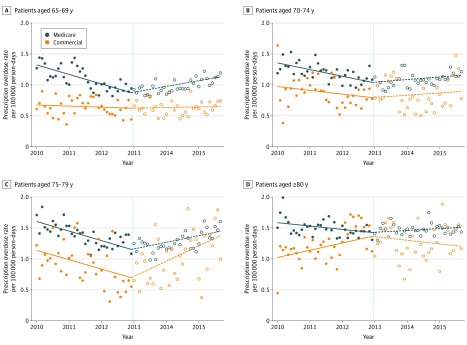
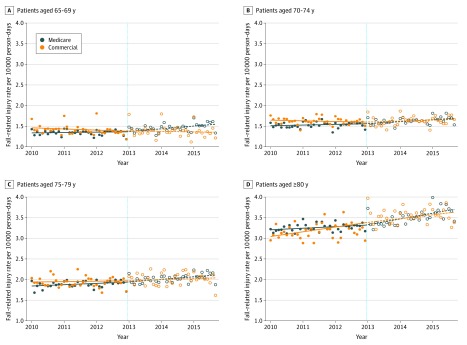
In 2012 (the year before the policy change), women constituted 57.5% of the MA group and 47.4% of the comparison group. A total of 25.8% of individuals in the MA group were aged 65 to 69 years, and 29.3% were 80 years or older (mean [SD], 75.1 [6.4] years); 56.7% of individuals in the comparison group were aged 65 to 69 years, and 15.1% were 80 years or older (mean [SD] age, 70.9 [6.5] years). In the MA group, 4 635 312 individuals contributed 156 754 749 person-months from 2010 through 2015; in the comparison group, 940 629 individuals contributed 25 104 534 person-months. After coverage of benzodiazepines began, the rate (ie, slope) of fall-related injury among MA beneficiaries increased from before to after coverage among all age groups. Compared with the comparison group, the increase in rate was statistically significant for those 80 years or older (rate changes for the MA vs comparison groups: 0.12 [95% CI, 0.07 to 0.17] vs -0.01 [95% CI, -0.11 to 0.10]; P = .04 for interaction). The overdose trend changed from decreasing to increasing among MA beneficiaries after coverage for all age groups, with a statistically significant increase compared with the comparison group among those aged 65 to 69 years (rate changes for the MA vs comparison groups: 0.23 [95% CI, 0.17 to 0.30] vs 0.02 [95% CI, -0.06 to 0.11]; P < .001 for interaction) and among those 80 years or older (rate changes for the MA vs comparison groups: 0.07 [95% CI, 0.00 to 0.14] vs -0.20 [95% CI, -0.35 to -0.05]; P = .002 for interaction). Results among MA beneficiaries were consistent when stratified by sex and when limited to those prescribed opioids.
Medicare's expansion of benzodiazepine coverage may have been associated with increases in the rates of overdose among adults ages 65 to 69 years and in the rates of overdose and fall-related injury among those 80 years or older.
苯二氮䓬类药物与老年人的安全相关危害有关,在美国医疗保险 D 部分处方药福利开始时并未涵盖。2013 年,苯二氮䓬类药物的覆盖范围扩大。
研究医疗保险优势(MA)受益人的苯二氮䓬类药物覆盖范围扩大是否与老年人跌倒相关伤害或过量用药的增加有关。
设计、设置和参与者:这项生态学研究使用了中断时间序列分析,对来自 4635312 名符合年龄条件的 MA 受益人和 940629 名商业保险个体(对照组)的 MA 索赔数据进行了比较系列分析,按年龄(65-69 岁、70-74 岁、75-79 岁和≥80 岁)分层,分别比较了苯二氮䓬类药物覆盖范围扩大前后(2010 年 1 月 1 日至 2012 年 12 月 31 日)和 2013 年 1 月 1 日至 2015 年 12 月 31 日)的跌倒相关伤害和过量用药趋势。数据分析于 2018 年 9 月 1 日至 2019 年 8 月 31 日进行。
2013 年医疗保险 D 部分苯二氮䓬类药物覆盖范围扩大。
跌倒相关伤害和过量用药的月发生率。
在 2012 年(政策变化前一年),女性构成 MA 组的 57.5%和对照组的 47.4%。MA 组中共有 25.8%的个体年龄在 65 至 69 岁之间,29.3%的个体年龄在 80 岁或以上(平均[标准差]年龄,75.1[6.4]岁);对照组中 56.7%的个体年龄在 65 至 69 岁之间,15.1%的个体年龄在 80 岁或以上(平均[标准差]年龄,70.9[6.5]岁)。在 MA 组中,4635312 名个体在 2010 年至 2015 年期间共贡献了 156754749 人月;在对照组中,940629 名个体贡献了 25104534 人月。苯二氮䓬类药物覆盖开始后,所有年龄组的 MA 受益人的跌倒相关伤害发生率(即斜率)从覆盖前增加到覆盖后。与对照组相比,80 岁或以上人群的增长率具有统计学意义(MA 组与对照组的变化率:0.12[95%置信区间,0.07 至 0.17]与-0.01[95%置信区间,-0.11 至 0.10];交互作用 P=0.04)。覆盖后,所有年龄组的 MA 受益人的过量用药趋势从下降转为上升,与 65 至 69 岁年龄组的对照组相比,增长率具有统计学意义(MA 组与对照组的变化率:0.23[95%置信区间,0.17 至 0.30]与 0.02[95%置信区间,-0.06 至 0.11];交互作用 P<0.001),与 80 岁或以上人群的增长率也具有统计学意义(MA 组与对照组的变化率:0.07[95%置信区间,0.00 至 0.14]与-0.20[95%置信区间,-0.35 至 -0.05];交互作用 P=0.002)。在按性别分层和仅限于开处阿片类药物的个体中,MA 受益人的结果保持一致。
医疗保险扩大苯二氮䓬类药物的覆盖范围可能与 65 岁至 69 岁成年人的过量用药率增加以及 80 岁或以上人群的过量用药和跌倒相关伤害率增加有关。