Department of Obstetrics, Gynecology & Reproductive Sciences, University of California, San Francisco, 513 Parnassus Avenue, San Francisco, CA 94143-0556, USA.
The Osher Center for Integrative Medicine, University of California, San Francisco, 513 Parnassus Avenue, San Francisco, CA 94143-0556, USA.
Cells. 2020 Mar 31;9(4):839. doi: 10.3390/cells9040839.
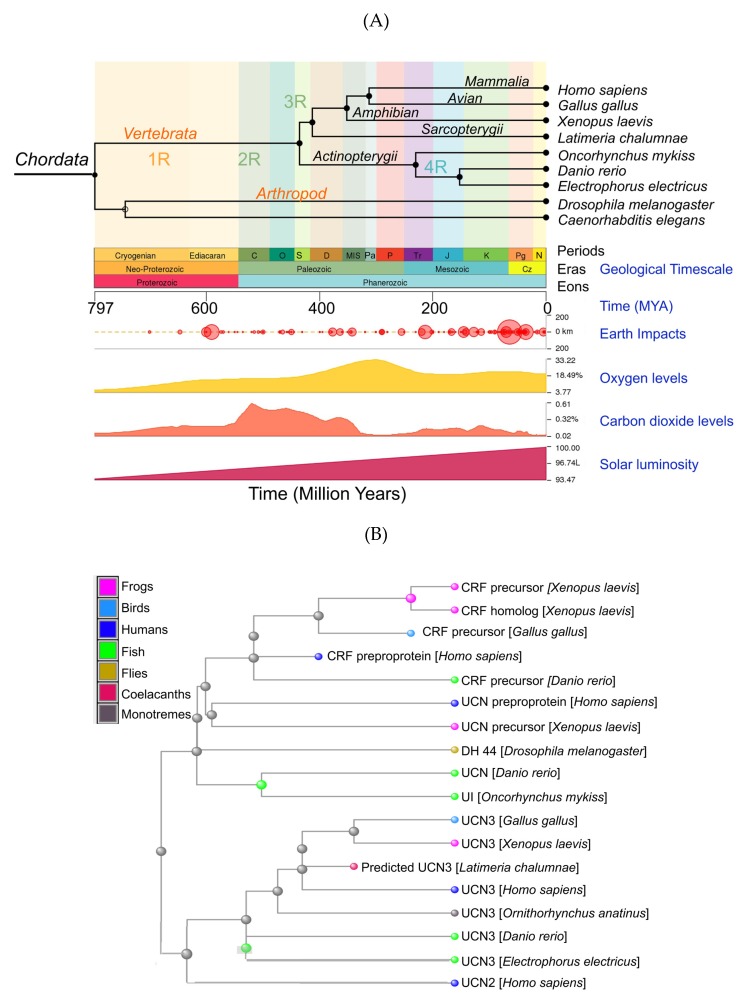
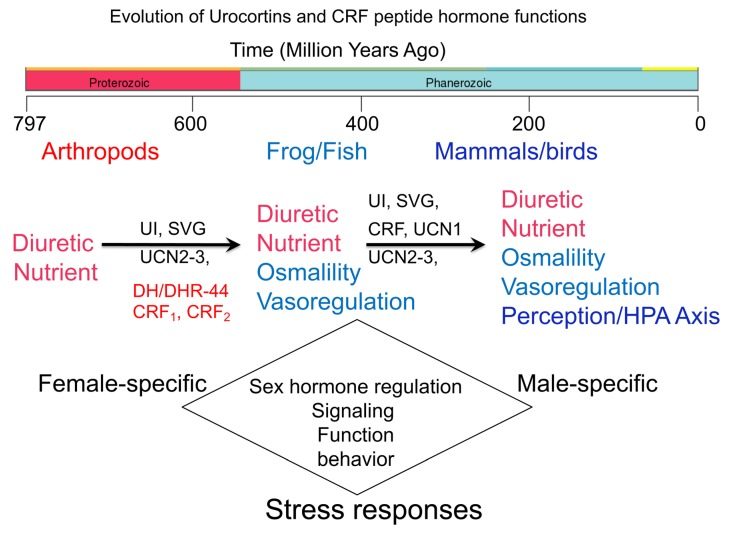
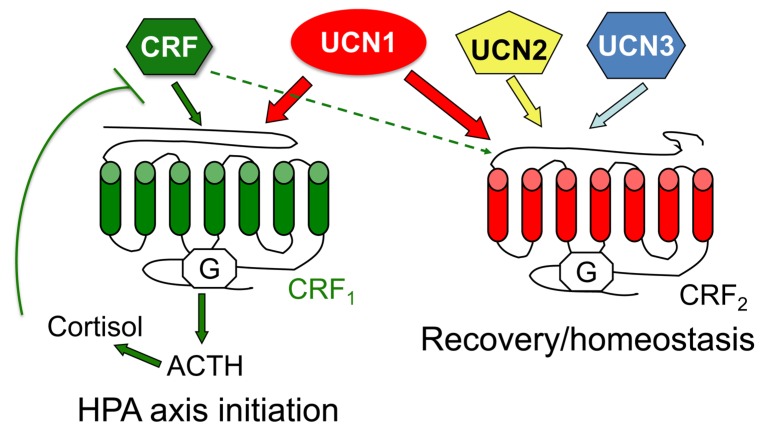
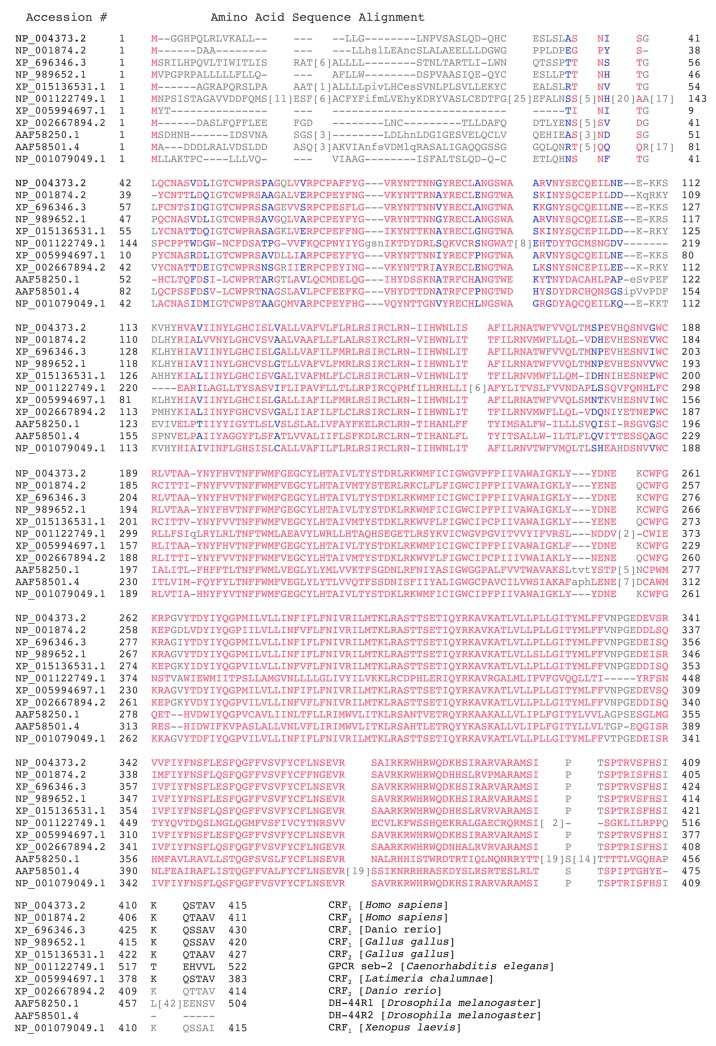
No organ in the body is impervious to the effects of stress, and a coordinated response from all organs is essential to deal with stressors. A dysregulated stress response that fails to bring systems back to homeostasis leads to compromised function and ultimately a diseased state. The components of the corticotropin-releasing factor (CRF) family, an ancient and evolutionarily conserved stress hormone-receptor system, helps both initiate stress responses and bring systems back to homeostasis once the stressors are removed. The mammalian CRF family comprises of four known agonists, CRF and urocortins (UCN1-3), and two known G protein-coupled receptors (GPCRs), CRF and CRF. Evolutionarily, precursors of CRF- and urocortin-like peptides and their receptors were involved in osmoregulation/diuretic functions, in addition to nutrient sensing. Both CRF and UCN1 peptide hormones as well as their receptors appeared after a duplication event nearly 400 million years ago. All four agonists and both CRF receptors show sex-specific changes in expression and/or function, and single nucleotide polymorphisms are associated with a plethora of human diseases. CRF receptors harbor N-terminal cleavable peptide sequences, conferring biased ligand properties. CRF receptors have the ability to heteromerize with each other as well as with other GPCRs. Taken together, CRF receptors and their agonists due to their versatile functional adaptability mediate nuanced responses and are uniquely positioned to orchestrate sex-specific signaling and function in several tissues.
体内没有任何器官对压力的影响具有免疫力,所有器官的协调反应对于应对压力源至关重要。如果压力反应失调,无法使系统恢复到体内平衡状态,就会导致功能受损,最终导致疾病状态。促肾上腺皮质释放因子 (CRF) 家族的组成部分是一种古老且进化上保守的应激激素-受体系统,有助于启动应激反应,并在去除应激源后使系统恢复到体内平衡。哺乳动物 CRF 家族由四种已知的激动剂(CRF 和 UCN1-3)和两种已知的 G 蛋白偶联受体(GPCR)(CRF 和 CRF)组成。在进化上,CRF-和 UCN 样肽及其受体的前体除了参与营养感应外,还参与了渗透压/利尿功能。CRF 和 UCN1 肽激素及其受体都出现在大约 4 亿年前的一次复制事件之后。所有四种激动剂和两种 CRF 受体都表现出性别特异性的表达和/或功能变化,并且单核苷酸多态性与多种人类疾病有关。CRF 受体具有可裂解的 N 端肽序列,赋予其偏向配体特性。CRF 受体能够与彼此以及其他 GPCR 形成异源二聚体。总之,由于其多功能适应性,CRF 受体及其激动剂能够介导细微的反应,并能够在多种组织中协调特有的信号转导和功能。