Woods Gregory M, Lyons A Bruce, Bettiol Silvana S
Menzies Institute for Medical Research, College of Health and Medicine, University of Tasmania, Hobart, TAS 7000, Australia.
Tasmanian School of Medicine, College of Health and Medicine, University of Tasmania, Hobart, TAS 7000, Australia.
Trop Med Infect Dis. 2020 Apr 1;5(2):50. doi: 10.3390/tropicalmed5020050.
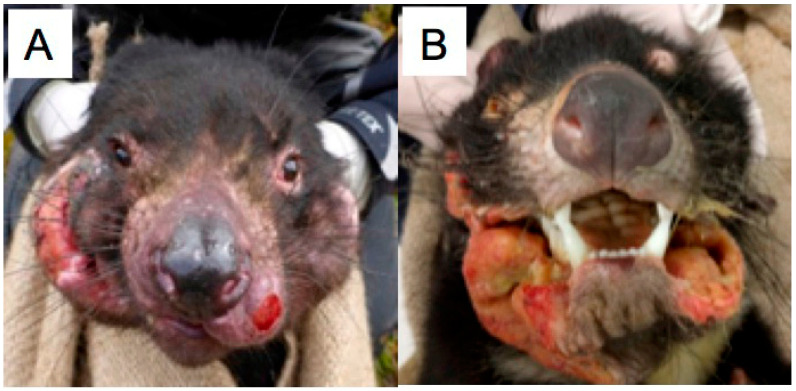
Devil facial tumor disease (DFTD) encompasses two independent transmissible cancers that have killed the majority of Tasmanian devils. The cancer cells are derived from Schwann cells and are spread between devils during biting, a common behavior during the mating season. The Centers for Disease Control and Prevention (CDC) defines a parasite as "An organism that lives on or in a host organism and gets its food from, or at, the expense of its host." Most cancers, including DFTD, live within a host organism and derive resources from its host, and consequently have parasitic-like features. Devil facial tumor disease is a transmissible cancer and, therefore, DFTD shares one additional feature common to most parasites. Through direct contact between devils, DFTD has spread throughout the devil population. However, unlike many parasites, the DFTD cancer cells have a simple lifecycle and do not have either independent, vector-borne, or quiescent phases. To facilitate a description of devil facial tumor disease, this review uses life cycles of parasites as an analogy.
袋獾面部肿瘤病(DFTD)包含两种独立的可传播癌症,它们已导致大多数袋獾死亡。癌细胞源自施万细胞,在撕咬过程中在袋獾之间传播,这是交配季节的常见行为。美国疾病控制与预防中心(CDC)将寄生虫定义为“一种生活在宿主生物体内或体表,从宿主获取食物或消耗宿主资源的生物”。包括DFTD在内的大多数癌症都存在于宿主生物体内并从宿主获取资源,因此具有类似寄生虫的特征。袋獾面部肿瘤病是一种可传播癌症,因此,DFTD还具有大多数寄生虫共有的另一个特征。通过袋獾之间的直接接触,DFTD已在袋獾种群中传播开来。然而,与许多寄生虫不同,DFTD癌细胞具有简单的生命周期,没有独立、媒介传播或静止阶段。为便于描述袋獾面部肿瘤病,本综述将寄生虫的生命周期用作类比。