Zhang Duan, Dong Qianqian
School of Civil and Transportation Engineering, Hebei University of Technology, Tianjin 300401, China.
Materials (Basel). 2020 Apr 1;13(7):1607. doi: 10.3390/ma13071607.
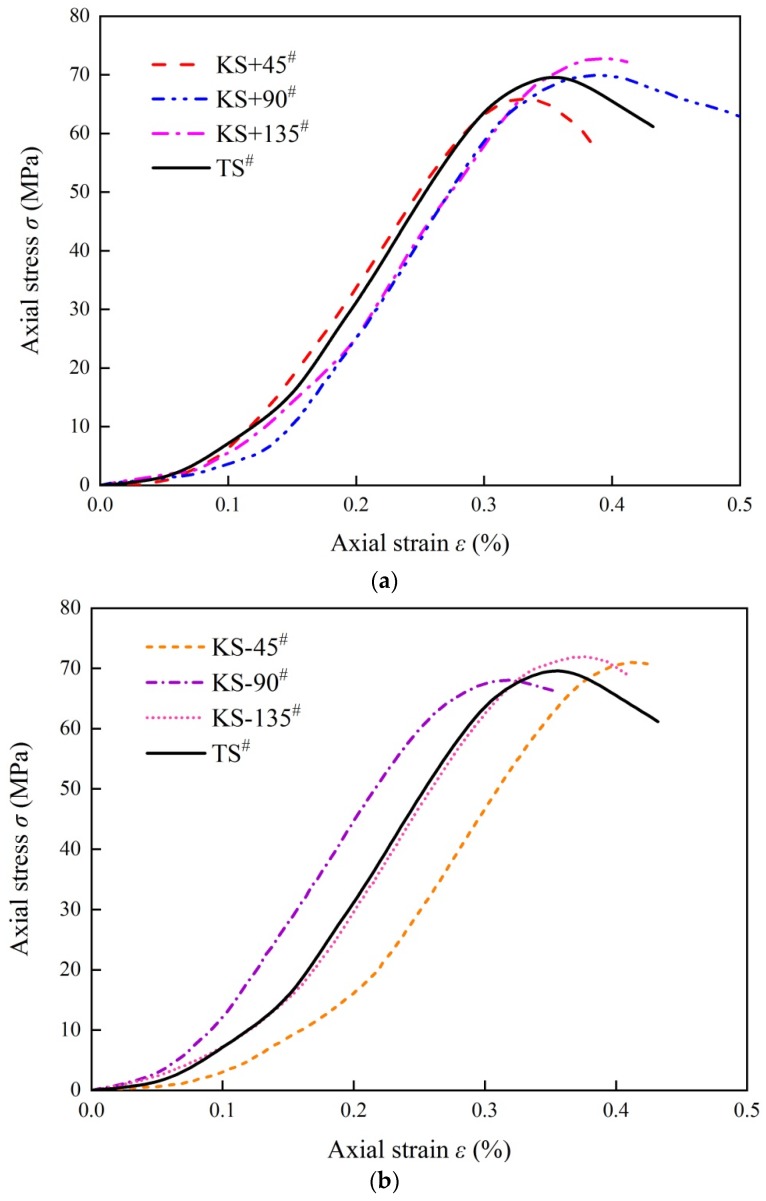
The crack propagation and failure of 3D-printed samples with prefabricated K-S fissures (a kinked fissure and a straight fissure) were observed under uniaxial compression, and the strain and displacement of the sample surface were quantified by the digital image correlation (DIC) method. The experimental results show that the branch inclination angle of the kinked fissure is an important factor affecting the crack initial position, and the evolution of the strain field during the failure process of the sample can better reflect the cracking law of the internal fissures. Furthermore, two coalescence modes are classified: Mode I is a tension-shear composite failure formed by the penetration of the tension-shear composite crack; Mode II is a tensile failure that penetrates the whole samples during the failure process without rock bridge damage. In addition, the numerical simulation results were well consistent with the cracking and failure modes.
在单轴压缩条件下,观察了带有预制K-S裂隙(一条弯折裂隙和一条直裂隙)的3D打印试样的裂纹扩展和破坏情况,并采用数字图像相关(DIC)方法对试样表面的应变和位移进行了量化。实验结果表明,弯折裂隙的分支倾角是影响裂纹初始位置的重要因素,试样破坏过程中应变场的演化能更好地反映内部裂隙的开裂规律。此外,将两种贯通模式进行了分类:模式I是由拉剪复合裂纹贯通形成的拉剪复合破坏;模式II是在破坏过程中贯穿整个试样的拉伸破坏,且无岩桥损伤。此外,数值模拟结果与开裂和破坏模式吻合良好。