Rashid Wajid, Shi Jianbin, Rahim Inam Ur, Dong Shikui, Sultan Hameeda
School of Environment, Beijing Normal University, Beijing 100875, China.
Department of Environmental and Conservation Sciences, University of Swat, Mingora 19130, Pakistan.
Animals (Basel). 2020 Apr 1;10(4):597. doi: 10.3390/ani10040597.
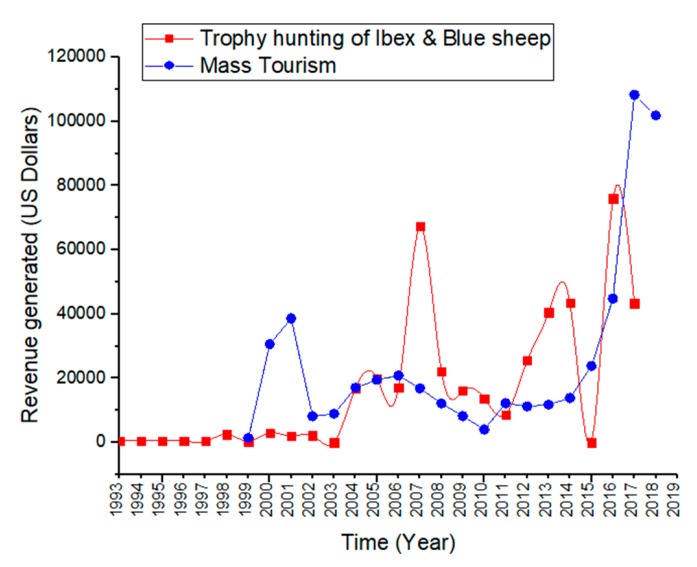
Trophy hunting and mass tourism are the two major interventions designed to provide various socioeconomic and ecological benefits at the local and regional levels. However, these interventions have raised some serious concerns that need to be addressed. This study was conducted in Khunjerab National Park (KNP) with an aim to analyze comparatively the socioeconomic and ecological impacts of trophy hunting and mass tourism over the last three decades within the context of sustainability. Focus Group Discussions (FGDs) with key stakeholders and household interviews were conducted to collect data on trophy hunting and mass tourism, and on local attitudes towards these two interventions in and around KNP. The results revealed that 170 Ibex () and 12 Blue sheep () were hunted in the study area over the past three decades, and trophy hunting was not based on a sustainable harvest level. Trophy hunting on average generated USD 16,272 annual revenue, which was invested in community development. However, trophy hunting has greatly changed the attitudes of local residents towards wildlife: a positive attitude towards the wild ungulates and strongly negative attitude towards wild carnivores. In addition, trophy hunting has reduced the availability of ungulate prey species for Snow leopards (), and consequently, Snow leopards have increased their predation on domestic livestock. This has, in turn, increased human-snow leopard conflict, as negative attitudes towards carnivores result in retaliatory killing of Snow leopards. Furthermore, according to official record data, the number of tourists to KNP has increased tremendously by 10,437.8%, from 1382 in 1999 to 145,633 in 2018. Mass tourism on average generated USD 33,904 annually and provided opportunities for locals to earn high incomes, but it caused damages to the environment and ecosystem in KNP through pollution generation and negative impacts on wildlife. Considering the limited benefits and significant problems created by trophy hunting and mass tourism, we suggest trophy hunting should be stopped and mass tourism should be shifted to ecotourism in and around KNP. Ecotourism could mitigate human-Snow leopard conflicts and help conserve the fragile ecosystem, while generating enough revenue incentives for the community to protect biodiversity and compensate for livestock depredation losses to Snow leopards. Our results may have implications for management of trophy hunting and mass tourism in other similar regions that deserve further investigation.
战利品狩猎和大众旅游是旨在在地方和区域层面提供各种社会经济和生态效益的两项主要干预措施。然而,这些干预措施引发了一些需要解决的严重问题。本研究在昆杰拉布国家公园(KNP)开展,旨在比较分析过去三十年来战利品狩猎和大众旅游在可持续性背景下的社会经济和生态影响。与关键利益相关者进行了焦点小组讨论(FGD)并开展了家庭访谈,以收集有关战利品狩猎和大众旅游以及当地对KNP及其周边地区这两种干预措施态度的数据。结果显示,在过去三十年里,研究区域内猎杀了170只北山羊()和12只岩羊(),战利品狩猎并非基于可持续的收获水平。战利品狩猎平均每年产生16,272美元的收入,这些收入被投入到社区发展中。然而,战利品狩猎极大地改变了当地居民对野生动物的态度:对野生有蹄类动物持积极态度,对野生食肉动物持强烈消极态度。此外,战利品狩猎减少了雪豹()的有蹄类猎物的可获得性,因此,雪豹增加了对家畜的捕食。这反过来又加剧了人类与雪豹的冲突,因为对食肉动物的消极态度导致了对雪豹的报复性杀戮。此外,根据官方记录数据,前往KNP的游客数量大幅增加了10,437.8%,从1999年的1382人增加到2018年的145,633人。大众旅游平均每年产生33,904美元的收入,并为当地人提供了获得高收入的机会,但它通过产生污染和对野生动物的负面影响对KNP的环境和生态系统造成了破坏。考虑到战利品狩猎和大众旅游带来的有限利益以及引发的重大问题,我们建议在KNP及其周边地区停止战利品狩猎,并将大众旅游转变为生态旅游。生态旅游可以缓解人类与雪豹的冲突,并有助于保护脆弱的生态系统,同时为社区提供足够的收入激励以保护生物多样性,并补偿雪豹造成的家畜捕食损失。我们的研究结果可能对其他类似地区的战利品狩猎和大众旅游管理具有启示意义,值得进一步研究。