
癌症中的酪氨酸激酶抑制剂:靶向治疗的突破与挑战
Tyrosine Kinase Inhibitors in Cancer: Breakthrough and Challenges of Targeted Therapy.
作者信息
Pottier Charles, Fresnais Margaux, Gilon Marie, Jérusalem Guy, Longuespée Rémi, Sounni Nor Eddine
机构信息
Laboratory of Tumor and Development Biology, GIGA-Cancer and GIGA-I3, GIGA-Research, University Hospital of Liège, 4000 Liège, Belgium.
Department of Medical Oncology, University Hospital of Liège, 4000 Liège, Belgium.
出版信息
Cancers (Basel). 2020 Mar 20;12(3):731. doi: 10.3390/cancers12030731.
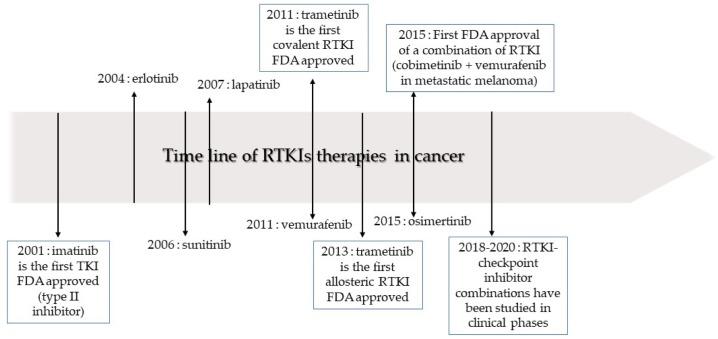
Receptor tyrosine kinases (RTKs) are key regulatory signaling proteins governing cancer cell growth and metastasis. During the last two decades, several molecules targeting RTKs were used in oncology as a first or second line therapy in different types of cancer. However, their effectiveness is limited by the appearance of resistance or adverse effects. In this review, we summarize the main features of RTKs and their inhibitors (RTKIs), their current use in oncology, and mechanisms of resistance. We also describe the technological advances of artificial intelligence, chemoproteomics, and microfluidics in elaborating powerful strategies that could be used in providing more efficient and selective small molecules inhibitors of RTKs. Finally, we discuss the interest of therapeutic combination of different RTKIs or with other molecules for personalized treatments, and the challenge for effective combination with less toxic and off-target effects.
受体酪氨酸激酶(RTKs)是调控癌细胞生长和转移的关键信号蛋白。在过去二十年中,几种靶向RTKs的分子被用于肿瘤学领域,作为不同类型癌症的一线或二线治疗药物。然而,它们的有效性受到耐药性或不良反应出现的限制。在本综述中,我们总结了RTKs及其抑制剂(RTKIs)的主要特征、它们在肿瘤学中的当前应用以及耐药机制。我们还描述了人工智能、化学蛋白质组学和微流控技术在制定强大策略方面的进展,这些策略可用于提供更高效、更具选择性的RTKs小分子抑制剂。最后,我们讨论了不同RTKIs或与其他分子联合治疗用于个性化治疗的意义,以及有效联合治疗且毒性和脱靶效应较小所面临的挑战。


 Zotero 插件