Research Department of Orthopaedics and Musculoskeletal Science, University College London, Royal National Orthopaedic Hospital, Stanmore HA7 4LP, UK.
Central Laser Facility, Research Complex at Harwell, Science & Technology Facilities Council, Rutherford Appleton Laboratory, Didcot OX11 0QX, UK.
Int J Mol Sci. 2020 Mar 20;21(6):2150. doi: 10.3390/ijms21062150.
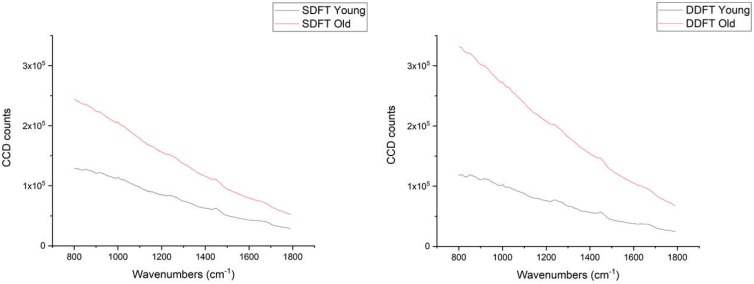
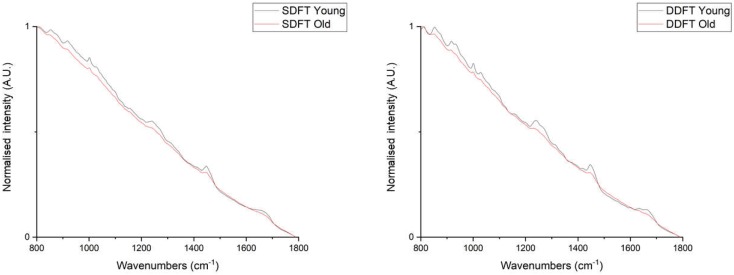
The lack of clinical detection tools at the molecular level hinders our progression in preventing age-related tendon pathologies. Raman spectroscopy can rapidly and non-invasively detect tissue molecular compositions and has great potential for in vivo applications. In biological tissues, a highly fluorescent background masks the Raman spectral features and is usually removed during data processing, but including this background could help age differentiation since fluorescence level in tendons increases with age. Therefore, we conducted a stepwise analysis of fluorescence and Raman combined spectra for better understanding of the chemical differences between young and old tendons. Spectra were collected from random locations of vacuum-dried young and old equine tendon samples (superficial digital flexor tendon (SDFT) and deep digital flexor tendon (DDFT), total = 15) under identical instrumental settings. The fluorescence-Raman spectra showed an increase in old tendons as expected. Normalising the fluorescence-Raman spectra further indicated a potential change in intra-tendinous fluorophores as tendon ages. After fluorescence removal, the pure Raman spectra demonstrated between-group differences in CH bending (1450 cm) and various ring-structure and carbohydrate-associated bands (1000-1100 cm), possibly relating to a decline in cellular numbers and an accumulation of advanced glycation end products in old tendons. These results demonstrated that Raman spectroscopy can successfully detect age-related tendon molecular differences.
缺乏分子水平的临床检测工具阻碍了我们在预防与年龄相关的肌腱病变方面的进展。拉曼光谱技术可以快速、无创地检测组织的分子组成,具有很大的体内应用潜力。在生物组织中,高度荧光的背景掩盖了拉曼光谱特征,通常在数据处理过程中被去除,但包括这个背景可能有助于年龄区分,因为肌腱的荧光水平随着年龄的增长而增加。因此,我们对荧光和拉曼联合光谱进行了逐步分析,以更好地理解年轻和老年肌腱之间的化学差异。在相同的仪器设置下,从真空干燥的年轻和老年马肌腱样本(浅表指屈肌腱(SDFT)和深指屈肌腱(DDFT))的随机位置采集了光谱(总样本量 = 15)。荧光-拉曼光谱显示,正如预期的那样,老年肌腱的荧光强度增加。进一步对荧光-拉曼光谱进行归一化处理表明,随着肌腱年龄的增长,肌腱内荧光团可能发生了潜在变化。去除荧光后,纯拉曼光谱显示 CH 弯曲(1450 cm)和各种环状结构和碳水化合物相关带(1000-1100 cm)在组间存在差异,这可能与老年肌腱中细胞数量的减少和晚期糖基化终产物的积累有关。这些结果表明,拉曼光谱可以成功检测与年龄相关的肌腱分子差异。