Department of Pediatrics, Unit of Pediatric Genetics and Immunology, University of Messina, Via Consolare Valeria 1, 98125, Messina, Italy.
Department of Clinical and Experimental Medicine, University of Catania, Via Santa Sofia 78, 95123, Catania, Italy.
Ital J Pediatr. 2020 Apr 3;46(1):42. doi: 10.1186/s13052-020-0798-4.
Recurrent respiratory infections (RRIs) are defined by the presence of at least one of the following criteria: (i) > 6 annual respiratory infections (RIs); (ii) > 1 monthly RIs involving the upper airways from September to April; (iii) > 3 annual RIs involving the lower airways represent a very common health problem in the first years of life. We conducted a multi-centre, prospective, single-open study to assess the efficacy and the safety of Streptococcus salivarius 24SMBc and Streptococcus oralis 89a in the prevention of upper respiratory tract infections (URTIs) in children.
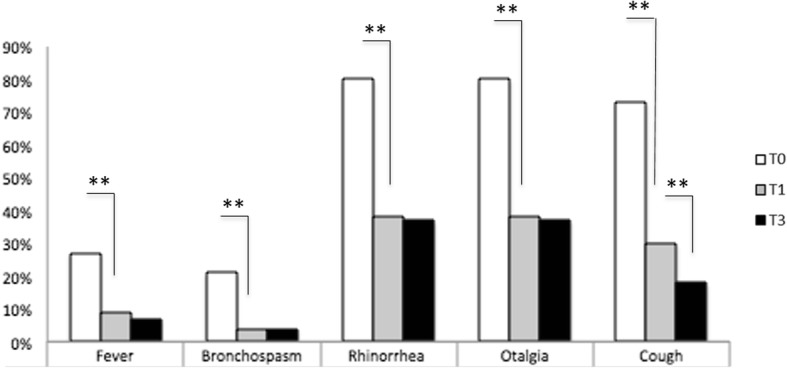
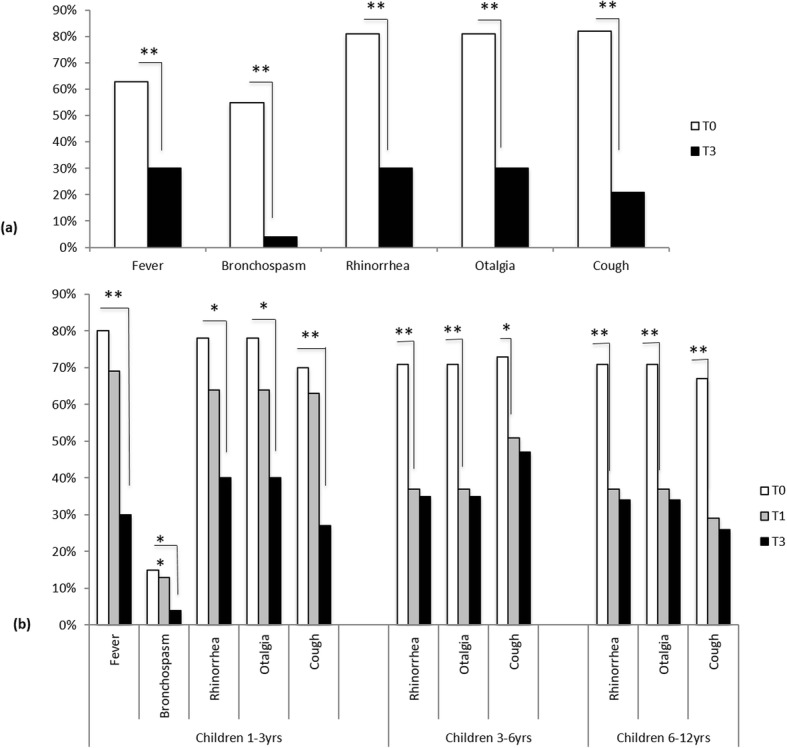
Ninety-one children (M:F = 47:44, mean age 7.4 ± 2.3 years) with RRIs were enrolled in the study between September and November 2018. At baseline, children received Streptococcus salivarius 24SMBc and Streptococcus oralis 89a as 2 puffs for nostril twice/day for 7 days/months. The treatment lasted for 3 consecutive months. Efficacy was expressed in terms of absence or presence of fever, cough, bronchospasm, rhinorrhea and otalgia, at 1 month (T1), and 3 (T3) months. Safety and tolerability of the probiotic were evaluated on the basis of the number and type of adverse events (AEs) recorded during the treatment.
Children treated with Streptococcus salivarius 24SMBc and Streptococcus oralis 89a showed a significant decrease of symptoms including episodes of fever, cough, bronchospasm, rhinorrhea, and otalgia (p < 0.001) compared to baseline. The treatment significantly reduced the number of episodes of fever, cough, bronchospasm, rhinorrhea, otalgia, and cough also in patients with positive familial history for atopy and in atopic children (p < 0.05). No significant differences in symptoms among children with negative familial history for atopy and children with positive familial history for atopy subgroups, not atopic and atopic children subgroups, and smoke-exposed and not smoke-exposed subgroups were observed (p > 0.05). Conducting a subgroup analysis according to the age, it has been reported that children aged 1-3 years old showed an improvement in all symptoms, however, they become statistically significant only at the end of the 3 months of treatment (p < 0.05). Conversely, in children aged 3-6 and 6-12 years old, the therapeutic efficacy was progressive and significant already from the first month of therapy (p < 0.05). None of the children were withdrawn from the study because of AEs, although 9 children experienced burning nose leading to interruption of therapy.
Our findings suggest that Streptococcus salivarius 24SMBc and Streptococcus oralis 89a treatment is safe and seems to be effective on short-term in the treatment of RRIs. Studies involving a longer observation period are necessary to establish the real efficacy of the product for the treatment of pediatric patients affected by RRIs.
复发性呼吸道感染(RRIs)的定义为存在以下至少一项标准:(i)每年呼吸道感染(RIs)超过 6 次;(ii)每年 9 月至 4 月有超过 1 次以上上呼吸道月度 RIs;(iii)每年有 3 次下呼吸道 RIs。RRIs 是儿童生命早期非常常见的健康问题。我们进行了一项多中心、前瞻性、单开放研究,以评估唾液链球菌 24SMBc 和口腔链球菌 89a 预防儿童上呼吸道感染(URTIs)的疗效和安全性。
91 名(男:女=47:44,平均年龄 7.4±2.3 岁)RRIs 患儿于 2018 年 9 月至 11 月期间入组本研究。基线时,患儿接受唾液链球菌 24SMBc 和口腔链球菌 89a 治疗,每侧鼻孔喷 2 下,每日 2 次,持续 7 天/月。治疗持续 3 个月。在 1 个月(T1)和 3 个月(T3)时,以发热、咳嗽、支气管痉挛、流涕和耳痛的有无来评估疗效。基于治疗期间记录的不良事件(AE)的数量和类型,评估益生菌的安全性和耐受性。
与基线相比,接受唾液链球菌 24SMBc 和口腔链球菌 89a 治疗的患儿发热、咳嗽、支气管痉挛、流涕和耳痛等症状明显减少(p<0.001)。治疗还显著减少了有特应性家族史和特应性儿童的发热、咳嗽、支气管痉挛、流涕、耳痛和咳嗽发作次数(p<0.05)。在无特应性家族史和有特应性家族史亚组、非特应性和特应性儿童亚组以及暴露于烟雾和非暴露于烟雾亚组中,患儿的症状无显著差异(p>0.05)。根据年龄进行亚组分析,报告称 1-3 岁儿童的所有症状均有所改善,但仅在治疗 3 个月后才具有统计学意义(p<0.05)。相反,在 3-6 岁和 6-12 岁儿童中,治疗效果从第一个月就开始逐渐显著(p<0.05)。尽管 9 名儿童因鼻腔烧灼感而中断治疗,但没有儿童因 AE 而退出研究。
我们的研究结果表明,唾液链球菌 24SMBc 和口腔链球菌 89a 治疗安全且似乎对 RRIs 的短期治疗有效。需要进行更长时间的观察研究,以确定该产品对受 RRIs 影响的儿科患者治疗的真正疗效。