University of Michigan, Department of Psychiatry, Rachel Upjohn Building, 4250 Plymouth Road, Ann Arbor, MI, 48109, United States; University of Michigan, Department of Psychology, East Hall, 530 Church Street, Ann Arbor, MI, 48109, United States.
University of Michigan, Department of Psychiatry, Rachel Upjohn Building, 4250 Plymouth Road, Ann Arbor, MI, 48109, United States.
Drug Alcohol Depend. 2020 May 1;210:107955. doi: 10.1016/j.drugalcdep.2020.107955. Epub 2020 Mar 18.
Youth who experience puberty earlier than their peers are at heightened risk for substance use during adolescence. However, little is known about whether pubertal timing exacerbates effects of relevant early risk factors, such as family substance use history, as predicted by the "accentuation hypothesis". Using longitudinal data from youth with and without a family history of alcohol use disorder (AUD FHx), we evaluated whether pubertal timing intensifies preexisting familial risk effects on late adolescent substance use.
Participants were 568 males and 245 females from the Michigan Longitudinal Study. Pubertal timing was indexed by fitting mixed-effects linear models to repeated measures of self-reported Tanner stage. Multilevel models then tested: (a) whether AUD FHx predicted pubertal timing, and (b) whether AUD FHx, pubertal timing, or their interaction predicted alcohol and marijuana use at ages 16-18.
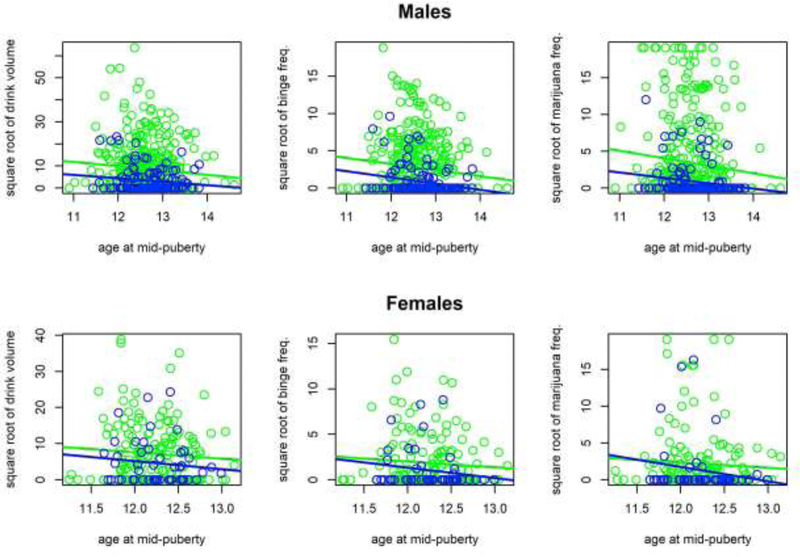
AUD FHx was unrelated to pubertal timing in either males or females. In males, alcohol and marijuana use in late adolescence were predicted by AUD FHx and timing, but not their interaction. In females, AUD FHx predicted alcohol-related outcomes, but there were no main or interaction effects of timing.
Pubertal timing does not moderate the link between AUD FHx and late adolescent substance use, in contrast to the accentuation hypothesis. In males, measures of pubertal maturation and familial risk provide unique information for prediction of use. Females displayed no link between pubertal timing and use, which may suggest different risk pathways, or may have been due to the female sample's smaller size.
比同龄人更早经历青春期的青少年在青少年时期使用物质的风险更高。然而,几乎不知道青春期时间是否会加剧相关早期风险因素的影响,如家庭物质使用史,这是“强调假说”所预测的。利用有和没有酒精使用障碍家族史(AUD FHx)的年轻人的纵向数据,我们评估了青春期时间是否会加剧先前存在的家族风险对青少年后期物质使用的影响。
参与者是来自密歇根纵向研究的 568 名男性和 245 名女性。青春期时间通过对自我报告的 Tanner 阶段的重复测量拟合混合效应线性模型来确定。然后使用多层次模型检验:(a)AUD FHx 是否预测青春期时间,以及(b)AUD FHx、青春期时间或它们的相互作用是否预测 16-18 岁时的酒精和大麻使用。
在男性和女性中,AUD FHx 与青春期时间均无关。在男性中,青春期晚期的酒精和大麻使用受 AUD FHx 和时间的预测,但不受它们相互作用的影响。在女性中,AUD FHx 预测了酒精相关的结果,但时间没有主要或相互作用的影响。
与强调假说相反,青春期时间并不能调节 AUD FHx 与青春期后期物质使用之间的联系。在男性中,青春期成熟度和家族风险的测量为使用的预测提供了独特的信息。女性的青春期时间与使用之间没有联系,这可能表明存在不同的风险途径,或者可能是由于女性样本较小所致。