
单细胞水平循环肿瘤细胞的基因组分析。
Genomic Analysis of Circulating Tumor Cells at the Single-Cell Level.
机构信息
Department of Oncology Biomarker Development, Genentech Inc., South San Francisco, California; Stanford Genome Technology Center, Stanford University School of Medicine, Palo Alto, California.
Stanford Genome Technology Center, Stanford University School of Medicine, Palo Alto, California.
出版信息
J Mol Diagn. 2020 Jun;22(6):770-781. doi: 10.1016/j.jmoldx.2020.02.013. Epub 2020 Apr 2.
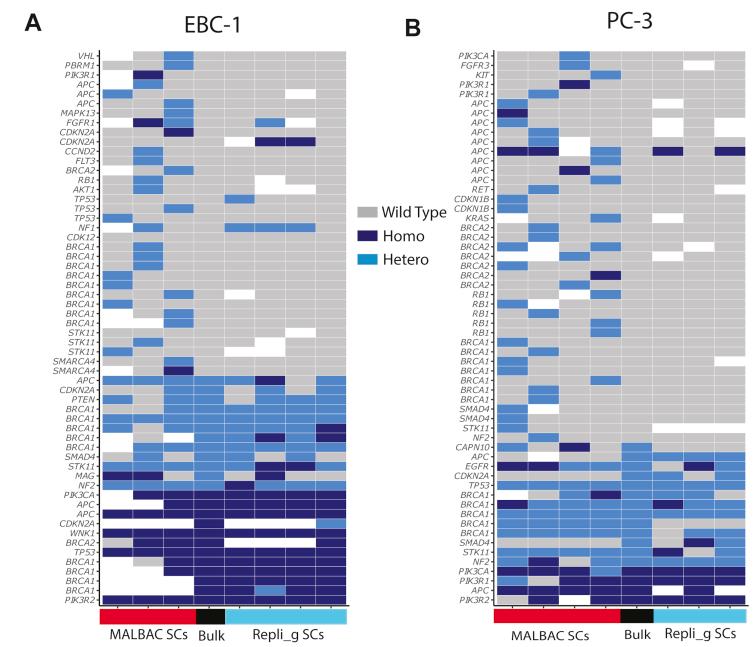
Circulating tumor cells (CTCs) have a great potential for noninvasive diagnosis and real-time monitoring of cancer. A comprehensive evaluation of four whole genome amplification (WGA)/next-generation sequencing workflows for genomic analysis of single CTCs, including PCR-based (GenomePlex and Ampli1), multiple displacement amplification (Repli-g), and hybrid PCR- and multiple displacement amplification-based [multiple annealing and loop-based amplification cycling (MALBAC)] is reported herein. To demonstrate clinical utilities, copy number variations (CNVs) in single CTCs isolated from four patients with squamous non-small-cell lung cancer were profiled. Results indicate that MALBAC and Repli-g WGA have significantly broader genomic coverage compared with GenomePlex and Ampli1. Furthermore, MALBAC coupled with low-pass whole genome sequencing has better coverage breadth, uniformity, and reproducibility and is superior to Repli-g for genome-wide CNV profiling and detecting focal oncogenic amplifications. For mutation analysis, none of the WGA methods were found to achieve sufficient sensitivity and specificity by whole exome sequencing. Finally, profiling of single CTCs from patients with non-small-cell lung cancer revealed potentially clinically relevant CNVs. In conclusion, MALBAC WGA coupled with low-pass whole genome sequencing is a robust workflow for genome-wide CNV profiling at single-cell level and has great potential to be applied in clinical investigations. Nevertheless, data suggest that none of the evaluated single-cell sequencing workflows can reach sufficient sensitivity or specificity for mutation detection required for clinical applications.
循环肿瘤细胞 (CTC) 具有很大的潜力,可用于癌症的非侵入性诊断和实时监测。本文全面评估了四种全基因组扩增 (WGA)/下一代测序工作流程,用于单个 CTC 的基因组分析,包括基于 PCR 的 (GenomePlex 和 Ampli1)、多次置换扩增 (Repli-g) 以及基于杂交 PCR 和多次置换扩增的 [多次退火和环式扩增循环 (MALBAC)]。为了证明临床应用的实用性,本文对从 4 名患有鳞状非小细胞肺癌的患者中分离出的单个 CTC 中的拷贝数变异 (CNV) 进行了分析。结果表明,与 GenomePlex 和 Ampli1 相比,MALBAC 和 Repli-g WGA 具有显著更宽的基因组覆盖范围。此外,MALBAC 与低通量全基因组测序相结合具有更好的覆盖广度、均匀性和可重复性,并且在全基因组 CNV 分析和检测局灶性致癌扩增方面优于 Repli-g。对于突变分析,通过全外显子组测序发现,没有一种 WGA 方法能够达到足够的灵敏度和特异性。最后,对非小细胞肺癌患者的单个 CTC 进行分析,揭示了潜在的临床相关 CNV。总之,MALBAC WGA 与低通量全基因组测序相结合是一种在单细胞水平上进行全基因组 CNV 分析的强大工作流程,具有很大的潜力应用于临床研究。然而,数据表明,评估的单细胞测序工作流程中没有一种能够达到用于临床应用的突变检测所需的足够灵敏度或特异性。


 Zotero 插件