Dittmann Matthias, Gonzalez Carvalho José Manuel, Rahbar Kambiz, Schäfers Michael, Claesener Michael, Riemann Burkhard, Seifert Robert
Department of Nuclear Medicine, University Hospital Münster, Albert-Schweitzer-Campus 1, 48149, Münster, Germany.
European Institute for Molecular Imaging (EIMI), University of Münster, Münster, Germany.
Eur J Nucl Med Mol Imaging. 2020 Oct;47(11):2639-2646. doi: 10.1007/s00259-020-04727-9. Epub 2020 Apr 4.
Efficient therapy of recurrent differentiated thyroid cancer (DTC) is dependent on precise molecular imaging techniques targeting the human sodium iodide symporter (hNIS), which is a marker both of thyroid and DTC cells. Various iodine isotopes have been utilized for detecting DTC; however, these come with unfavorable radiation exposure and image quality ([I]iodine) or limited availability ([I]iodine). In contrast, [F]tetrafluoroborate (TFB) is a novel radiolabeled PET substrate of hNIS, results in PET images with high-quality and low radiation doses, and should therefore be suited for imaging of DTC. The aim of the present study was to compare the diagnostic performance of [F]TFB-PET to the clinical reference standard [I]iodine scintigraphy in patients with recurrent DTC.
Twenty-five patients with recurrent DTC were included in this retrospective analysis. All patients underwent [F]TFB-PET combined with either CT or MRI due to newly discovered elevated TG levels, antiTG levels, sonographically suspicious cervical lymph nodes, or combinations of these findings. Correlative [I]iodine whole-body scintigraphy (dxWBS) including SPECT-CT was present for all patients; correlative [F]FDG-PET-CT was present for 21 patients. Histological verification of [F]TFB positive findings was available in 4 patients.
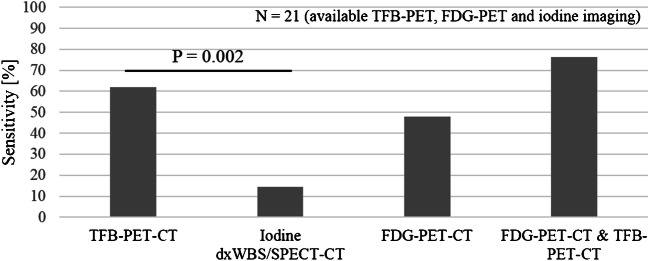
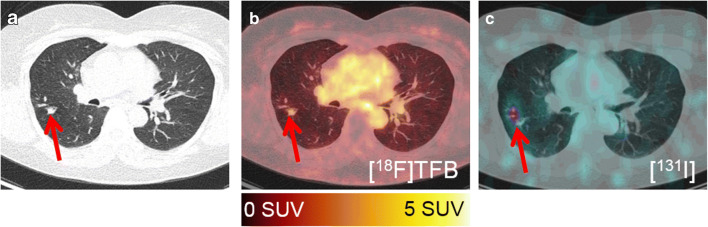
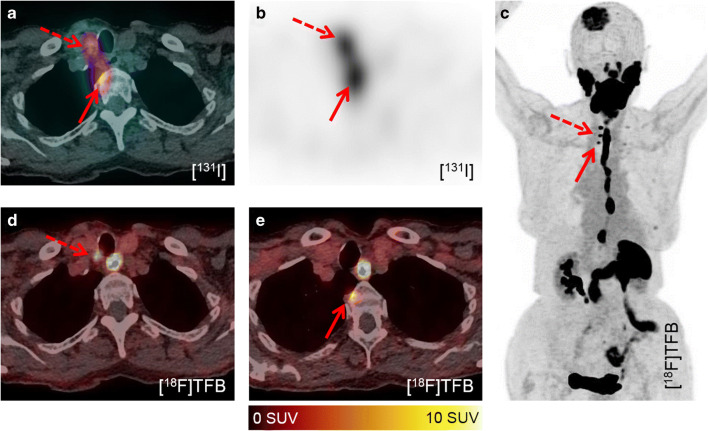
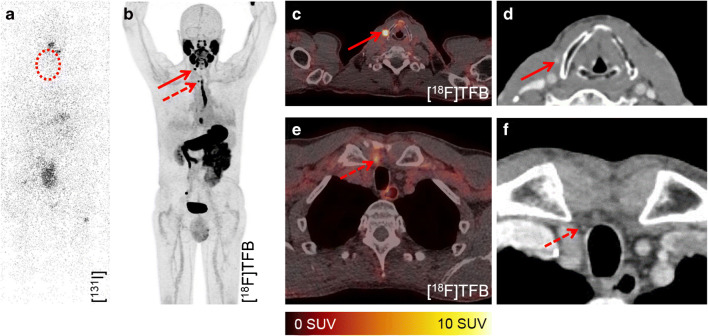
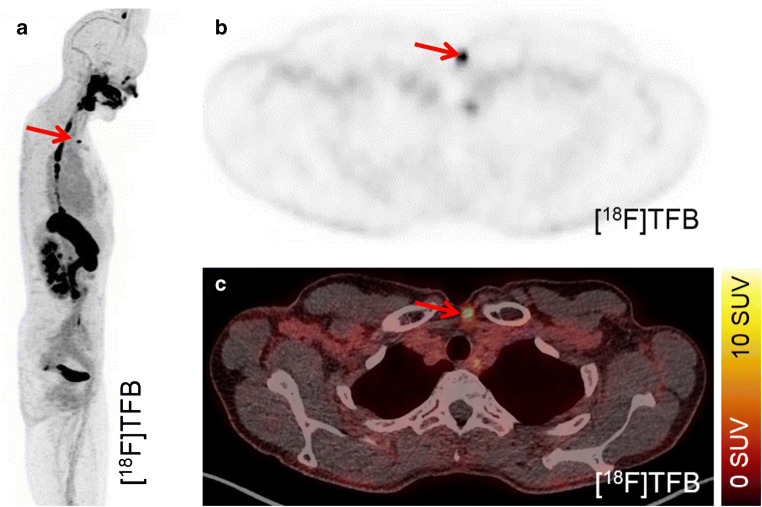
[F]TFB-PET detected local recurrence or metastases of DTC in significantly more patients than conventional [I]iodine dxWBS and SPECT-CT (13/25 = 52% vs. 3/25 = 12%, p = 0.002). The diagnosis of 6 patients with cervical lymph node metastases that showed mildly increased FDG metabolism but negative [I]iodine scintigraphy was changed: [F]TFB-PET revealed hNIS expression in the metastases, which were therefore reclassified as only partly de-differentiated (histological confirmation present in two patients). Highest sensitivity for detecting recurrent DTC had the combination of [F]TFB-PET-CT/MRI with [F]FDG-PET-CT (64%).
In the present cohort, [F]TFB-PET shows higher sensitivity and accuracy than [I]iodine WBS and SPECT-CT in detecting recurrent DTC. The combination of [F]TFB-PET with [F]FDG-PET-CT seems a reasonable strategy to characterize DTC tumor manifestations with respect to their differentiation and thereby also individually plan and monitor treatment. Future prospective studies evaluating the potential of [F]TFB-PET in recurrent DTC are warranted.
复发性分化型甲状腺癌(DTC)的有效治疗依赖于针对人钠碘同向转运体(hNIS)的精确分子成像技术,hNIS是甲状腺和DTC细胞的标志物。各种碘同位素已被用于检测DTC;然而,这些方法存在辐射暴露和图像质量不佳([I]碘)或可用性有限([I]碘)的问题。相比之下,[F]四氟硼酸盐(TFB)是一种新型的hNIS放射性标记PET底物,可产生高质量和低辐射剂量的PET图像,因此应适用于DTC的成像。本研究的目的是比较[F]TFB-PET与临床参考标准[I]碘闪烁扫描在复发性DTC患者中的诊断性能。
本回顾性分析纳入了25例复发性DTC患者。由于新发现的甲状腺球蛋白(TG)水平升高、抗TG水平升高、超声检查可疑的颈部淋巴结或这些发现的组合,所有患者均接受了[F]TFB-PET联合CT或MRI检查。所有患者均进行了包括SPECT-CT的相关[I]碘全身闪烁扫描(dxWBS);21例患者进行了相关的[F]FDG-PET-CT检查。4例患者可获得[F]TFB阳性结果的组织学验证。
[F]TFB-PET检测到DTC局部复发或转移的患者明显多于传统的[I]碘dxWBS和SPECT-CT(13/25 = 52% vs. 3/25 = 12%,p = 0.002)。6例颈部淋巴结转移患者的诊断发生了改变,这些患者的FDG代谢轻度增加但[I]碘闪烁扫描为阴性:[F]TFB-PET显示转移灶中有hNIS表达,因此这些转移灶被重新分类为仅部分去分化(2例患者有组织学证实)。[F]TFB-PET-CT/MRI与[F]FDG-PET-CT联合检测复发性DTC的敏感性最高(64%)。
在本队列中,[F]TFB-PET在检测复发性DTC方面显示出比[I]碘WBS和SPECT-CT更高的敏感性和准确性。[F]TFB-PET与[F]FDG-PET-CT联合似乎是一种合理的策略,可根据DTC肿瘤表现的分化情况进行特征化,从而也能单独规划和监测治疗。有必要进行未来的前瞻性研究,评估[F]TFB-PET在复发性DTC中的潜力。