Division of Cardiology, Michigan State University, Kalamazoo.
Sparrow Clinical Research Institute, Sparrow Healthcare, Lansing, Michigan.
JAMA Netw Open. 2020 Apr 1;3(4):e202175. doi: 10.1001/jamanetworkopen.2020.2175.
Several studies have examined the role of warfarin in preventing strokes in patients with atrial fibrillation and end-stage renal disease; however, the results remain inconclusive.
To assess recently published studies to examine the outcomes of the use of warfarin among patients with atrial fibrillation and end-stage renal disease.
A literature search was performed using the terms warfarin and atrial fibrillation and end-stage renal disease and warfarin and atrial fibrillation and dialysis in the MEDLINE, Embase, and Google Scholar databases from January 1, 2008, to February 28, 2019.
The studies included were those with patients with end-stage renal disease and atrial fibrillation who were receiving warfarin and with hazard ratios (HRs) of at least 1 primary outcome. The studies excluded were those with a lack of information on outcomes and unreliable 95% CIs of the results.
The Meta-analysis of Observational Studies in Epidemiology (MOOSE) guidelines were followed in selecting studies. Collected data were also scrutinized for reliable 95% CIs. Finally, studies were examined for perceived biases, their limitations, and the definitions of the outcomes.
The HRs and 95% CIs were calculated for the incidence of ischemic stroke, hemorrhagic stroke, major bleeding, and mortality among patients receiving anticoagulants and those not receiving anticoagulants.
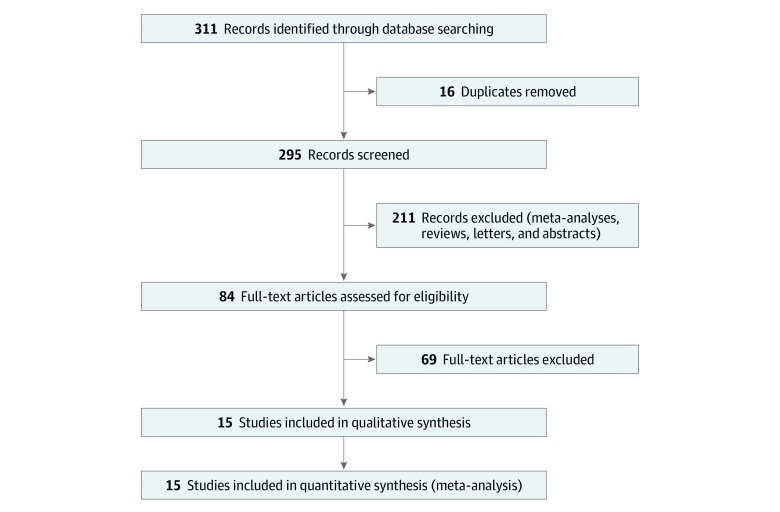
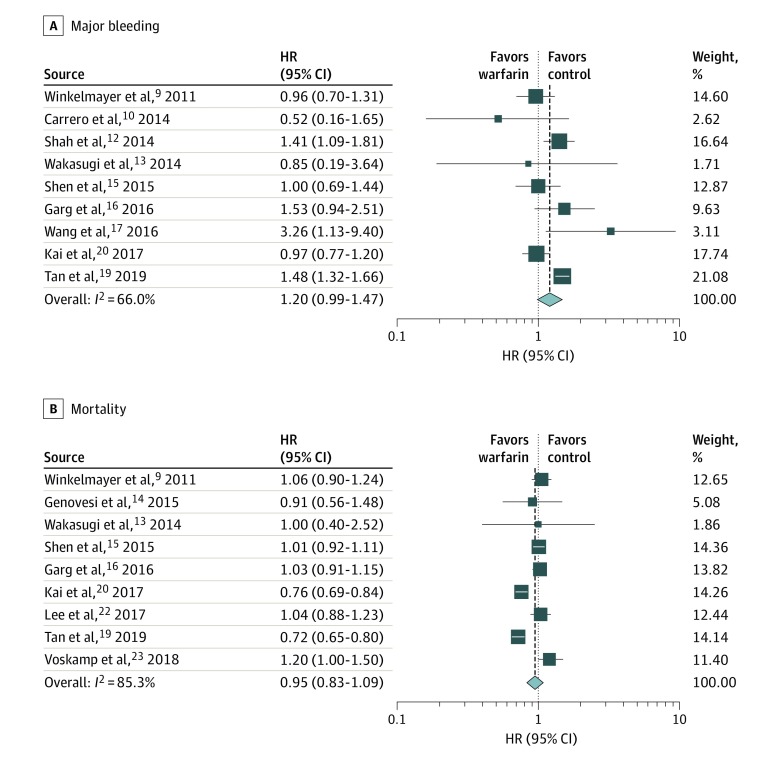
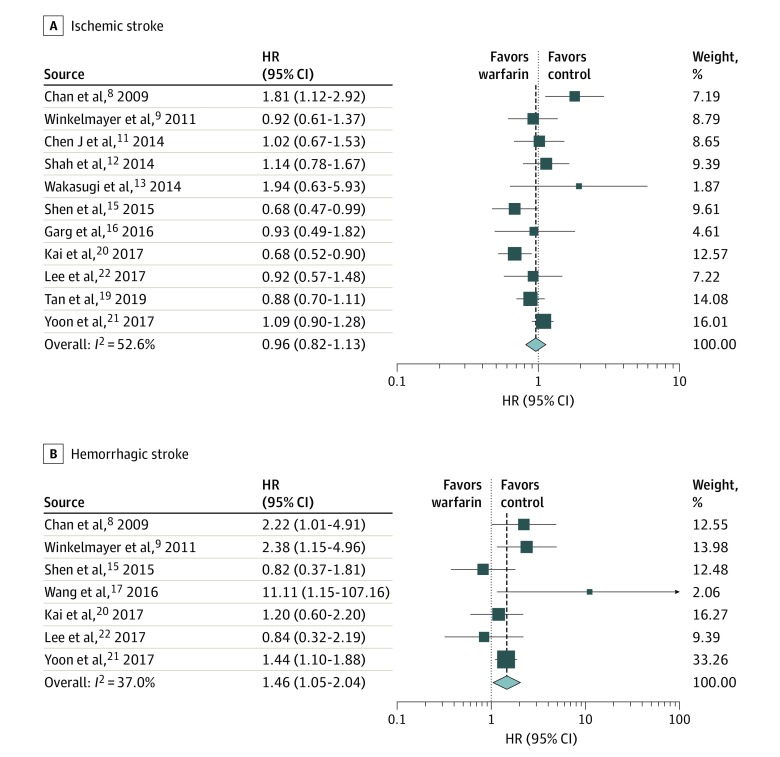
Study selection yielded 15 studies with a total of 47 480 patients with atrial fibrillation and end-stage renal disease. Of these patients, 10 445 (22.0%) were taking warfarin. With a mean (SD) follow-up period of 2.6 (1.4) years, warfarin use was associated with no significant change for the risk of ischemic stroke (HR, 0.96; 95% CI, 0.82-1.13), with a significantly higher risk of hemorrhagic stroke (HR, 1.49; 95% CI, 1.03-1.94), with no significant difference in the risk of major bleeding (HR, 1.20; 95% CI, 0.99-1.47), and with no change in overall mortality (HR, 0.95; 95% CI, 0.83-1.09).
In the studies reviewed, warfarin use appears to have been associated with no change in the incidence of ischemic stroke in patients with atrial fibrillation and end-stage renal disease. However, from the studies reviewed, it does appear to be associated with a significantly higher risk of hemorrhagic stroke, with no significant difference in the risk of major bleeding, and with no change in mortality.
有几项研究检查了华法林在预防伴有心房颤动和终末期肾病的患者中风中的作用;然而,结果仍不确定。
评估最近发表的研究,以检查伴有心房颤动和终末期肾病的患者使用华法林的结果。
使用“华法林”和“心房颤动”以及“终末期肾病”和“华法林”和“心房颤动”以及“透析”等术语,在 MEDLINE、Embase 和 Google Scholar 数据库中进行了文献检索,检索时间为 2008 年 1 月 1 日至 2019 年 2 月 28 日。
入选的研究为伴有终末期肾病和心房颤动的患者,这些患者正在接受华法林治疗,且主要结局的风险比(HR)至少为 1。排除的研究为结局信息缺失和结果的 95%置信区间(CI)不可靠的研究。
采用观察性研究的荟萃分析(MOOSE)指南选择研究。还仔细检查了收集的数据,以确保其具有可靠的 95%CI。最后,对研究进行了感知偏差、局限性以及结局定义的检查。
计算了接受抗凝治疗和未接受抗凝治疗的患者缺血性中风、出血性中风、大出血和死亡率的 HR 和 95%CI。
研究选择产生了 15 项共涉及 47480 名伴有心房颤动和终末期肾病的患者的研究。其中,10445 名(22.0%)患者正在服用华法林。在平均(SD)2.6(1.4)年的随访期间,华法林的使用与缺血性中风风险的无显著变化相关(HR,0.96;95%CI,0.82-1.13),出血性中风风险显著升高(HR,1.49;95%CI,1.03-1.94),大出血风险无显著差异(HR,1.20;95%CI,0.99-1.47),总死亡率无变化(HR,0.95;95%CI,0.83-1.09)。
在审查的研究中,华法林的使用似乎与伴有心房颤动和终末期肾病的患者中风发生率无变化相关。然而,从审查的研究来看,它似乎与出血性中风风险显著升高相关,与大出血风险无显著差异,与死亡率无变化相关。