Lee Seung Yong, Hwang Jae-Yeol, Park Jongho, Nandadasa Chandani N, Kim Younghak, Bang Joonho, Lee Kimoon, Lee Kyu Hyoung, Zhang Yunwei, Ma Yanming, Hosono Hideo, Lee Young Hee, Kim Seong-Gon, Kim Sung Wng
Department of Energy Science, Sungkyunkwan University, Suwon, 16419, Republic of Korea.
Center for Integrated Nanostructure Physics, Institute for Basic Science, Suwon, 16419, Republic of Korea.
Nat Commun. 2020 Mar 23;11(1):1526. doi: 10.1038/s41467-020-15253-5.
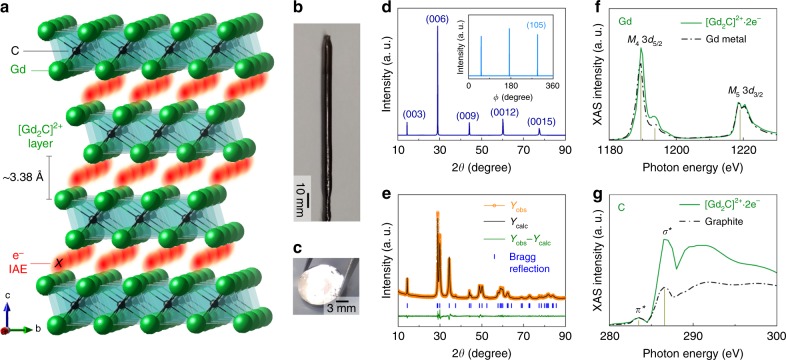
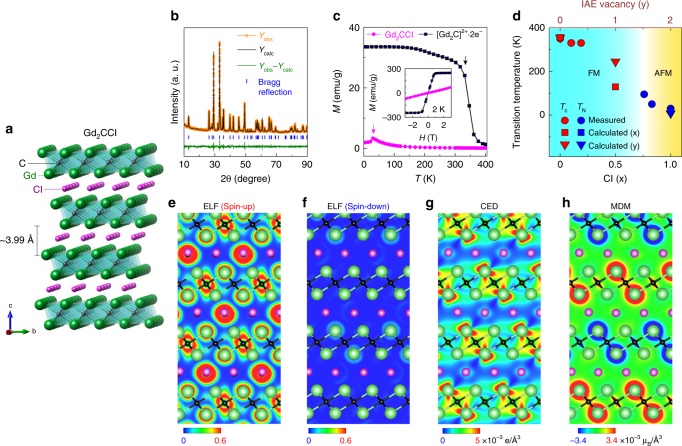
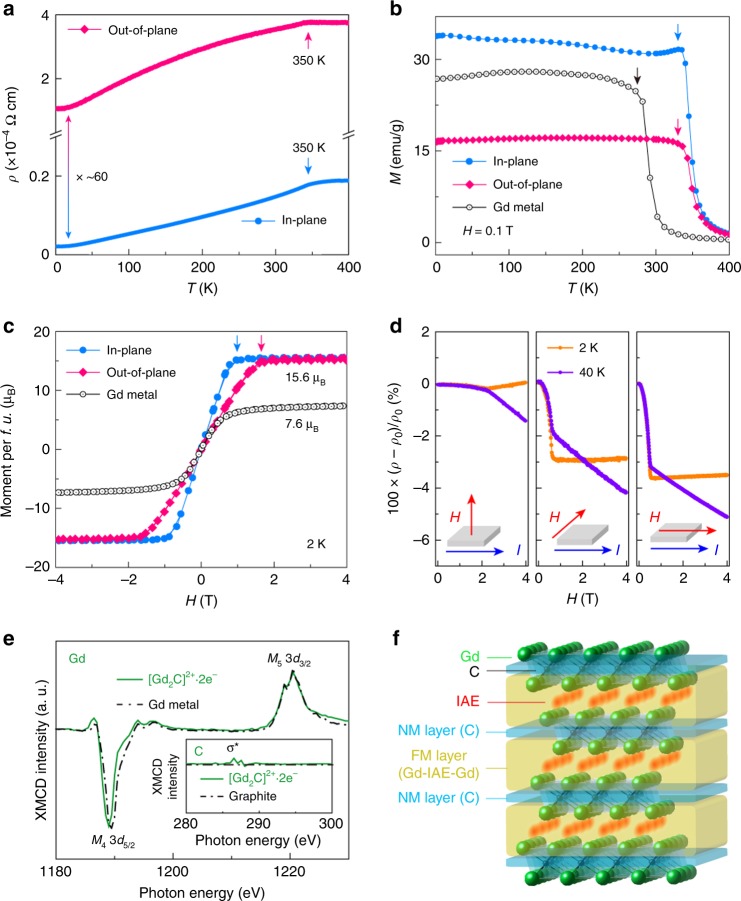
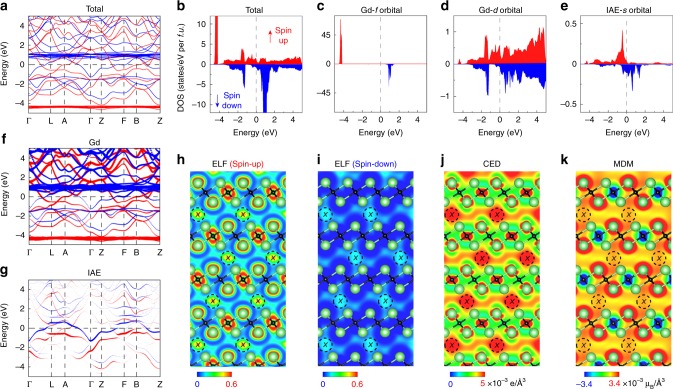
An electride, a generalized form of cavity-trapped interstitial anionic electrons (IAEs) in a positively charged lattice framework, shows exotic properties according to the size and geometry of the cavities. Here, we report that the IAEs in layer structured [GdC]·2e electride behave as ferromagnetic elements in two-dimensional interlayer space and possess their own magnetic moments of ~0.52 μ per quasi-atomic IAE, which facilitate the exchange interactions between interlayer gadolinium atoms across IAEs, inducing the ferromagnetism in [GdC]·2e electride. The substitution of paramagnetic chlorine atoms for IAEs proves the magnetic nature of quasi-atomic IAEs through a transition from ferromagnetic [GdC]·2e to antiferromagnetic GdCCl caused by attenuating interatomic exchange interactions, consistent with theoretical calculations. These results confirm that quasi-atomic IAEs act as ferromagnetic elements and trigger ferromagnetic spin alignments within the antiferromagnetic [GdC] lattice framework. These results present a broad opportunity to tailor intriguing ferromagnetism originating from quasi-atomic interstitial electrons in low-dimensional materials.
电子化合物是一种在带正电的晶格框架中捕获间隙阴离子电子(IAE)的广义形式,根据空腔的大小和几何形状表现出奇异的性质。在此,我们报道层状结构的[GdC]·2e电子化合物中的IAE在二维层间空间中表现为铁磁元素,每个准原子IAE具有约0.52 μ的自身磁矩,这促进了层间钆原子通过IAE的交换相互作用,从而在[GdC]·2e电子化合物中诱导出铁磁性。用顺磁性氯原子取代IAE,通过减弱原子间交换相互作用导致从铁磁性[GdC]·2e转变为反铁磁性GdCCl,证明了准原子IAE的磁性,这与理论计算结果一致。这些结果证实,准原子IAE作为铁磁元素,在反铁磁性[GdC]晶格框架内触发铁磁自旋排列。这些结果为在低维材料中定制源自准原子间隙电子的有趣铁磁性提供了广阔的机会。