
在德国,与传统细胞学检查相比,液基细胞学宫颈癌筛查的成本效益和成本效益分析
Cost-Effectiveness and Cost-Benefit of Cervical Cancer Screening with Liquid Based Cytology Compared with Conventional Cytology in Germany.
作者信息
Armstrong Stephanie F, Guest Julian F
机构信息
Catalyst Consultants, Rickmansworth, UK.
Faculty of Life Sciences and Medicine, King's College, London, UK.
出版信息
Clinicoecon Outcomes Res. 2020 Mar 17;12:153-166. doi: 10.2147/CEOR.S234385. eCollection 2020.
OBJECTIVE
To assess the health economic impact of cervical screening with liquid based cytology (LBC) compared with conventional cytology (CC) in Germany.
METHODS
An economic model was constructed depicting the management of a hypothetical cohort of women aged ≥20 years who undergo cervical screening in Germany. The model estimated the cost-effectiveness and cost-benefit of LBC compared with CC at 2017/18 prices over a time-horizon of 70 years.
RESULTS
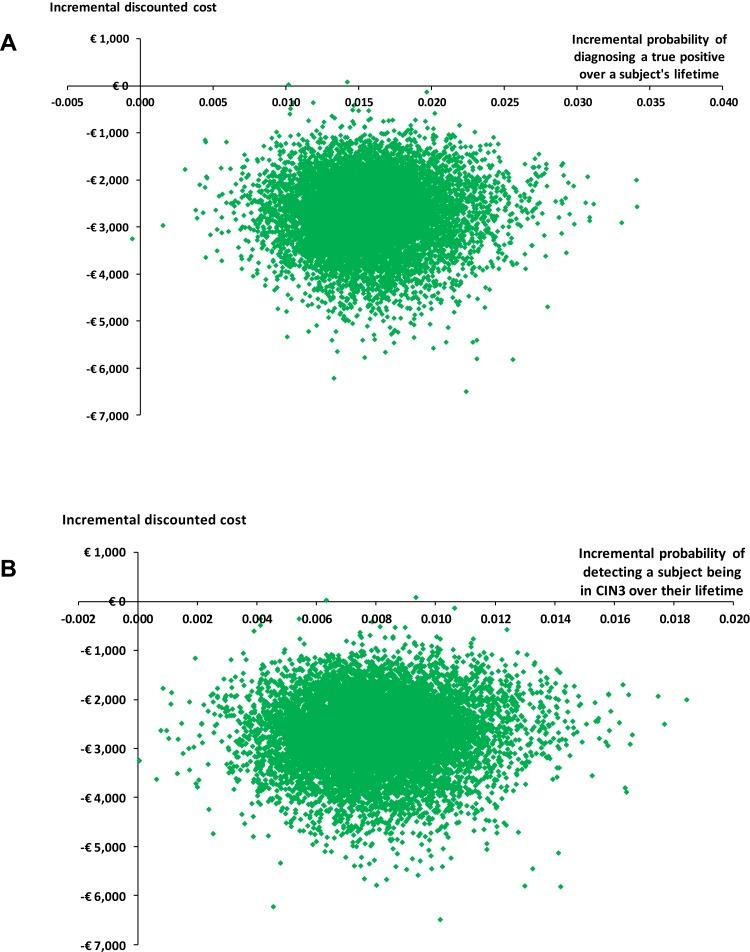
Performing cervical screens with LBC instead of CC is expected to increase the probability of detecting a true positive over a subject's lifetime by 73% (0.038 versus 0.022) and of diagnosing a subject with stage 3 cervical intraepithelial neoplasia (CIN3) (0.019 versus 0.011). Women screened with LBC instead of CC are expected to have a 57% reduction in the probability of having undetected CIN3 (0.006 versus 0.014) and to experience a 44% reduction in the probability of transitioning into disease progression (from 0.018 to 0.010). The mean discounted lifetime cost of healthcare resource use associated with performing cervical screens with LBC and CC was estimated at €4852 and €7523 per subject respectively. For every Euro invested in cervical screening with LBC instead of CC, the German healthcare system could potentially save ~€170 over a subject's lifetime.
CONCLUSION
Within the study's limitations, the analysis showed that LBC affords a cost-effective cervical screening test compared with CC in Germany, since it improves detection rates and has the potential to lead to a reduction in disease progression for less cost.
目的
评估在德国,与传统细胞学检查(CC)相比,液基细胞学检查(LBC)用于宫颈癌筛查的健康经济影响。
方法
构建一个经济模型,描述德国≥20岁接受宫颈癌筛查的假设队列女性的管理情况。该模型以2017/18年价格估算了LBC与CC相比在70年时间范围内的成本效益和成本效益。
结果
采用LBC而非CC进行宫颈癌筛查,预计在受试者一生中检测到真阳性的概率将提高73%(从0.022提高到0.038),诊断为3期宫颈上皮内瘤变(CIN3)的概率也会提高(从0.011提高到0.019)。采用LBC而非CC进行筛查的女性,未检测到CIN3的概率预计降低57%(从0.014降至0.006),疾病进展的概率预计降低44%(从0.018降至0.010)。与采用LBC和CC进行宫颈癌筛查相关的医疗资源使用的平均贴现终生成本分别估计为每位受试者4852欧元和7523欧元。与采用CC相比,每投资1欧元用于LBC宫颈癌筛查,德国医疗系统在受试者一生中可能节省约170欧元。
结论
在研究的局限性范围内,分析表明,在德国,与CC相比,LBC提供了一种具有成本效益的宫颈癌筛查测试,因为它提高了检测率,并且有可能以更低的成本降低疾病进展。


 Zotero 插件