Kim Sung-Eun
Department of Food and Nutrition, Sookmyung Women's University, 100 Cheongpa-ro 47-gil, Yongsan-gu, Seoul 04310, Republic of Korea.
Nutr Res Pract. 2020 Apr;14(2):95-101. doi: 10.4162/nrp.2020.14.2.95. Epub 2020 Mar 6.
BACKGROUND/OBJECTIVES: Folate plays a critical role in DNA synthesis and methylation. Intracellular folate homeostasis is maintained by the enzymes folylpolyglutamate synthase (FPGS) and γ-glutamyl hydrolase (GGH). FPGS adds glutamate residues to folate upon its entry into the cell through a process known as polyglutamylation to enhance folate retention in the cell and to maintain a steady supply of utilizable folate derivatives for folate-dependent enzyme reactions. Thereafter, GGH catalyzes the hydrolysis of polyglutamylated folate into monoglutamylated folate, which can subsequently be exported from the cell. The objective of this review is to summarize the scientific evidence available on the effects of intracellular folate homeostasis-associated enzymes on cancer chemotherapy.
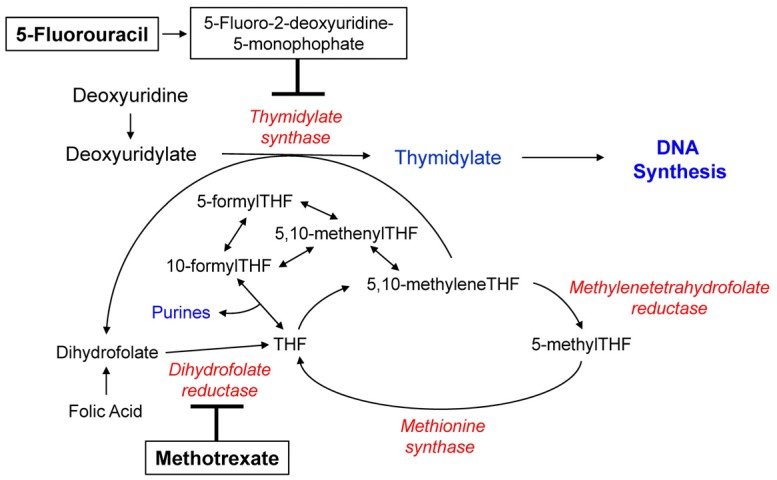
This review discusses the effects of FPGS and GGH on chemosensitivity to cancer chemotherapeutic agents such as antifolates, such as methotrexate, and 5-fluorouracil.
Polyglutamylated (anti)folates are better substrates for intracellular folate-dependent enzymes and retained for longer within cells. In addition to polyglutamylation of (anti)folates, FPGS and GGH modulate intracellular folate concentrations, which are an important determinant of chemosensitivity of cancer cells toward chemotherapeutic agents. Therefore, FPGS and GGH affect chemosensitivity to antifolates and 5-fluorouracil by altering intracellular retention status of antifolates and folate cofactors such as 5,10-methylenetetrahydrofolate, subsequently influencing the cytotoxic effects of 5-fluorouracil, respectively. Generally, high FPGS and/or low GGH activity is associated with increased chemosensitivity of cancer cells to methotrexate and 5-fluorouracil, while low FPGS and/or high GGH activity seems to correspond to resistance to these drugs. Further preclinical and clinical studies elucidating the pharmocogenetic ramifications of these enzyme-induced changes are warranted to provide a framework for developing rational, effective, safe, and customized chemotherapeutic practices.
背景/目的:叶酸在DNA合成和甲基化过程中发挥关键作用。细胞内叶酸稳态由叶酸多聚谷氨酸合成酶(FPGS)和γ-谷氨酰水解酶(GGH)维持。叶酸进入细胞后,FPGS通过多聚谷氨酸化过程将谷氨酸残基添加到叶酸上,以增强叶酸在细胞内的保留,并维持叶酸依赖性酶反应中可利用叶酸衍生物的稳定供应。此后,GGH催化多聚谷氨酸化叶酸水解为单谷氨酸化叶酸,随后可从细胞中输出。本综述的目的是总结关于细胞内叶酸稳态相关酶对癌症化疗影响的现有科学证据。
本综述讨论了FPGS和GGH对癌症化疗药物(如抗叶酸药物,如甲氨蝶呤和5-氟尿嘧啶)化疗敏感性的影响。
多聚谷氨酸化(抗)叶酸是细胞内叶酸依赖性酶更好的底物,并且在细胞内保留时间更长。除了(抗)叶酸的多聚谷氨酸化外,FPGS和GGH调节细胞内叶酸浓度,这是癌细胞对化疗药物化疗敏感性的重要决定因素。因此,FPGS和GGH通过改变抗叶酸药物和叶酸辅因子(如5,10-亚甲基四氢叶酸)的细胞内保留状态来影响对抗叶酸药物和5-氟尿嘧啶的化疗敏感性,随后分别影响5-氟尿嘧啶的细胞毒性作用。一般来说,高FPGS和/或低GGH活性与癌细胞对甲氨蝶呤和5-氟尿嘧啶的化疗敏感性增加相关,而低FPGS和/或高GGH活性似乎与对这些药物的耐药性相对应。有必要进行进一步的临床前和临床研究,以阐明这些酶诱导变化的药物遗传学影响,从而为制定合理、有效、安全和个性化的化疗方案提供框架。