Janousek William M, Marra Peter P, Kilpatrick A Marm
Department of Ecology and Evolutionary Biology, University of California, Santa Cruz, California 95064, USA.
Parasit Vectors. 2014 Aug 28;7:399. doi: 10.1186/1756-3305-7-399.
Extensive work has shown that vectors almost never feed at random. Often, a subset of individual hosts and host species are fed on much more frequently than expected from their abundance and this can amplify pathogen transmission. However, the drivers of variation in contact patterns between vectors and their hosts are not well understood, even in relatively well-studied systems such as West Nile virus (WNV).
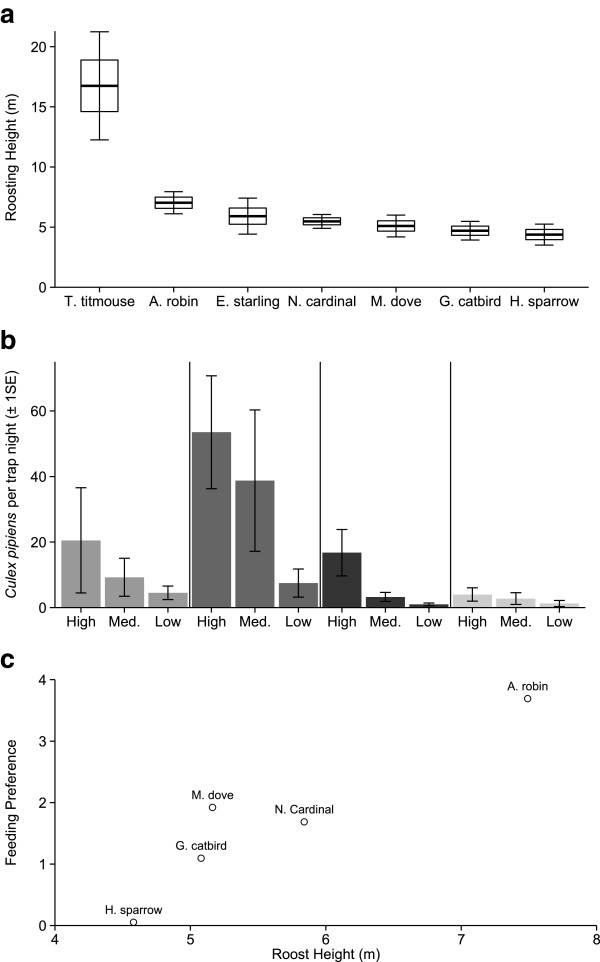
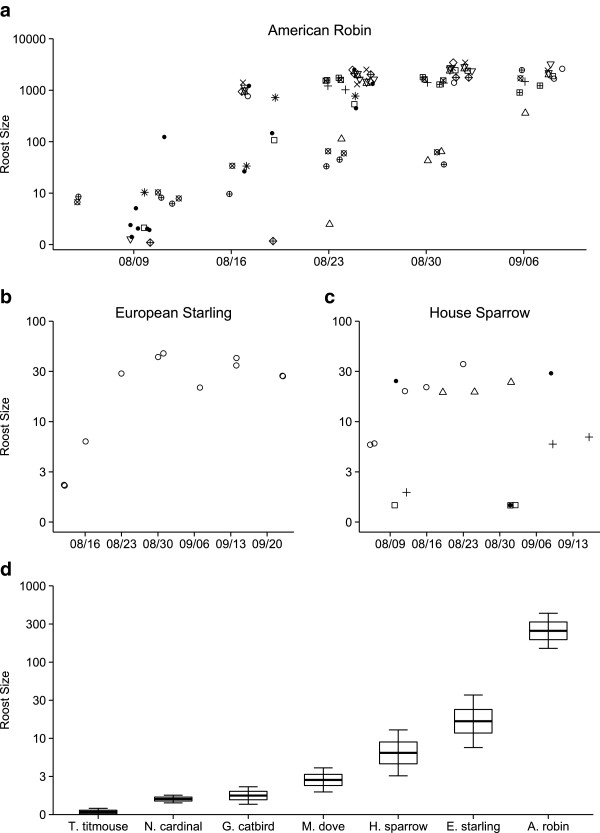
We compared roosting height and roost aggregation size of seven avian host species of WNV with patterns of host-seeking mosquito (Culex pipiens) abundance at communal and non-communal roost sites.
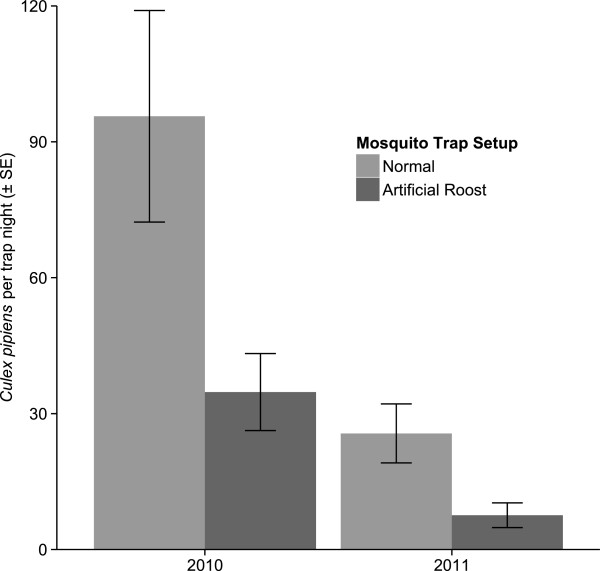
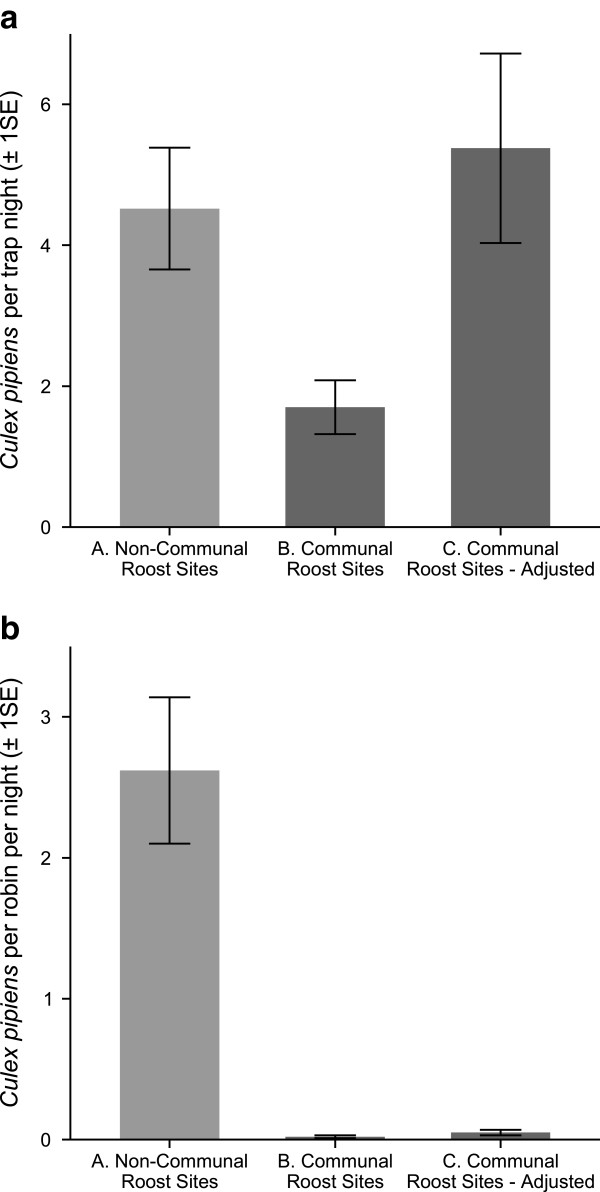
First, host-seeking mosquito abundance increased with height and paralleled increased mosquito feeding preferences on species roosting higher in the tree canopy. Second, there were several hundred-fold fewer mosquitoes per bird trapped at American robin (Turdus migratorius) communal roosts compared to non-communal roost sites, which could reduce transmission from and to this key amplifying host species. Third, seasonal changes in communal roost formation may partly explain observed seasonal changes in mosquito feeding patterns, including a decrease in feeding on communal roosting robins.
These results illustrate how variation in habitat use by hosts and vectors and social aggregation by hosts influence vector-host interactions and link the behavioral ecology of birds and the transmission of vector-borne diseases to humans.
大量研究表明,病媒几乎从不随机觅食。通常,一部分个体宿主和宿主物种被叮咬的频率远高于根据其数量预期的频率,这会加剧病原体传播。然而,即使在诸如西尼罗河病毒(WNV)这样研究相对充分的系统中,病媒与其宿主之间接触模式变化的驱动因素也尚未得到很好的理解。
我们比较了WNV的七种鸟类宿主的栖息高度和栖息地聚集规模与在群居和非群居栖息地中寻找宿主的蚊子(致倦库蚊)数量模式。
第一,寻找宿主的蚊子数量随高度增加,并且与蚊子对树冠层中栖息位置较高物种的叮咬偏好增加相一致。第二,与非群居栖息地相比,在美洲知更鸟(旅鸫)群居栖息地捕获的每只鸟身上的蚊子数量要少数百倍,这可能会减少与这个关键扩增宿主物种之间的传播。第三,群居栖息地形成的季节性变化可能部分解释了观察到的蚊子叮咬模式的季节性变化,包括对群居栖息的知更鸟叮咬的减少。
这些结果说明了宿主和病媒对栖息地利用的变化以及宿主的社会聚集如何影响病媒-宿主相互作用,并将鸟类的行为生态学与病媒传播疾病向人类的传播联系起来。