Bekele Habtamu, Dheressa Merga, Mengistie Bezatu, Sintayehu Yitagesu, Fekadu Gelana
School of Nursing and Midwifery, College of Health and Medical Science, Haramaya University, Ethiopia P.O. Box: 235.
Department of Environmental Health, College of Health and Medical Science, Haramaya University, Ethiopia P.O. Box: 235.
J Pregnancy. 2020 Mar 19;2020:3179193. doi: 10.1155/2020/3179193. eCollection 2020.
A pregnancy is described unintended if it is either unwanted or mistimed. The former occurs when no child or no more children are desired, and the latter is when the conception occurs earlier than the desired time, but wanted later. Unwanted pregnancy causes a serious health, economic, and social problem to the woman and her family. In the study area, there is limited data on unintended pregnancy. Therefore, this study fills this gap by studying the magnitude of unintended pregnancy and its associated factors among pregnant women attending antenatal care in the study area.
A facility-based cross-sectional study was done from 1 March to 1 April 2019, among 612 randomly selected pregnant women attending antenatal care at Bako Tibe district public health facility. The data were collected via interview using a structured and pretested questionnaire. They were entered into EpiData Version 3.1 and SPSS Version 23 for cleaning and analyses. The variables, which were significant at ≤ 0.2 in the bivariate logistic regression, were included in the multivariable analysis. The direction and strength of statistical association were measured by an odds ratio with 95% CI. A variable with a value < 0.05 was considered a significantly associated factor with the outcome one.
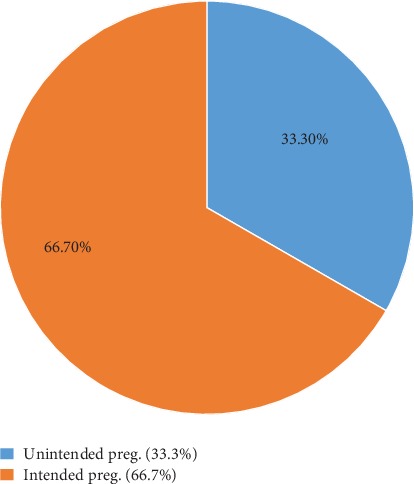
In this study, the prevalence of unintended pregnancy was 33.3%, at 95% CI (29.8, 37.3). The factors that had significant association with unintended pregnancy were family size ≥ 6 (AOR = 8.0, 95% CI: 1.38-46.66), women who did not communicate about family planning with their husbands (AOR = 2.8, 95% CI: 1.50-5.20), and parity ≥ 5 (AOR = 3.0, 95% CI: 1.34-6.8).
About one-third of the pregnant women reported that their pregnancy was unintended. Parity, family size, and lack of spousal communication showed a significant association with the problem. To decrease the current level of unintended pregnancy in the area, the Bako Tibe District Health Bureau and the health workers should work harder to scale up spousal communication on family planning.
如果怀孕是意外怀孕,即意外受孕或时机不当。前者发生在不想要孩子或不再想要孩子的情况下,后者是指受孕时间早于预期,但之后又想要孩子。意外怀孕给女性及其家庭带来了严重的健康、经济和社会问题。在研究区域,关于意外怀孕的数据有限。因此,本研究通过调查研究区域内接受产前护理的孕妇中意外怀孕的发生率及其相关因素,填补了这一空白。
2019年3月1日至4月1日,在巴科·蒂贝地区公共卫生机构对612名随机抽取的接受产前护理的孕妇进行了一项基于机构的横断面研究。通过使用结构化且经过预测试的问卷进行访谈收集数据。数据录入EpiData 3.1版本和SPSS 23版本进行清理和分析。在双变量逻辑回归中显著性≤0.2的变量纳入多变量分析。统计关联的方向和强度用比值比及95%置信区间衡量。P值<0.05的变量被认为是与结果有显著关联的因素。
本研究中,意外怀孕的发生率为33.3%,95%置信区间为(29.8, 37.3)。与意外怀孕有显著关联的因素包括家庭规模≥6(比值比=8.0,95%置信区间:1.38 - 46.66);未与丈夫就计划生育进行沟通的女性(比值比=2.8,95%置信区间:1.50 - 5.20);产次≥5(比值比=3.0,95%置信区间:1.34 - 6.8)。
约三分之一的孕妇报告其怀孕是意外怀孕。产次、家庭规模和配偶间缺乏沟通与该问题有显著关联。为降低该地区当前的意外怀孕水平,巴科·蒂贝地区卫生局和卫生工作者应更加努力地扩大关于计划生育的配偶间沟通。