Kang Ju-Bin, Lee Seung-Yun, Park Dong-Ju, Koh Phil-Ok
Department of Anatomy, College of Veterinary Medicine, Research Institute of Life Science, Gyeongsang National University, 501 Jinju-daero, Jinju, 52828 South Korea.
Lab Anim Res. 2020 Apr 3;36:8. doi: 10.1186/s42826-020-00041-5. eCollection 2020.
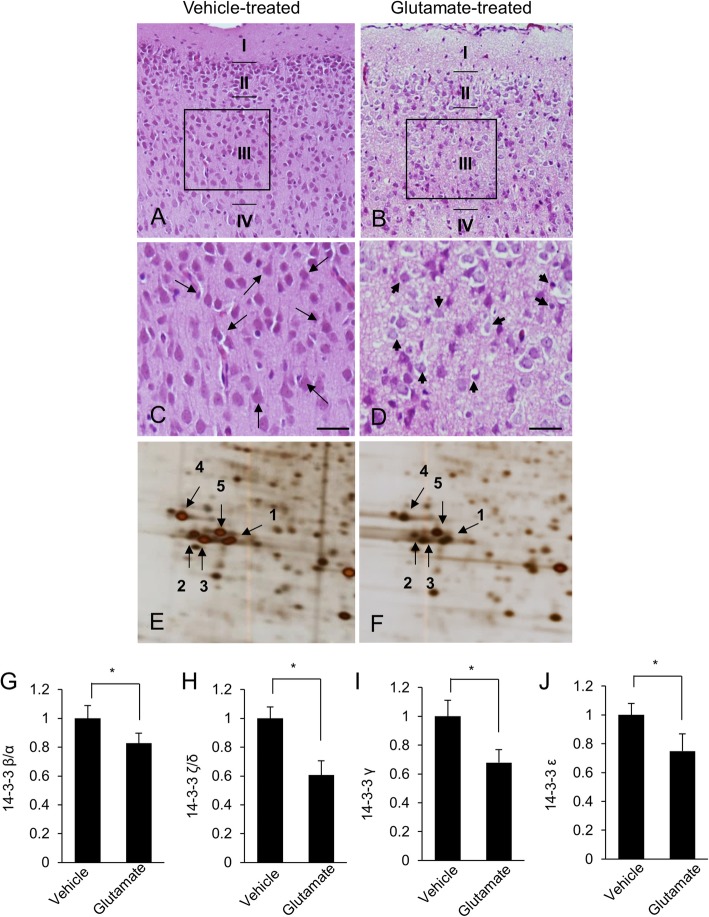
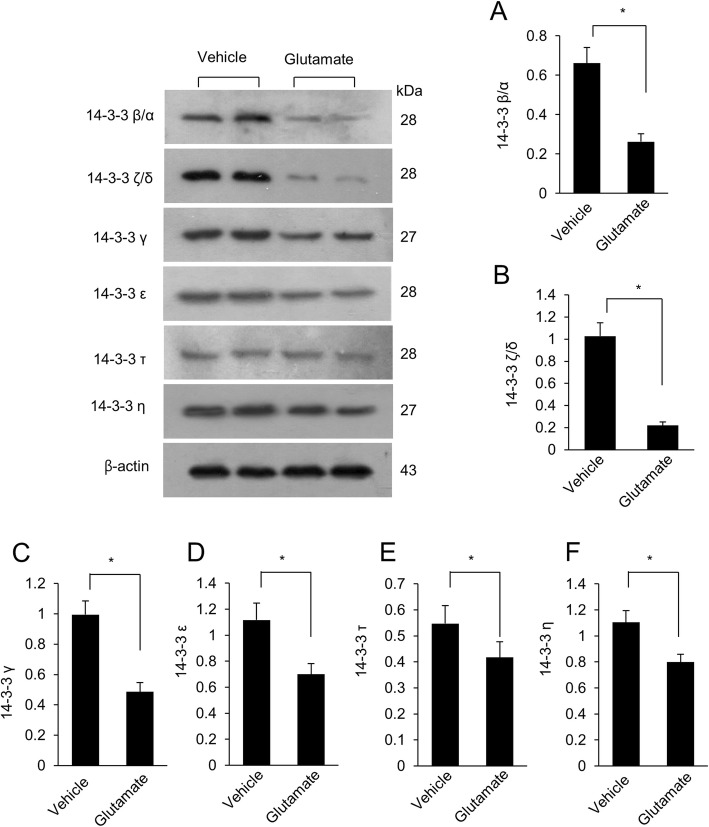
Glutamate is a representative excitatory neurotransmitter. However, excessive glutamate exposure causes neuronal cell damage by generating neuronal excitotoxicity. Excitotoxicity in neonates caused by glutamate treatment induces neurological deficits in adults. The 14-3-3 family proteins are conserved proteins that are expressed ubiquitously in a variety of tissues. These proteins contribute to cellular processes, including signal transduction, protein synthesis, and cell cycle control. We proposed that glutamate induces neuronal cell damage by regulating 14-3-3 protein expression in newborn animals. In this study, we investigated the histopathological changes and 14-3-3 proteins expressions as a result of glutamate exposure in the neonatal cerebral cortex. Rat pups at post-natal day 7 were intraperitoneally administrated with vehicle or glutamate (10 mg/kg). Animals were sacrificed 4 h after treatment, and brain tissues were fixed for histological study. Cerebral cortices were isolated and frozen for proteomic study. We observed serious histopathological damages including shrunken dendrites and atypical neurons in glutamate-treated cerebral cortices. In addition, we identified that 14-3-3 family proteins decreased in glutamate-exposed cerebral cortices using a proteomic approach. Moreover, Western blot analysis provided results that glutamate treatment in neonates decreased 14-3-3 family proteins expressions, including the β/α, ζ/δ, γ, ε, τ, and η isoforms. 14-3-3 proteins are involved in signal transduction, metabolism, and anti-apoptotic functions. Thus, our findings suggest that glutamate induces neonatal neuronal cell damage by modulating 14-3-3 protein expression.
谷氨酸是一种典型的兴奋性神经递质。然而,过量暴露于谷氨酸会通过产生神经元兴奋性毒性导致神经元细胞损伤。谷氨酸处理引起的新生儿兴奋性毒性会导致成年后出现神经功能缺损。14-3-3家族蛋白是保守蛋白,在多种组织中普遍表达。这些蛋白参与细胞过程,包括信号转导、蛋白质合成和细胞周期调控。我们提出谷氨酸通过调节新生动物中14-3-3蛋白的表达来诱导神经元细胞损伤。在本研究中,我们调查了新生大鼠大脑皮层暴露于谷氨酸后引起的组织病理学变化和14-3-3蛋白的表达。出生后第7天的幼鼠腹腔注射溶剂或谷氨酸(10毫克/千克)。处理4小时后处死动物,取脑组织固定用于组织学研究。分离大脑皮层并冷冻用于蛋白质组学研究。我们观察到谷氨酸处理的大脑皮层出现严重的组织病理学损伤,包括树突萎缩和非典型神经元。此外,我们通过蛋白质组学方法确定,暴露于谷氨酸的大脑皮层中14-3-3家族蛋白减少。此外,蛋白质印迹分析结果显示,新生动物经谷氨酸处理后,14-3-3家族蛋白的表达下降,包括β/α、ζ/δ、γ、ε、τ和η亚型。14-3-3蛋白参与信号转导、代谢和抗凋亡功能。因此,我们的研究结果表明,谷氨酸通过调节14-3-3蛋白的表达诱导新生神经元细胞损伤。