Department of Medical Microbiology, University of Pretoria, Pretoria, South Africa.
Department of Medical Microbiology, Tshwane Academic Division, National Health Laboratory Service (NHLS), Pretoria, South Africa.
Front Cell Infect Microbiol. 2020 Feb 28;10:71. doi: 10.3389/fcimb.2020.00071. eCollection 2020.
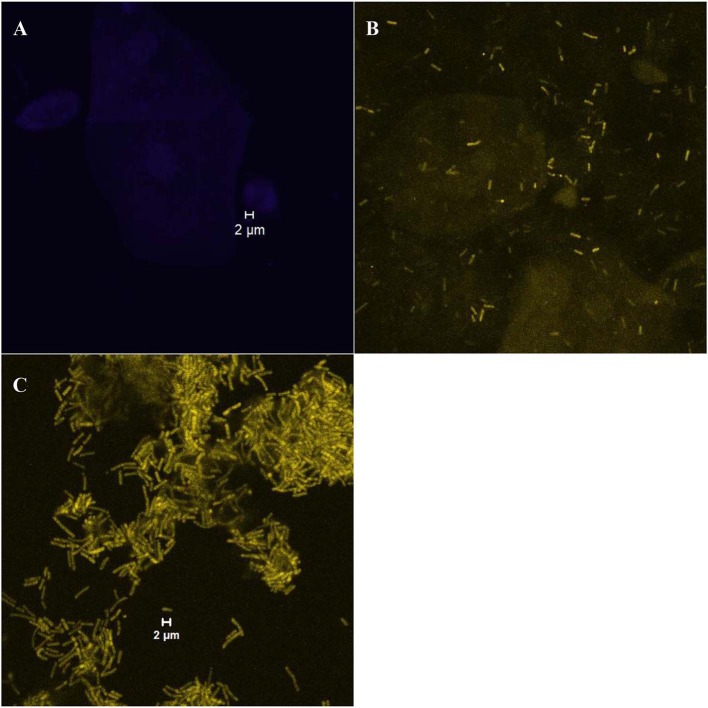
Bacterial vaginosis (BV) is a common vaginal condition in women of reproductive age. During BV development, BV-associated bacteria may form a polymicrobial biofilm, which predispose women to recurrent BV. The aim of the study was to investigate the growth forms of spp. and spp. and to determine the association between the bacterial growth forms and clinical characteristics [urinary tract infection (UTI) symptoms, human immunodeficiency virus (HIV) infection and abnormal vaginal discharge] in women attending a tertiary hospital in Pretoria, South Africa. A first-void urine specimen was collected from 196 women and BV was diagnosed using the Nugent scoring and the Ison-Hay criteria (vaginal smear microscopy). Fluorescence hybridisation (FISH) was performed to classify the growth forms ["dispersed" or "biofilm"]. Bacterial cells were categorized as "dispersed" if cells were scattered separately and as "biofilm" if bacterial aggregates on the vaginal epithelial cells were observed. BV was detected in 52 women (52/196; 27%) and in these women, spp. were predominantly present in biofilms (46/52; 88% for Nugent scoring; and 45/50; 90% for Ison-Hay criteria), whereas spp. were predominantly present in a dispersed form (38/52; 73% for Nugent scoring; and 37/50; 74% for Ison-Hay criteria). The odds of having BV increased when biofilms were present ( < 0.001), whereas the opposite was observed for biofilms ( = 0.001). Neither spp. or spp. (both dispersed or biofilms) had an association with the presence of UTI symptoms, HIV coinfection or abnormal vaginal discharge. In conclusion, this study demonstrated and confirmed that biofilms are associated with BV and that spp. may form biofilms to protect against BV.
细菌性阴道病(BV)是育龄妇女常见的阴道疾病。在 BV 发展过程中,BV 相关细菌可能形成多微生物生物膜,使妇女易患复发性 BV。本研究旨在调查 spp. 和 spp. 的生长形态,并确定这些细菌生长形态与南非比勒陀利亚一家三级医院就诊妇女的临床特征[尿路感染(UTI)症状、人类免疫缺陷病毒(HIV)感染和异常阴道分泌物]之间的关系。从 196 名妇女中采集第一次排空的尿液标本,使用 Nugent 评分和 Ison-Hay 标准(阴道涂片显微镜检查)诊断 BV。采用荧光杂交(FISH)对生长形态[“分散”或“生物膜”]进行分类。如果细胞分散存在,则将细菌细胞分类为“分散”,如果观察到细菌聚集在阴道上皮细胞上,则将其分类为“生物膜”。在 52 名妇女(52/196;27%)中检测到 BV,在这些妇女中, spp. 主要存在于生物膜中(Nugent 评分 46/52;88%;Ison-Hay 标准 45/50;90%),而 spp. 主要以分散形式存在(Nugent 评分 38/52;73%;Ison-Hay 标准 37/50;74%)。当存在 生物膜时,BV 的发生几率增加(<0.001),而当存在 生物膜时则相反(=0.001)。无论是 spp. 还是 spp.(无论是分散形式还是生物膜形式)都与 UTI 症状、HIV 合并感染或异常阴道分泌物无关。综上所述,本研究证实了 生物膜与 BV 相关,而 spp. 可能形成生物膜以预防 BV。