Apithanyasai Suchanya, Supakata Nuta, Papong Seksan
International Program in Hazardous Substance and Environmental Management, Graduate School, Chulalongkorn University, Bangkok, Thailand.
Department of Environmental Science, Faculty of Science, Chulalongkorn University, Bangkok, Thailand.
Heliyon. 2020 Mar 31;6(3):e03697. doi: 10.1016/j.heliyon.2020.e03697. eCollection 2020 Mar.
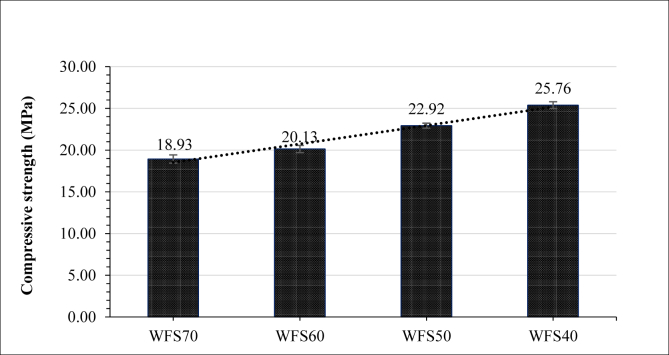
The purpose of this study was to investigate the best ratio of waste foundry sand (WFS), fly ash (FA), and electric arc furnace slag (EAF slag) for the production of geopolymer bricks. In this research study, WFS, FA, and EAF slag were mixed at the ratio of 70:30:0, 60:30:10, 50:30:20, and 40:30:30 with 8M sodium hydroxide (NaOH) and 98% purity sodium silicate (NaSiO) with a ratio of NaSiO/8M NaOH = 2.5. The mixtures were compacted in 5 cm × 5 cm x 5 cm molds and cured at an ambient temperature for 28 days. Then, their compressive strength was analyzed. The results showed that the geopolymer bricks with the highest compressive strength were those mixed at the 40:30:30 ratio, with a compressive strength of 25.76 MPa. The strongest bricks were also analyzed using the leaching test to ensure the production involved non-hazardous materials. To compare the environmental impacts of geopolymer bricks and concrete bricks, their effects on climate change, ozone depletion, terrestrial acidification, human toxicity, terrestrial ecotoxicity, and fossil fuel depletion were examined from cradle to grave using SimaPro 8.0.5.13 software. The results of the life cycle assessment (LCA) from cradle to grave showed that the environmental impact of geopolymer brick production was lower in every aspect than that of concrete production. Therefore, geopolymer brick production can reduce environmental impact and can be a value-added use for industrial waste.
本研究的目的是探究用于生产地质聚合物砖的废铸造砂(WFS)、粉煤灰(FA)和电弧炉渣(EAF炉渣)的最佳比例。在本研究中,将WFS、FA和EAF炉渣按70:30:0、60:30:10、50:30:20和40:30:30的比例与8M氢氧化钠(NaOH)和纯度为98%的硅酸钠(NaSiO)混合,NaSiO/8M NaOH的比例为2.5。将混合物在5厘米×5厘米×5厘米的模具中压实,并在环境温度下养护28天。然后,分析其抗压强度。结果表明,抗压强度最高的地质聚合物砖是按40:30:30比例混合的,抗压强度为25.76兆帕。还使用浸出试验对强度最高的砖进行了分析,以确保生产过程中使用的是无害材料。为了比较地质聚合物砖和混凝土砖对环境的影响,使用SimaPro 8.0.5.13软件从摇篮到坟墓对它们在气候变化、臭氧层损耗、陆地酸化、人体毒性、陆地生态毒性和化石燃料消耗方面的影响进行了研究。从摇篮到坟墓的生命周期评估(LCA)结果表明,地质聚合物砖生产在各个方面对环境的影响都低于混凝土生产。因此,地质聚合物砖生产可以减少环境影响,并且可以成为工业废物的增值利用方式。