Vanheusden Marisa, Vitale Raffaele, Camacho Rafael, Janssen Kris P F, Acke Aline, Rocha Susana, Hofkens Johan
Department of Chemistry, KU Leuven, Leuven 3000, Belgium.
ACS Omega. 2020 Mar 17;5(12):6792-6799. doi: 10.1021/acsomega.0c00118. eCollection 2020 Mar 31.
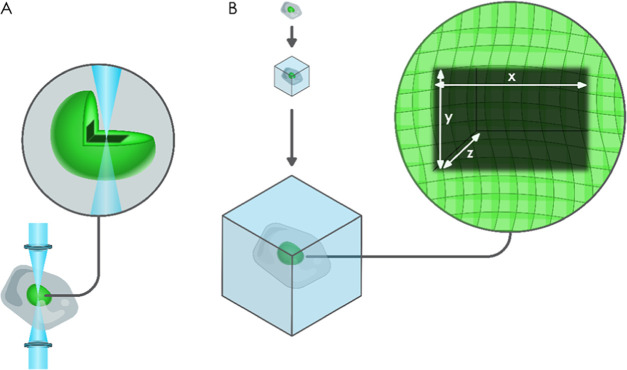
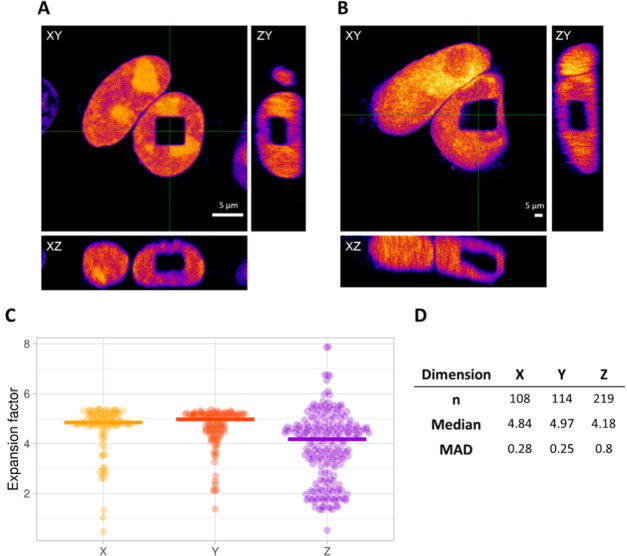
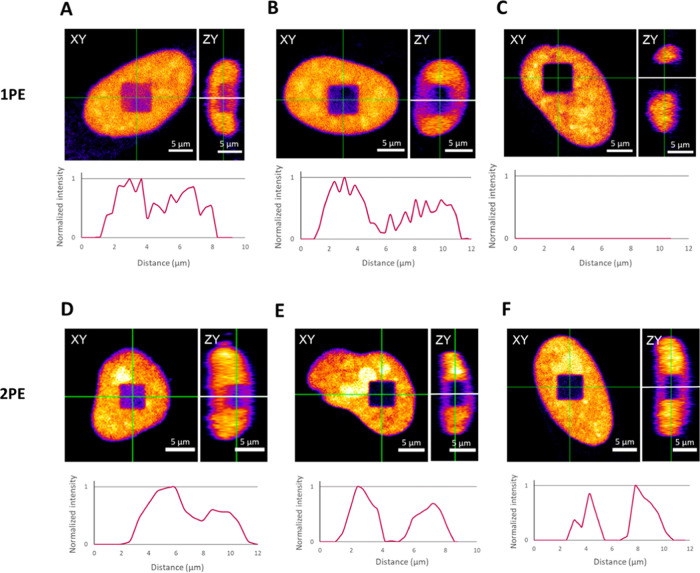
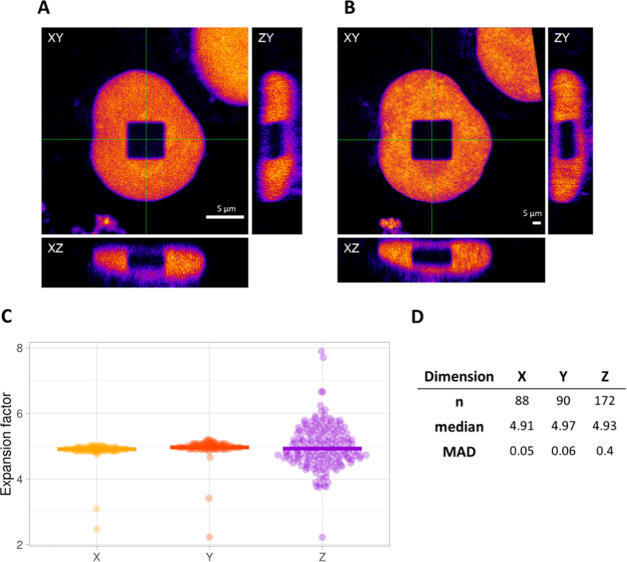
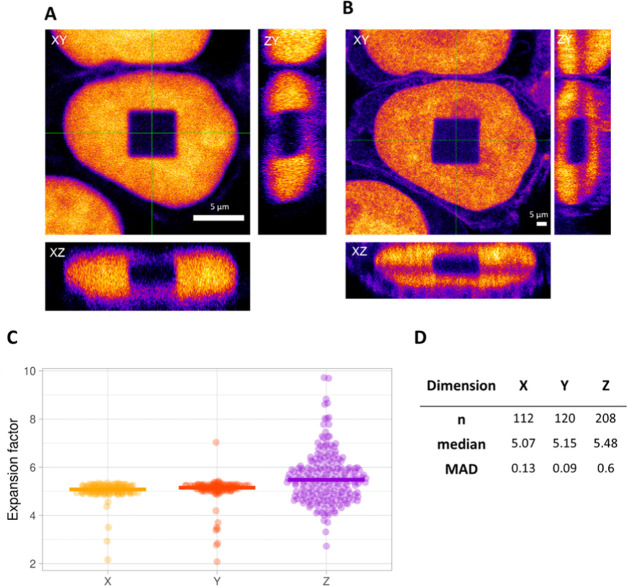
Four years after its first report, expansion microscopy (ExM) is now being routinely applied in laboratories worldwide to achieve super-resolution imaging on conventional fluorescence microscopes. By chemically anchoring all molecules of interest to the polymer meshwork of an expandable hydrogel, their physical distance is increased by a factor of ∼4-5× upon dialysis in water, resulting in an imprint of the original sample with a lateral resolution up to 50-70 nm. To ensure a correct representation of the original spatial distribution of the molecules, it is crucial to confirm that the expansion is isotropic, preferentially in all three dimensions. To address this, we present an approach to evaluate the local expansion factor within a biological sample and in all three dimensions. We use photobleaching to introduce well-defined three-dimensional (3D) features in the cell and, by comparing the size and shape pre- and postexpansion, these features can be used as an intrinsic ruler. In addition, our method is capable of pointing out sample distortions and can be used as a quality control tool for expansion microscopy experiments in biological samples.
在首次报道四年后,扩展显微镜技术(ExM)如今已在全球各实验室中常规应用,以在传统荧光显微镜上实现超分辨率成像。通过将所有感兴趣的分子化学锚定到可膨胀水凝胶的聚合物网络上,在水中透析时它们的物理距离会增加约4 - 5倍,从而得到原始样品的印记,横向分辨率可达50 - 70纳米。为确保正确呈现分子的原始空间分布,至关重要的是要确认膨胀是各向同性的,最好是在所有三个维度上。为解决这一问题,我们提出了一种方法来评估生物样品内以及所有三个维度上的局部膨胀因子。我们利用光漂白在细胞中引入明确的三维(3D)特征,并且通过比较膨胀前后这些特征的大小和形状,这些特征可作为一个内在标尺。此外,我们的方法能够指出样品的变形情况,并且可作为生物样品中扩展显微镜实验的质量控制工具。