Tedla Bemnet A, Pickering Darren, Becker Luke, Loukas Alex, Pearson Mark S
Centre for Molecular Therapeutics, Australian Institute of Tropical Health and Medicine, James Cook University, Cairns, QLD 4878, Australia.
Vaccines (Basel). 2020 Apr 3;8(2):162. doi: 10.3390/vaccines8020162.
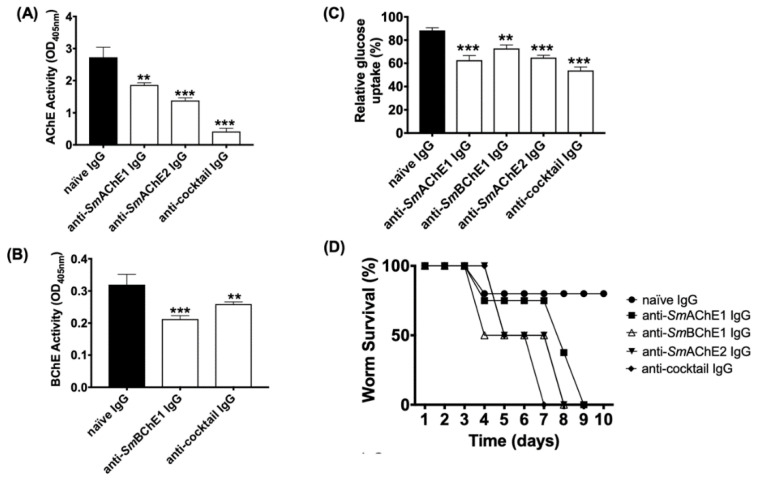
Schistosomiasis is a neglected tropical disease caused by parasitic blood flukes of the genus , which kills 300,000 people every year in developing countries, and there is no vaccine. Recently, we have shown that cholinesterases (ChEs)-enzymes that regulate neurotransmission-from are expressed on the outer tegument surface and present in the excretory/secretory products of larval schistosomula and adult worms, and are essential for parasite survival in the definitive host, highlighting their utility as potential schistosomiasis vaccine targets. When treated with anti-schistosome cholinesterase (ChE) IgG, both schistosomula and adult worms displayed significantly decreased ChE activity, which eventually resulted in parasite death. Vaccination with individual ChEs, or a combination of all three ChEs, significantly reduced worm burdens in two independent trials compared to controls. Average adult worm numbers and liver egg burdens were significantly decreased for all vaccinated mice across both trials, with values of 29-39% and 13-46%, respectively, except for those vaccinated with AChE1 in trial 1. Egg viability, as determined by egg hatching from liver homogenates, was significantly reduced in the groups vaccinated with the ChE cocktail (40%) and AChE2 (46%). Furthermore, surviving worms from each vaccinated group were significantly stunted and depleted of glycogen stores, compared to controls. These results suggest that ChEs could be incorporated into a vaccine against schistosomiasis to reduce the pathology and transmission of this debilitating disease.
血吸虫病是一种由血吸虫属寄生性血吸虫引起的被忽视的热带疾病,在发展中国家每年导致30万人死亡,且尚无疫苗。最近,我们发现,来自[此处原文有缺失信息]的胆碱酯酶(ChEs)——调节神经传递的酶——在幼虫期血吸虫和成虫的体表外膜表面表达,并存在于其排泄/分泌产物中,且对于终末宿主中的寄生虫存活至关重要,这突出了它们作为潜在血吸虫病疫苗靶点的效用。用抗血吸虫胆碱酯酶(ChE)IgG处理后,幼虫期血吸虫和成虫的ChE活性均显著降低,最终导致寄生虫死亡。在两项独立试验中,与对照组相比,用单个ChE或所有三种ChE的组合进行疫苗接种可显著减轻虫负荷。在两项试验中,所有接种疫苗的小鼠的平均成虫数量和肝脏虫卵负荷均显著降低,除试验1中接种乙酰胆碱酯酶1(AChE1)的小鼠外,分别为29% - 39%和13% - 46%。通过肝脏匀浆孵化虫卵测定的虫卵活力,在接种ChE鸡尾酒(40%)和AChE2(46%)的组中显著降低。此外,与对照组相比,每个接种疫苗组中存活的蠕虫明显发育不良且糖原储备减少。这些结果表明,胆碱酯酶可被纳入抗血吸虫病疫苗中,以减轻这种使人衰弱的疾病的病理变化和传播。