Nakamura Kohei, Aimono Eriko, Tanishima Shigeki, Imai Mitsuho, Nagatsuma Akiko Kawano, Hayashi Hideyuki, Yoshimura Yuki, Nakayama Kentaro, Kyo Satoru, Nishihara Hiroshi
Genomics Unit, Keio Cancer Center, Keio University School of Medicine, 35 Shinanomachi, Shinjukuku, Tokyo 160-8582, Japan.
Department of Obstetrics and Gynecology, Kumagaya General Hospital, Saitama 360-8657, Japan.
Diagnostics (Basel). 2020 Apr 3;10(4):200. doi: 10.3390/diagnostics10040200.
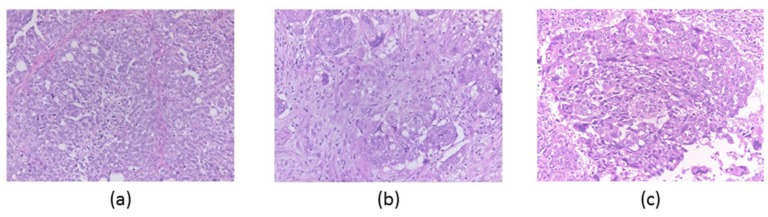
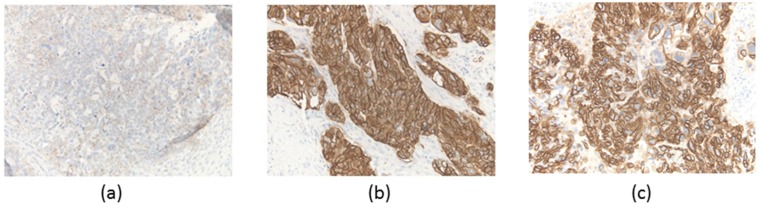
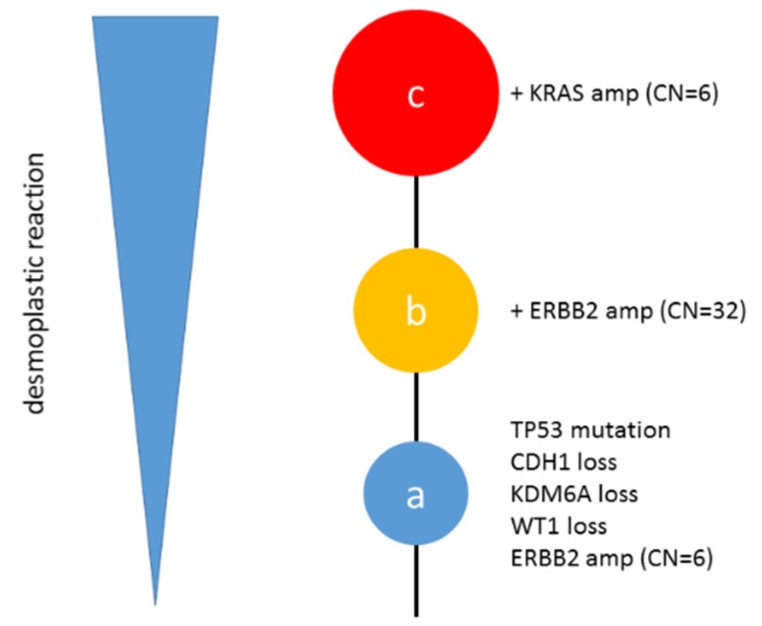
Precision medicine, which includes comprehensive genome sequencing, is a potential therapeutic option for treating high-grade serous carcinoma (HGSC). However, HGSC is a heterogeneous tumor at the architectural, cellular, and molecular levels. Intratumoral molecular heterogeneity currently limits the precision of medical strategies based on the gene mutation status. This study was carried out to analyze the presence of 160 cancer-related genetic alterations in three tissue regions with different pathological features in a patient with HGSC. The patient exhibited histological heterogeneous features with different degrees of large atypical cells and desmoplastic reactions. TP53 mutation, ERBB2 and KRAS amplification, and WT1, CDH1, and KDM6A loss were detected as actionable gene alterations. Interestingly, the ERBB2 and KRAS amplification status gradually changed according to the region examined. The difference was consistent with the differences in pathological features. Our results demonstrate the need for sampling of the appropriate tissue region showing progression of pathological features for molecular analysis to solve issues related to tumor heterogeneity prior to developing precision oncology strategies.
精准医学,包括全面的基因组测序,是治疗高级别浆液性癌(HGSC)的一种潜在治疗选择。然而,HGSC在结构、细胞和分子水平上是一种异质性肿瘤。肿瘤内分子异质性目前限制了基于基因突变状态的医疗策略的精准性。本研究旨在分析一名HGSC患者三个具有不同病理特征的组织区域中160种癌症相关基因改变的存在情况。该患者表现出不同程度的大非典型细胞和促纤维增生反应的组织学异质性特征。检测到TP53突变、ERBB2和KRAS扩增以及WT1、CDH1和KDM6A缺失作为可操作的基因改变。有趣的是,ERBB2和KRAS扩增状态根据所检查的区域逐渐变化。这种差异与病理特征的差异一致。我们的结果表明,在制定精准肿瘤学策略之前,需要对显示病理特征进展的适当组织区域进行采样以进行分子分析,以解决与肿瘤异质性相关的问题。