Jiang Wei, Dulaimi Essel, Devarajan Karthik, Parsons Theodore, Wang Qiong, Liao Lili, Cho Eun-Ah, O'Neill Raymond, Solomides Charalambos, Peiper Stephen C, Testa Joseph R, Uzzo Robert, Yang Haifeng
Department of Pathology, Anatomy and Cell Biology, Thomas Jefferson University, Philadelphia, Pennsylvania, United States of America.
Department of Pathology, Fox Chase Cancer Center, Philadelphia, Pennsylvania, United States of America.
PLoS One. 2016 Oct 20;11(10):e0164554. doi: 10.1371/journal.pone.0164554. eCollection 2016.
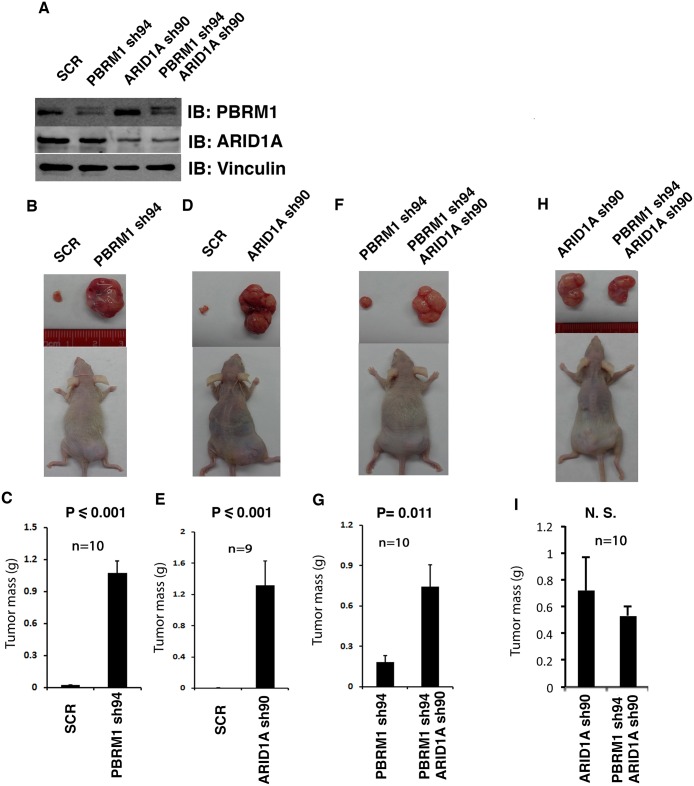
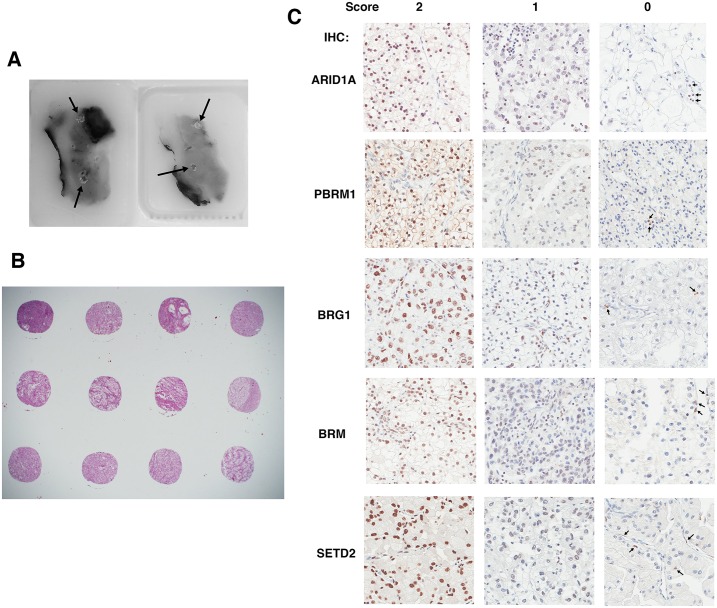
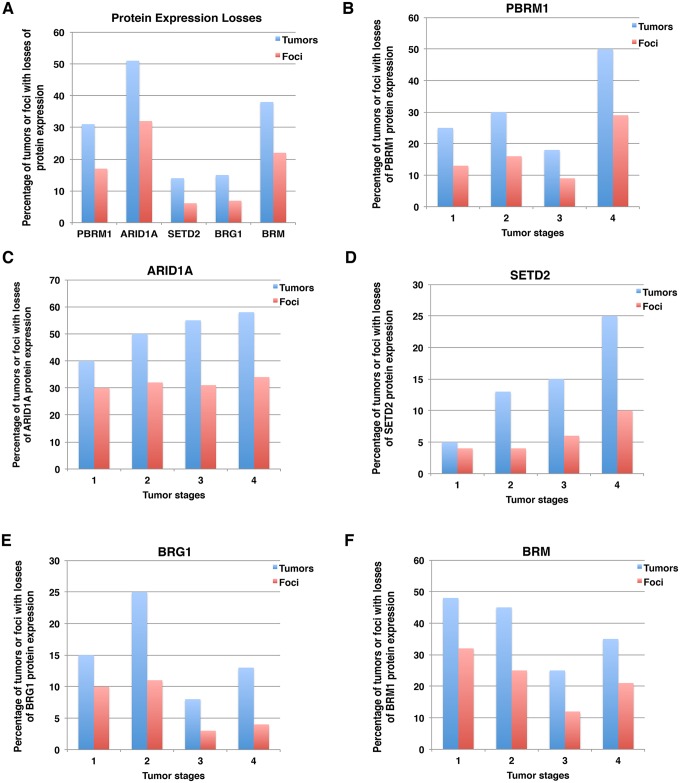
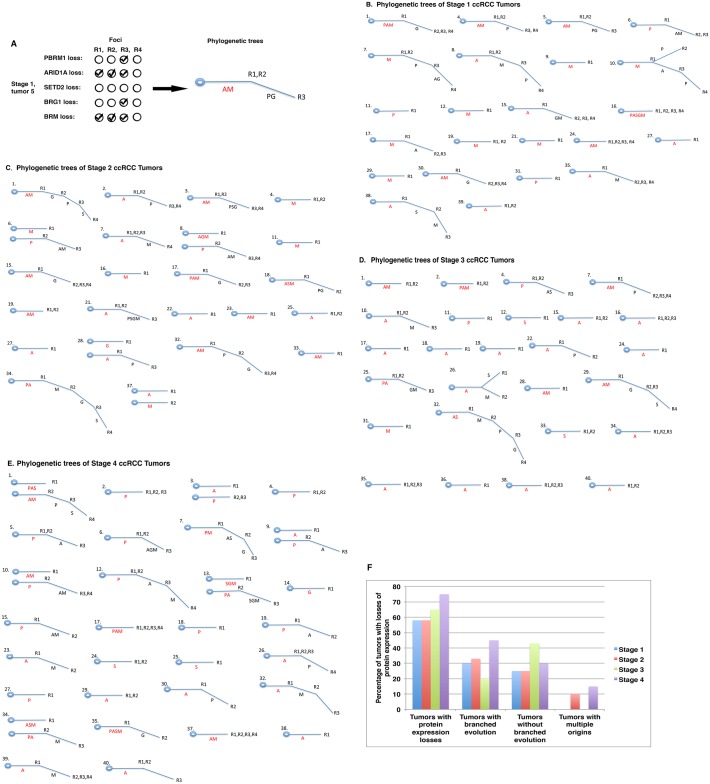
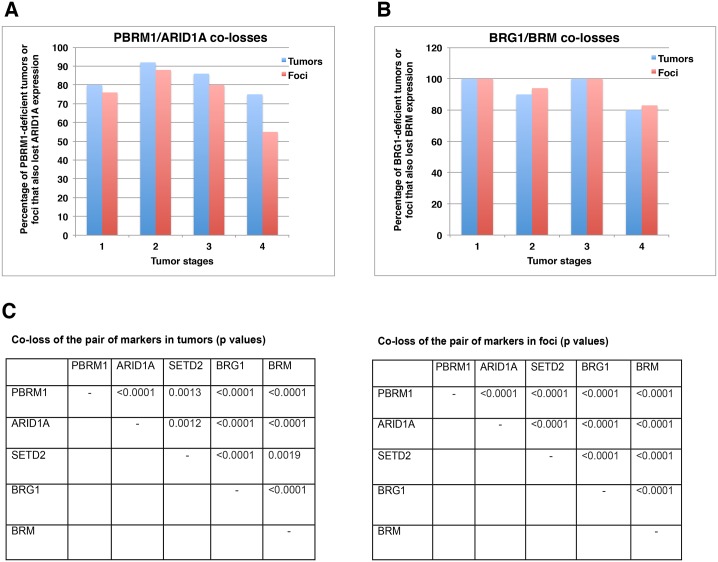
Recent studies have shown that intratumoral heterogeneity (ITH) is prevalent in clear cell renal cell carcinoma (ccRCC), based on DNA sequencing and chromosome aberration analysis of multiple regions from the same tumor. VHL mutations were found to be universal throughout individual tumors when it occurred (ubiquitous), while the mutations in other tumor suppressor genes tended to be detected only in parts of the tumors (subclonal). ITH has been studied mostly by DNA sequencing in limited numbers of samples, either by whole genome sequencing or by targeted sequencing. It is not known whether immunohistochemistry (IHC) can be used as a tool to study ITH. To address this question, we examined the protein expression of PBRM1, and PBRM1-related proteins such as ARID1A, SETD2, BRG1, and BRM. Altogether, 160 ccRCC (40 per stage) were used to generate a tissue microarray (TMA), with four foci from each tumor included. Loss of expression was defined as 0-5% of tumor cells with positive nuclear staining in an individual focus. We found that 49/160 (31%), 81/160 (51%), 23/160 (14%), 24/160 (15%), and 61/160 (38%) of ccRCC showed loss of expression of PBRM1, ARID1A, SETD2, BRG1, and BRM, respectively, and that IHC could successfully detect a high prevalence of ITH. Phylogenetic trees were constructed that reflected the ITH. Striking co-losses among proteins were also observed. For instance, ARID1A loss almost always accompanied PBRM1 loss, whereas BRM loss accompanied loss of BRG1, PBRM1 or ARID1A. SETD2 loss frequently occurred with loss of one or more of the other four proteins. Finally, in order to learn the impact of combined losses, we compared the tumor growth after cells acquired losses of ARID1A, PBRM1, or both in a xenograft model. The results suggest that ARID1A loss has a greater tumor-promoting effect than PBRM1 loss, indicating that xenograft analysis is a useful tool to investigate how these losses impact on tumor behavior, either alone or in combination.
最近的研究表明,基于对同一肿瘤多个区域的DNA测序和染色体畸变分析,肿瘤内异质性(ITH)在透明细胞肾细胞癌(ccRCC)中普遍存在。当VHL突变发生时,在单个肿瘤中普遍存在(无处不在),而其他肿瘤抑制基因中的突变往往仅在部分肿瘤中检测到(亚克隆)。ITH大多通过对有限数量样本进行DNA测序来研究,要么通过全基因组测序,要么通过靶向测序。尚不清楚免疫组织化学(IHC)是否可作为研究ITH的工具。为解决这个问题,我们检测了PBRM1以及与PBRM1相关的蛋白质如ARID1A、SETD2、BRG1和BRM的蛋白表达。总共使用160例ccRCC(每个分期40例)制作组织微阵列(TMA),每个肿瘤包含4个病灶。表达缺失定义为单个病灶中核染色阳性的肿瘤细胞占0 - 5%。我们发现,分别有49/160(31%)、81/160(51%)、23/160(14%)、24/160(15%)和61/160(38%)的ccRCC显示PBRM1、ARID1A、SETD2、BRG1和BRM表达缺失,并且免疫组织化学能够成功检测到ITH的高发生率。构建了反映ITH的系统发育树。还观察到蛋白质之间显著的共同缺失。例如,ARID1A缺失几乎总是伴随着PBRM1缺失,而BRM缺失伴随着BRG1、PBRM1或ARID1A的缺失。SETD2缺失经常与其他四种蛋白质中的一种或多种缺失同时发生。最后,为了解联合缺失的影响,我们在异种移植模型中比较了细胞获得ARID1A、PBRM1或两者缺失后的肿瘤生长情况。结果表明,ARID1A缺失比PBRM1缺失具有更大的促肿瘤作用,这表明异种移植分析是研究这些缺失如何单独或联合影响肿瘤行为的有用工具。