Singh Santosh K, Mishra Manoj K, Rivers Brian M, Gordetsky Jennifer B, Bae Sejong, Singh Rajesh
Department of Microbiology, Biochemistry and Immunology, Cancer Health Equity Institute, Morehouse School of Medicine, Atlanta, GA 30310, USA.
Department of Biological Sciences, Alabama State University, Montgomery, AL 36101, USA.
Cancers (Basel). 2020 Apr 5;12(4):883. doi: 10.3390/cancers12040883.
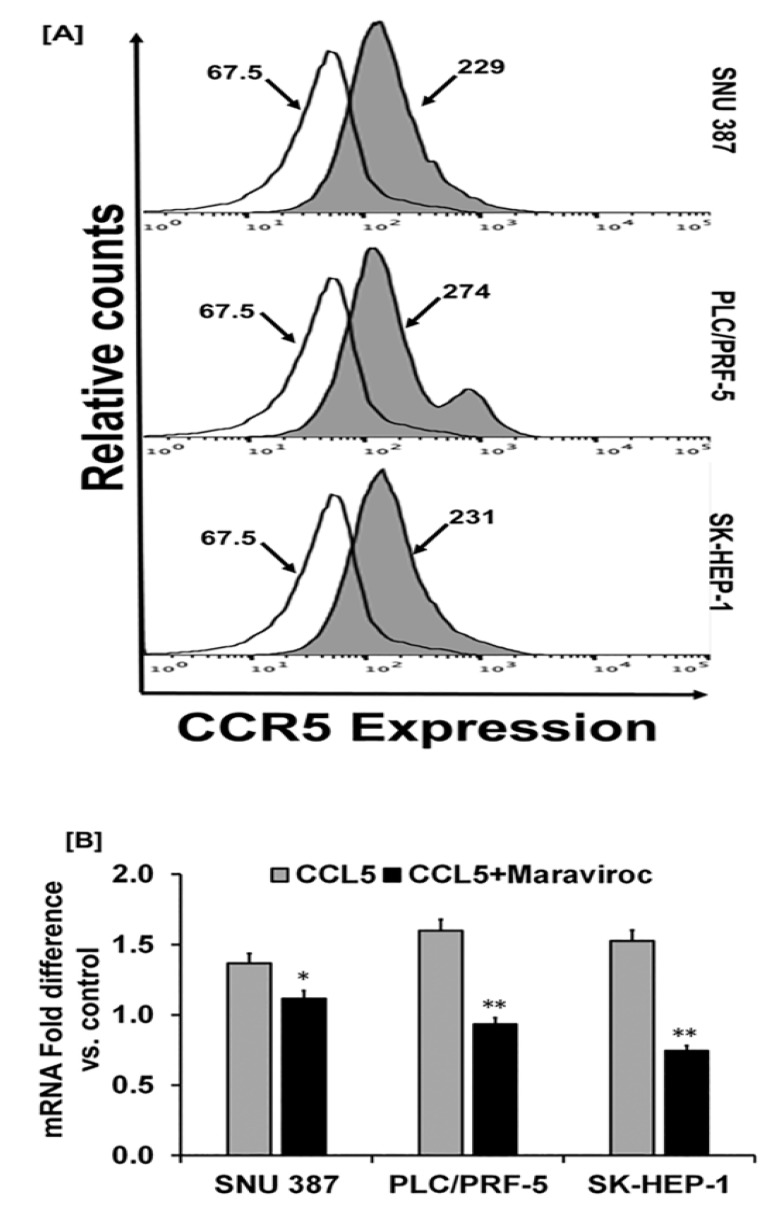
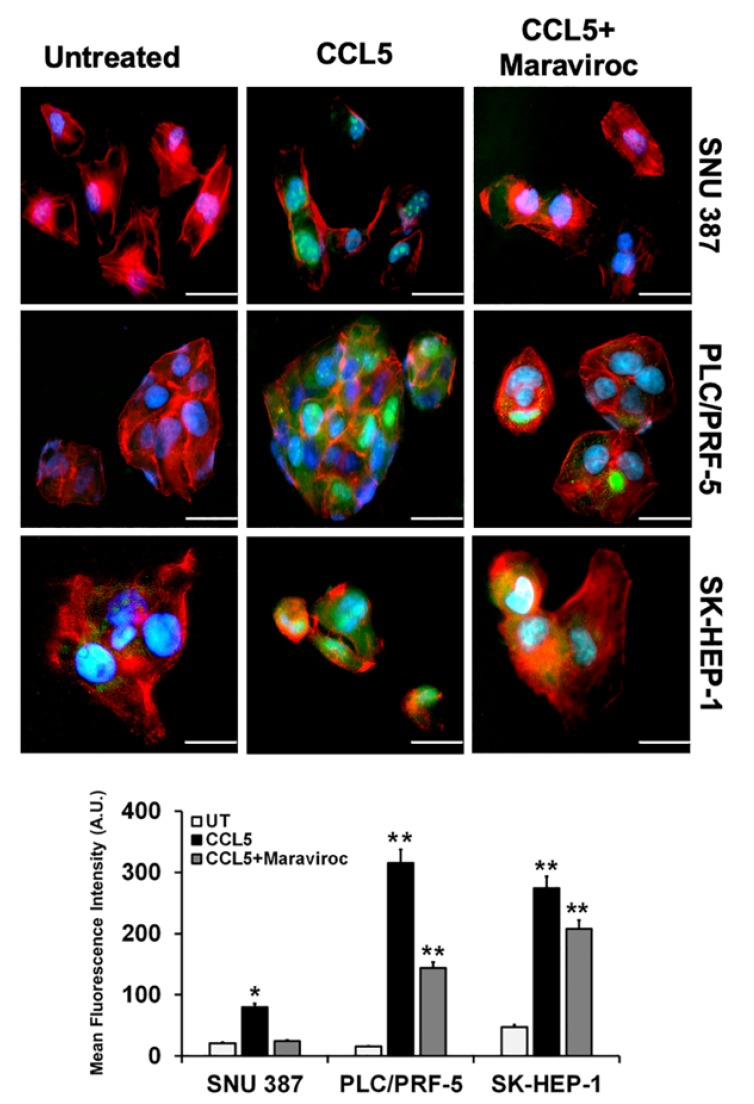
Despite the improvement in survival for patients with liver cancer (LCa) in recent decades, only one in five patients survive for 5 years after diagnosis. Thus, there is an urgent need to find new treatment options to improve patient survival. For various cancers, including LCa, the chemokine CCL5 (RANTES) facilitates tumor progression and metastasis. Since the function of the CCR5/CCL5 interaction in LCa cell proliferation and migration is poorly understood, the present study was undertaken to investigate the role of the CCR5/CCL5 axis in these processes. Flow cytometry, RT-PCR, Western blot, and immunofluorescence techniques were used to quantify the expression of CCR5 and CCL5 in LCa cells. To determine the biological significance of CCR5 expressed by LCa cell lines, a tissue microarray of LCas stained for CCR5 and CCL5 was analyzed. The results showed higher expression ( < 0.001) of CCR5 and CCL5 in hepatocellular carcinoma (HCC) tissues compared to non-neoplastic liver tissues. Furthermore, to delineate the role of the CCR5/CCL5 interaction in LCa cell proliferation and migration, various LCa cells were treated with maraviroc, a CCR5 antagonist, in the presence of CCL5. These data demonstrated the biological and clinical significance of the CCR5/CCL5 axis in LCa progression. The targeting of this axis is a promising avenue for the treatment of LCa.
尽管近几十年来肝癌(LCa)患者的生存率有所提高,但只有五分之一的患者在确诊后能存活5年。因此,迫切需要寻找新的治疗方案来提高患者生存率。对于包括LCa在内的各种癌症,趋化因子CCL5(调节激活正常T细胞表达和分泌因子)促进肿瘤进展和转移。由于CCR5/CCL5相互作用在LCa细胞增殖和迁移中的功能尚不清楚,本研究旨在探讨CCR5/CCL5轴在这些过程中的作用。采用流式细胞术、逆转录-聚合酶链反应(RT-PCR)、蛋白质免疫印迹法和免疫荧光技术定量LCa细胞中CCR5和CCL5的表达。为了确定LCa细胞系表达的CCR5的生物学意义,分析了用CCR5和CCL5染色的LCa组织微阵列。结果显示,与非肿瘤性肝组织相比,肝细胞癌(HCC)组织中CCR5和CCL5的表达更高(<0.001)。此外,为了阐明CCR5/CCL5相互作用在LCa细胞增殖和迁移中的作用,在存在CCL5的情况下,用CCR5拮抗剂马拉维若对各种LCa细胞进行处理。这些数据证明了CCR5/CCL5轴在LCa进展中的生物学和临床意义。靶向该轴是治疗LCa的一个有前景的途径。