Aldinucci Donatella, Borghese Cinzia, Casagrande Naike
Molecular Oncology Unit, Centro di Riferimento Oncologico di Aviano (CRO), IRCCS, PN, I-33081 Aviano, Italy.
Cancers (Basel). 2020 Jul 2;12(7):1765. doi: 10.3390/cancers12071765.
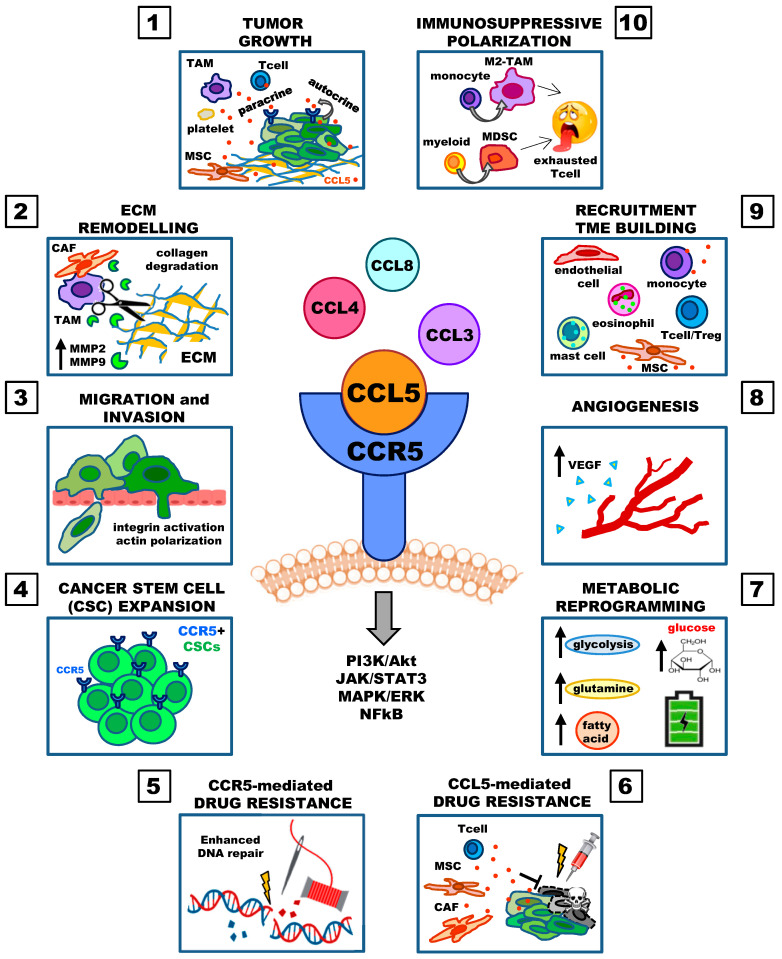
Tumor cells can "hijack" chemokine networks to support tumor progression. In this context, the C-C chemokine ligand 5/C-C chemokine receptor type 5 (CCL5/CCR5) axis is gaining increasing attention, since abnormal expression and activity of CCL5 and its receptor CCR5 have been found in hematological malignancies and solid tumors. Numerous preclinical in vitro and in vivo studies have shown a key role of the CCL5/CCR5 axis in cancer, and thus provided the rationale for clinical trials using the repurposed drug maraviroc, a CCR5 antagonist used to treat HIV/AIDS. This review summarizes current knowledge on the role of the CCL5/CCR5 axis in cancer. First, it describes the involvement of the CCL5/CCR5 axis in cancer progression, including autocrine and paracrine tumor growth, ECM (extracellular matrix) remodeling and migration, cancer stem cell expansion, DNA damage repair, metabolic reprogramming, and angiogenesis. Then, it focuses on individual hematological and solid tumors in which CCL5 and CCR5 have been studied preclinically. Finally, it discusses clinical trials of strategies to counteract the CCL5/CCR5 axis in different cancers using maraviroc or therapeutic monoclonal antibodies.
肿瘤细胞可以“劫持”趋化因子网络以支持肿瘤进展。在这种情况下,C-C趋化因子配体5/C-C趋化因子受体5(CCL5/CCR5)轴越来越受到关注,因为在血液系统恶性肿瘤和实体瘤中已发现CCL5及其受体CCR5存在异常表达和活性。大量临床前的体外和体内研究表明CCL5/CCR5轴在癌症中起关键作用,从而为使用已重新利用的药物马拉维若进行临床试验提供了理论依据,马拉维若为一种用于治疗HIV/AIDS的CCR5拮抗剂。本综述总结了目前关于CCL5/CCR5轴在癌症中作用的知识。首先,它描述了CCL5/CCR5轴在癌症进展中的参与情况,包括自分泌和旁分泌肿瘤生长、细胞外基质(ECM)重塑与迁移、癌症干细胞扩增、DNA损伤修复、代谢重编程和血管生成。然后,它聚焦于临床前已对CCL5和CCR5进行研究的各类血液系统恶性肿瘤和实体瘤。最后,它讨论了使用马拉维若或治疗性单克隆抗体对抗不同癌症中CCL5/CCR5轴的策略的临床试验。