Hierro-Bujalance Carmen, Infante-Garcia Carmen, Del Marco Angel, Herrera Marta, Carranza-Naval Maria Jose, Suarez Javier, Alves-Martinez Pilar, Lubian-Lopez Simon, Garcia-Alloza Monica
Division of Physiology, School of Medicine, Universidad de Cadiz, Plaza Fragela sn, 4 piso 410, Cadiz, Spain.
Instituto de Investigacion e Innovación en Ciencias Biomedicas de la Provincia de Cadiz (INIBICA), Cadiz, Spain.
Alzheimers Res Ther. 2020 Apr 7;12(1):40. doi: 10.1186/s13195-020-00607-4.
Both Alzheimer's disease (AD) and type 2 diabetes (T2D) share common pathological features including inflammation, insulin signaling alterations, or vascular damage. AD has no successful treatment, and the close relationship between both diseases supports the study of antidiabetic drugs to limit or slow down brain pathology in AD. Empagliflozin (EMP) is a sodium-glucose co-transporter 2 inhibitor, the newest class of antidiabetic agents. EMP controls hyperglycemia and reduces cardiovascular comorbidities and deaths associated to T2D. Therefore, we have analyzed the role of EMP at the central level in a complex mouse model of AD-T2D.
We have treated AD-T2D mice (APP/PS1xdb/db mice) with EMP 10 mg/kg for 22 weeks. Glucose, insulin, and body weight were monthly assessed. We analyzed learning and memory in the Morris water maze and the new object discrimination test. Postmortem brain assessment was conducted to measure brain atrophy, senile plaques, and amyloid-β levels. Tau phosphorylation, hemorrhage burden, and microglia were also measured in the brain after EMP treatment.
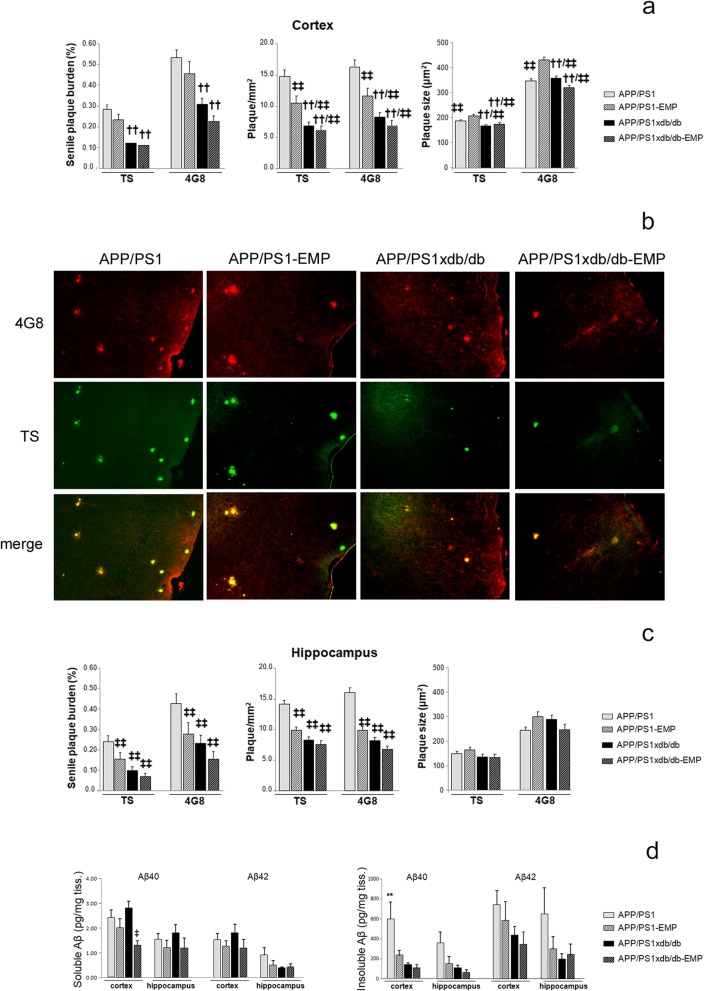
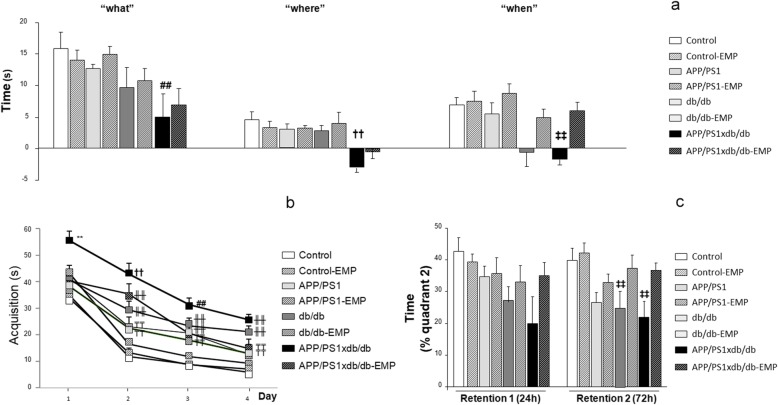
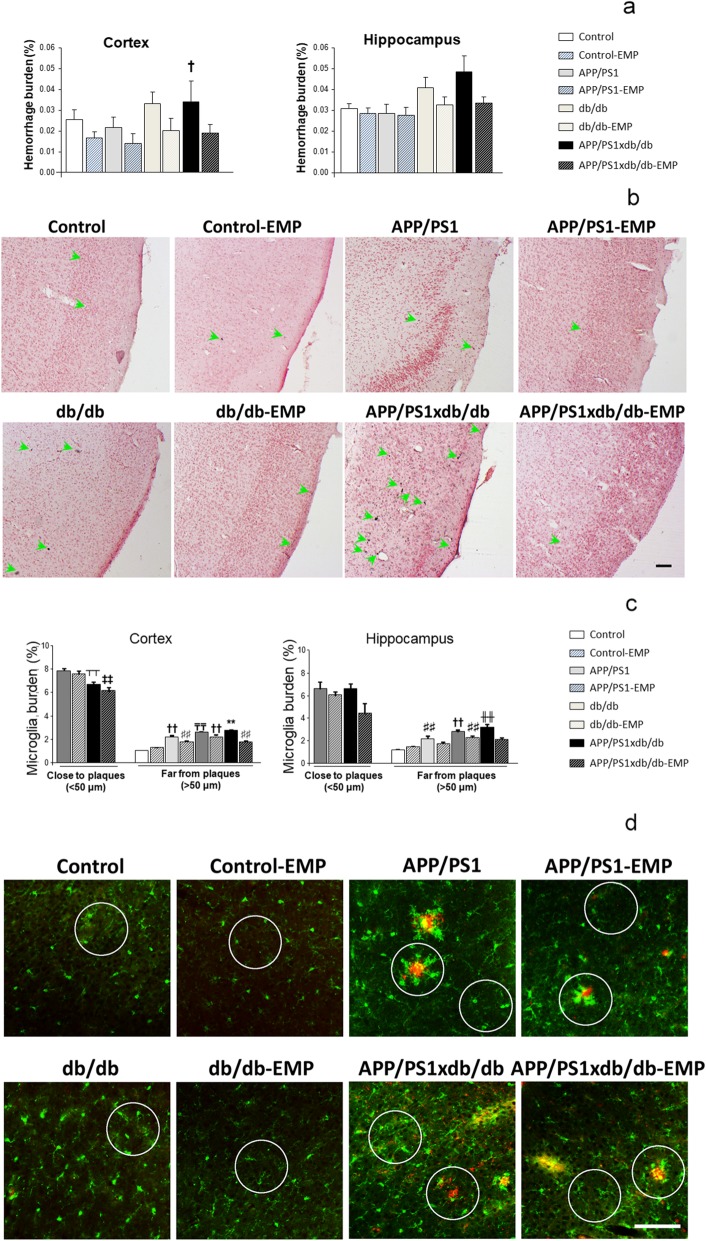
EMP treatment helped to maintain insulin levels in diabetic mice. At the central level, EMP limited cortical thinning and reduced neuronal loss in treated mice. Hemorrhage and microglia burdens were also reduced in EMP-treated mice. Senile plaque burden was lower, and these effects were accompanied by an amelioration of cognitive deficits in APP/PS1xdb/db mice.
Altogether, our data support a feasible role for EMP to reduce brain complications associated to AD and T2D, including classical pathological features and vascular disease, and supporting further assessment of EMP at the central level.
阿尔茨海默病(AD)和2型糖尿病(T2D)具有共同的病理特征,包括炎症、胰岛素信号改变或血管损伤。AD尚无成功的治疗方法,两种疾病之间的密切关系支持了对抗糖尿病药物的研究,以限制或减缓AD的脑病理变化。恩格列净(EMP)是一种钠-葡萄糖协同转运蛋白2抑制剂,是最新一类抗糖尿病药物。EMP可控制高血糖,并降低与T2D相关的心血管合并症和死亡率。因此,我们分析了EMP在AD-T2D复杂小鼠模型中枢水平的作用。
我们用10mg/kg的EMP治疗AD-T2D小鼠(APP/PS1xdb/db小鼠)22周。每月评估血糖、胰岛素和体重。我们在莫里斯水迷宫和新物体辨别试验中分析学习和记忆。进行死后脑评估以测量脑萎缩、老年斑和淀粉样β水平。在EMP治疗后,还测量了脑中的tau蛋白磷酸化、出血负担和小胶质细胞。
EMP治疗有助于维持糖尿病小鼠的胰岛素水平。在中枢水平,EMP限制了治疗小鼠的皮质变薄并减少了神经元损失。EMP治疗的小鼠出血和小胶质细胞负担也降低。老年斑负担较低,这些作用伴随着APP/PS1xdb/db小鼠认知缺陷的改善。
总之,我们的数据支持EMP在减少与AD和T2D相关的脑并发症方面的可行作用,包括经典病理特征和血管疾病,并支持在中枢水平对EMP进行进一步评估。