Carranza-Naval Maria Jose, Del Marco Angel, Hierro-Bujalance Carmen, Alves-Martinez Pilar, Infante-Garcia Carmen, Vargas-Soria Maria, Herrera Marta, Barba-Cordoba Belen, Atienza-Navarro Isabel, Lubian-Lopez Simon, Garcia-Alloza Monica
Division of Physiology, School of Medicine, Universidad de Cádiz, Cádiz, Spain.
Instituto de Investigacion e Innovacion en Ciencias Biomedicas de la Provincia de Cádiz (INIBICA), Cádiz, Spain.
Front Aging Neurosci. 2021 Dec 16;13:741923. doi: 10.3389/fnagi.2021.741923. eCollection 2021.
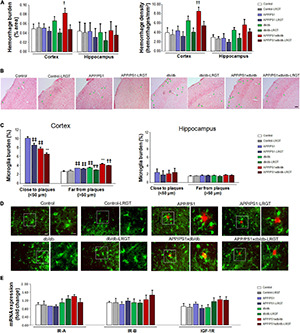
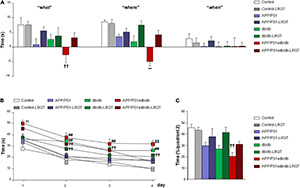
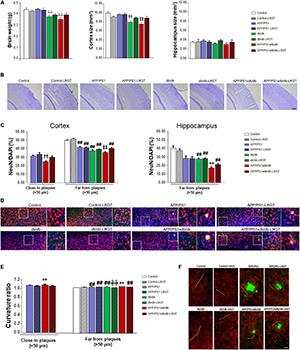
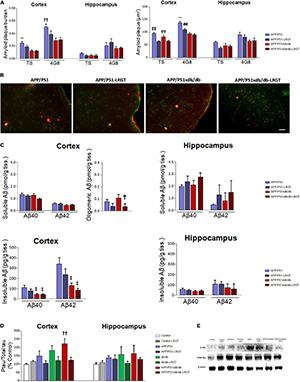
Alzheimer's disease is the most common form of dementia, and epidemiological studies support that type 2 diabetes (T2D) is a major contributor. The relationship between both diseases and the fact that Alzheimer's disease (AD) does not have a successful treatment support the study on antidiabetic drugs limiting or slowing down brain complications in AD. Among these, liraglutide (LRGT), a glucagon-like peptide-1 agonist, is currently being tested in patients with AD in the Evaluating Liraglutide in Alzheimer's Disease (ELAD) clinical trial. However, the effects of LRGT on brain pathology when AD and T2D coexist have not been assessed. We have administered LRGT (500 μg/kg/day) to a mixed murine model of AD and T2D (APP/PS1xdb/db mice) for 20 weeks. We have evaluated metabolic parameters as well as the effects of LRGT on learning and memory. analysis included assessment of brain amyloid-β and tau pathologies, microglia activation, spontaneous bleeding and neuronal loss, as well as insulin and insulin-like growth factor 1 receptors. LRGT treatment reduced glucose levels in diabetic mice (db/db and APP/PS1xdb/db) after 4 weeks of treatment. LRGT also helped to maintain insulin levels after 8 weeks of treatment. While we did not detect any effects on cortical insulin or insulin-like growth factor 1 receptor m-RNA levels, LRGT significantly reduced brain atrophy in the db/db and APP/PS1xdb/db mice. LRGT treatment also rescued neuron density in the APP/PS1xdb/db mice in the proximity ( = 0.008) far from amyloid plaques ( < 0.001). LRGT reduced amyloid plaque burden in the APP/PS1 animals ( < 0.001), as well as Aβ aggregates levels ( = 0.046), and tau hyperphosphorylation ( = 0.009) in the APP/PS1xdb/db mice. Spontaneous bleeding was also ameliorated in the APP/PS1xdb/db animals ( = 0.012), and microglia burden was reduced in the proximity of amyloid plaques in the APP/PS1 and APP/PS1xdb/db mice ( < 0.001), while microglia was reduced in areas far from amyloid plaques in the db/db and APP/PS1xdb/db mice ( < 0.001). This overall improvement helped to rescue cognitive impairment in AD-T2D mice in the new object discrimination test ( < 0.001) and Morris water maze ( < 0.001). Altogether, our data support the role of LRGT in reduction of associated brain complications when T2D and AD occur simultaneously, as regularly observed in the clinical arena.
阿尔茨海默病是最常见的痴呆形式,流行病学研究表明2型糖尿病(T2D)是一个主要促成因素。这两种疾病之间的关系以及阿尔茨海默病(AD)尚无成功治疗方法这一事实,支持了对抗糖尿病药物限制或减缓AD脑并发症的研究。其中,胰高血糖素样肽-1激动剂利拉鲁肽(LRGT)目前正在“评估利拉鲁肽治疗阿尔茨海默病(ELAD)”临床试验中对AD患者进行测试。然而,尚未评估LRGT在AD和T2D共存时对脑病理的影响。我们对AD和T2D的混合小鼠模型(APP/PS1xdb/db小鼠)给予LRGT(500μg/kg/天),持续20周。我们评估了代谢参数以及LRGT对学习和记忆的影响。分析包括评估脑淀粉样β蛋白和tau蛋白病理、小胶质细胞激活、自发性出血和神经元丢失,以及胰岛素和胰岛素样生长因子1受体。治疗4周后,LRGT治疗降低了糖尿病小鼠(db/db和APP/PS1xdb/db)的血糖水平。治疗8周后,LRGT还有助于维持胰岛素水平。虽然我们未检测到对皮质胰岛素或胰岛素样生长因子1受体mRNA水平有任何影响,但LRGT显著减轻了db/db和APP/PS1xdb/db小鼠的脑萎缩。LRGT治疗还挽救了APP/PS1xdb/db小鼠靠近淀粉样斑块处(P = 0.008)和远离淀粉样斑块处(P < 0.001)的神经元密度。LRGT降低了APP/PS1动物的淀粉样斑块负荷(P < 0.001),以及APP/PS1xdb/db小鼠的Aβ聚集体水平(P = 0.046)和tau蛋白过度磷酸化(P = 0.009)。APP/PS1xdb/db动物的自发性出血也得到改善(P = 0.012),APP/PS1和APP/PS1xdb/db小鼠淀粉样斑块附近的小胶质细胞负荷降低(P < 0.001),而db/db和APP/PS1xdb/db小鼠远离淀粉样斑块区域的小胶质细胞减少(P < 0.001)。这种整体改善有助于挽救AD-T2D小鼠在新物体辨别试验(P < 0.001)和莫里斯水迷宫试验(P < 0.001)中的认知障碍。总之,我们的数据支持LRGT在T2D和AD同时发生时减少相关脑并发症的作用,这在临床领域经常观察到。