Husna Ibrahim Nurul, Yahaya Mohamad Fairuz, Mohamed Wael, Teoh Seong Lin, Hui Chua Kien, Kumar Jaya
Department of Physiology, Faculty of Medicine, Universiti Kebangsaan Malaysia Medical Centre, Kuala Lumpur, Malaysia.
Department of Anatomy, Faculty of Medicine, Universiti Kebangsaan Malaysia Medical Centre, Kuala Lumpur, Malaysia.
Front Pharmacol. 2020 Mar 24;11:261. doi: 10.3389/fphar.2020.00261. eCollection 2020.
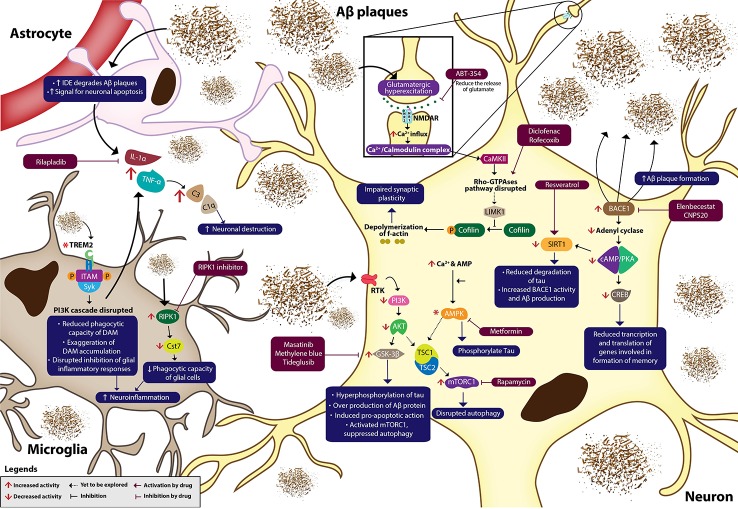
Alzheimer's disease (AD) is recognized as a major health hazard that mostly affects people older than 60 years. AD is one of the biggest medical, economic, and social concerns to patients and their caregivers. AD was ranked as the 5 leading cause of global deaths in 2016 by the World Health Organization (WHO). Many drugs targeting the production, aggregation, and clearance of Aβ plaques failed to give any conclusive clinical outcomes. This mainly stems from the fact that AD is not a disease attributed to a single-gene mutation. Two hallmarks of AD, Aβ plaques and neurofibrillary tangles (NFTs), can simultaneously induce other AD etiologies where every pathway is a loop of consequential events. Therefore, the focus of recent AD research has shifted to exploring other etiologies, such as neuroinflammation and central hyperexcitability. Neuroinflammation results from the hyperactivation of microglia and astrocytes that release pro-inflammatory cytokines due to the neurological insults caused by Aβ plaques and NFTs, eventually leading to synaptic dysfunction and neuronal death. This review will report the failures and side effects of many anti-Aβ drugs. In addition, emerging treatments targeting neuroinflammation in AD, such as nonsteroidal anti-inflammatory drugs (NSAIDs) and receptor-interacting serine/threonine protein kinase 1 (RIPK1), that restore calcium dyshomeostasis and microglia physiological function in clearing Aβ plaques, respectively, will be deliberately discussed. Other novel pharmacotherapy strategies in treating AD, including disease-modifying agents (DMTs), repurposing of medications used to treat non-AD illnesses, and multi target-directed ligands (MTDLs) are also reviewed. These approaches open new doors to the development of AD therapy, especially combination therapy that can cater for several targets simultaneously, hence effectively slowing or stopping AD.
阿尔茨海默病(AD)被认为是一种主要危害健康的疾病,主要影响60岁以上的人群。AD是患者及其护理人员面临的最大医学、经济和社会问题之一。2016年,AD被世界卫生组织(WHO)列为全球第五大死因。许多针对β淀粉样蛋白(Aβ)斑块产生、聚集和清除的药物未能取得任何确凿的临床疗效。这主要是因为AD并非由单一基因突变引起的疾病。AD的两个标志,即Aβ斑块和神经原纤维缠结(NFTs),可同时引发其他AD病因,其中每条通路都是一系列相关事件的循环。因此,近期AD研究的重点已转向探索其他病因,如神经炎症和中枢性过度兴奋。神经炎症是由小胶质细胞和星形胶质细胞的过度激活引起的,由于Aβ斑块和NFTs造成的神经损伤,它们会释放促炎细胞因子,最终导致突触功能障碍和神经元死亡。本综述将报告许多抗Aβ药物的失败情况和副作用。此外,还将专门讨论针对AD神经炎症的新兴治疗方法,如非甾体抗炎药(NSAIDs)和受体相互作用丝氨酸/苏氨酸蛋白激酶1(RIPK1),它们分别可恢复钙稳态失调和小胶质细胞清除Aβ斑块的生理功能。还综述了治疗AD的其他新型药物治疗策略,包括疾病修饰药物(DMTs)、用于治疗非AD疾病药物的重新利用以及多靶点导向配体(MTDLs)。这些方法为AD治疗的发展打开了新的大门,尤其是联合治疗,它可以同时针对多个靶点,从而有效地减缓或阻止AD。