Unit of Pediatrics, Department of Human Pathology of Adulthood and Childhood, University of Messina, Messina, Italy.
Front Endocrinol (Lausanne). 2020 Mar 24;11:147. doi: 10.3389/fendo.2020.00147. eCollection 2020.
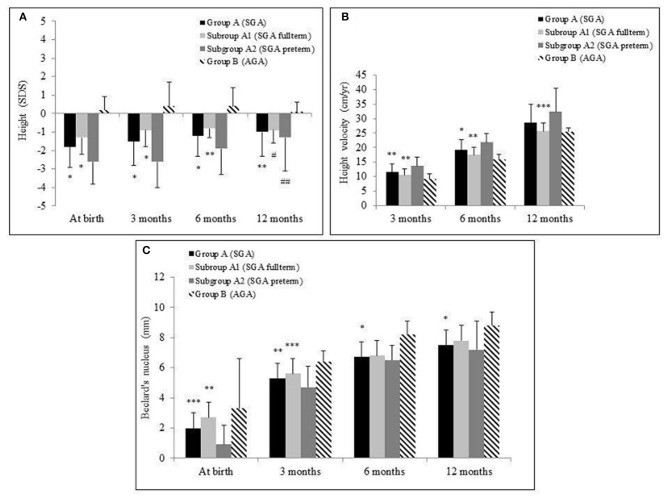
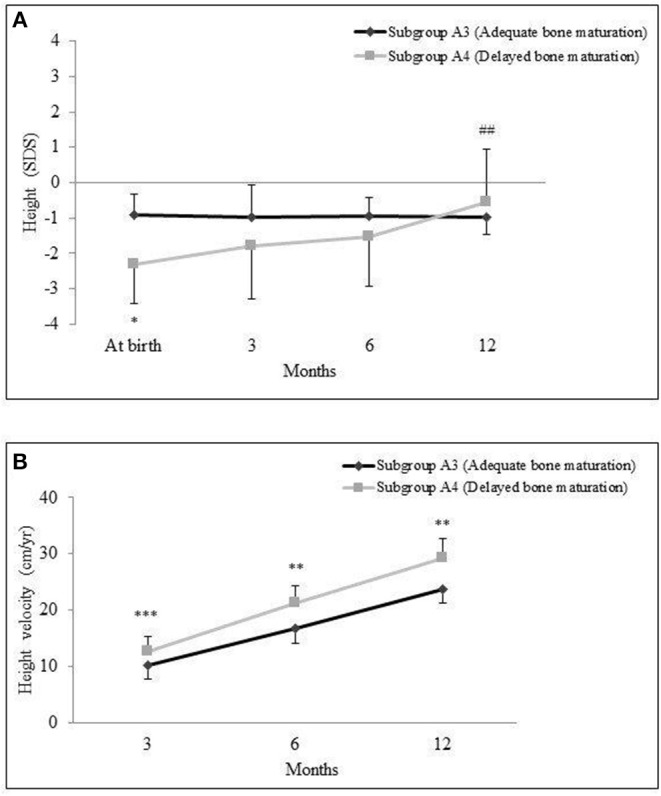
About 85-90% of children born small for gestational age (SGA) experience a catch-up growth that occurs mostly during the first year of life and results in a full stature recovery by the age of 2. To investigate the relation between bone maturation (BM) and catch-up growth during the first year of life in SGA infants. Newborns whose weight and/or length was <-2 SD for gestational age were classified as SGA (group A). The study included a group of 32 SGA, 21 of which are full term [37-41 gestation weeks (GW), subgroup A1] and 11 preterm (30-36 GW, subgroup A2). Control group (B) consisted of 19 full-term and adequate-for-gestational-age (AGA) newborns. All the participants were born in the same hospital and period (January-December 2017). Chromosomal disorders, congenital defects, and maternal chronic diseases were criteria of exclusion. The study population underwent longitudinal evaluation of growth parameters and BM at 0, 3, 6, and 12 months. Assessment of BM was performed by an ultrasonographic (US) study of Béclard's nucleus (NB) (<3 mm at birth, meaning intrauterine delay of BM). Significantly higher height velocity (HV) was observed in subgroup A2 vs. A1 (32.4 ± 8.0 vs. 25.6 ± 2.9 cm, = 0.01); nevertheless, more subjects in subgroup A2 had height <-2 SD at year 1 than had subgroup A1 (27.3 vs. 0%, = 0.01). Intrauterine delay of BM was more common in group A vs. B (59.4 vs. 21.2%, = 0.0078) and in subgroup A2 vs. A1 (90.9 vs. 42.9%, = 0.0086). In group A, HV over the first year of life negatively correlates with NB diameter assessed at birth ( = -0.6, < 0.001) but positively correlates with NB growth ( = 0.52, < 0.01). Moreover, SGA babies with intrauterine delay of BM showed higher HV and better height gain at 12 months' evaluation than did SGA with adequate BM (29.75 ± 3.1 vs. 23.8 ± 2.7 cm, = 0.003). Neonatal BM should be regarded as a predictive factor of SGA height gain during the first year of life. US evaluation of NB is a useful noninvasive technique to identify intrauterine delay of BM, which positively correlates with early postnatal catch-up growth of SGA infants.
大约 85-90%出生体重小于胎龄儿(SGA)的儿童会经历追赶性生长,这种生长主要发生在生命的第一年,并导致其在 2 岁时身高完全恢复。为了研究 SGA 婴儿在生命第一年中骨成熟(BM)与追赶性生长之间的关系。将体重和/或长度低于胎龄的 -2SD 的新生儿归类为 SGA(A 组)。该研究包括 32 名 SGA 婴儿,其中 21 名足月(37-41 孕周,A1 亚组),11 名早产(30-36 孕周,A2 亚组)。对照组(B)由 19 名足月且适于胎龄的(AGA)新生儿组成。所有参与者均在同一家医院和同一时期(2017 年 1 月至 12 月)出生。染色体异常、先天性缺陷和母亲慢性疾病是排除标准。研究人群在 0、3、6 和 12 个月时进行生长参数和 BM 的纵向评估。通过对 Beclard 核(NB)(出生时<3mm,即 BM 宫内延迟)的超声(US)研究来评估 BM。A2 亚组的身高增长速度(HV)明显高于 A1 亚组(32.4±8.0 与 25.6±2.9cm,=0.01);然而,A2 亚组中有更多的儿童在第 1 年身高低于 -2SD,而非 A1 亚组(27.3%与 0%,=0.01)。A 组的 BM 宫内延迟发生率高于 B 组(59.4%与 21.2%,=0.0078)和 A2 亚组高于 A1 亚组(90.9%与 42.9%,=0.0086)。在 A 组中,出生时 NB 直径与生命第一年的 HV 呈负相关(=-0.6,<0.001),但与 NB 生长呈正相关(=0.52,<0.01)。此外,NB 宫内延迟的 SGA 婴儿在 12 个月时的 HV 和身高增益均高于 BM 正常的 SGA 婴儿(29.75±3.1 与 23.8±2.7cm,=0.003)。新生儿期 BM 应被视为 SGA 儿童在生命第一年中身高增长的预测因素。NB 的 US 评估是一种有用的非侵入性技术,可识别 BM 宫内延迟,其与 SGA 婴儿出生后的早期追赶性生长呈正相关。