Kitamura Gene, Albers Marcio Bottene Villa, Lesniak Bryson P, Rabuck Stephen Joseph, Musahl Volker, Andrews Carol L, Ghodadra Anish, Fu Freddie
Department of Radiology, University of Pittsburgh Medical Center (UPMC), Pittsburgh, Pennsylvania, U.S.A.
University of Pittsburgh, School of Medicine, Pittsburgh, Pennsylvania, U.S.A.
Arthrosc Sports Med Rehabil. 2019 Sep 26;1(1):e41-e46. doi: 10.1016/j.asmr.2019.06.004. eCollection 2019 Nov.
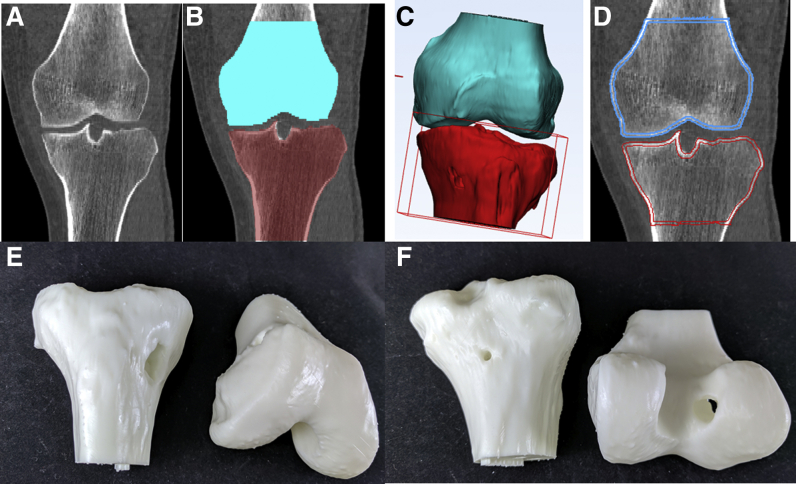
To determine whether using 3-dimensional (3D)-printed models in addition to computed tomography (CT) scans to evaluate the primary femoral and tibial tunnels before revision anterior cruciate ligament (ACL) reconstruction leads to better agreement with the surgical approach than CT alone.
Fifteen patients who underwent revision ACL reconstruction were retrospectively identified. The mean age was 24.3 years, and 73% were female. Using only CT images, 3 board-certified orthopaedists and 5 sports medicine orthopaedic fellows evaluated whether the existing tibial and femoral tunnels were acceptable for the revision surgery. Subsequently, 3D-printed models were made available in addition to the CT scan, and the same questions were asked.
For the attending orthopaedic physicians, adding the 3D-printed models did not have a significant impact on the tibial or femoral tunnel agreement compared with the surgical approach. With the fellow physicians, however, using the 3D-printed models with tibial tunnel evaluation led to a higher agreement rate (76%) compared with CT images alone (63%) ( = .050). Furthermore, with the fellow physicians, there was a higher overall agreement when evaluating both the tibial and femoral tunnels with the addition of 3D-printed models (74%) compared with CT alone (65%) ( = .049).
Our hypothesis that using 3D-printed models leads to better agreement with the surgical approach was unsupported based on the response of the board-certified orthopaedists. Based on the fellow response, it stands to reason that 3D-printed models may be a useful tool in understanding spatial orientation when planning for revision ACL surgery.
IV, retrospective case series.
确定在翻修前交叉韧带(ACL)重建术前,除了使用计算机断层扫描(CT)扫描外,使用三维(3D)打印模型评估股骨和胫骨隧道是否比单独使用CT能更好地与手术入路达成一致。
回顾性纳入15例行翻修ACL重建术的患者。平均年龄24.3岁,73%为女性。仅使用CT图像,3名获得委员会认证的骨科医生和5名运动医学骨科住院医师评估现有的胫骨和股骨隧道是否适合翻修手术。随后,除了CT扫描外还提供3D打印模型,并询问相同的问题。
对于主治骨科医生而言,与手术入路相比,添加3D打印模型对胫骨或股骨隧道一致性没有显著影响。然而,对于住院医师,在评估胫骨隧道时使用3D打印模型与单独使用CT图像相比,一致性率更高(76%比63%,P = 0.050)。此外,对于住院医师,在评估胫骨和股骨隧道时添加3D打印模型的总体一致性更高(74%),高于单独使用CT(65%)(P = 0.049)。
基于获得委员会认证的骨科医生的反馈,我们关于使用3D打印模型能更好地与手术入路达成一致的假设未得到支持。基于住院医师的反馈,有理由认为3D打印模型在计划翻修ACL手术时可能是理解空间方向的有用工具。
IV,回顾性病例系列。