Matos Ana Lígia Soares, Moreira Jessica Pronestino de Lima, Luiz Ronir Raggio, Silva Evelise Pochmann da, Rodacki Melanie, Gómez Juan Fidel Bencomo, Zajdenverg Lenita
Maternidade Escola, Universidade Federal do Rio de Janeiro, Rio de Janeiro, RJ, Brasil.
Instituto de Estudos de Saúde Coletiva, Universidade Federal do Rio de Janeiro, Rio de Janeiro, RJ, Brasil.
Arch Endocrinol Metab. 2020 Aug;64(4):454-461. doi: 10.20945/2359-3997000000229. Epub 2020 Apr 6.
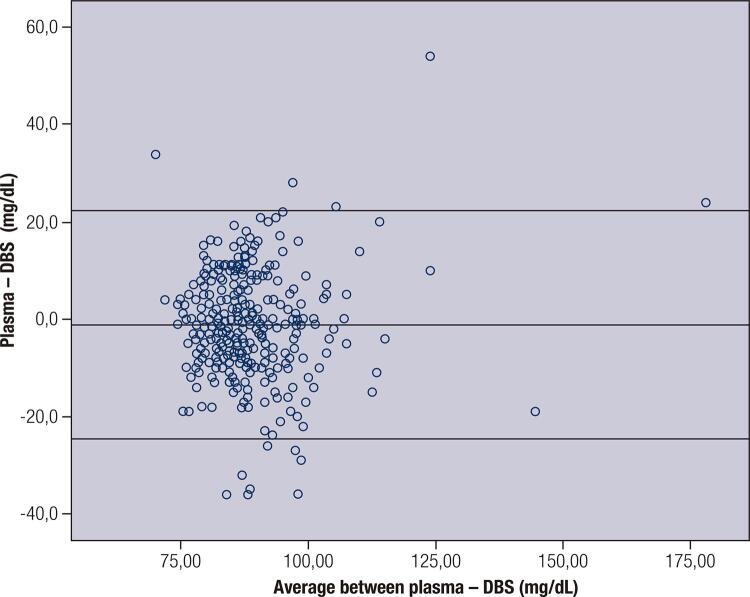
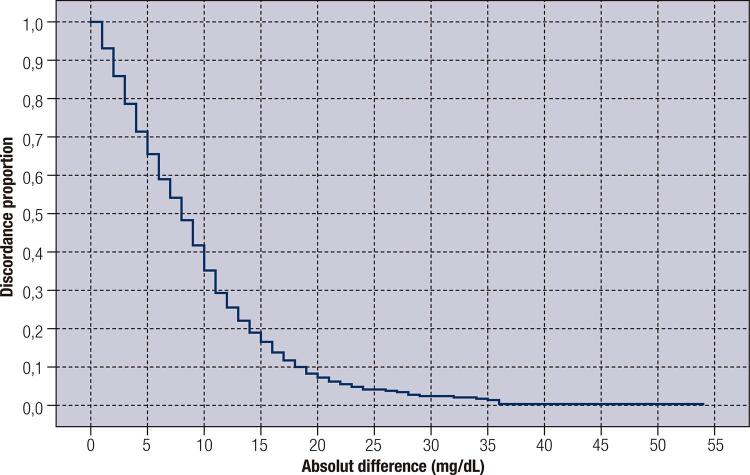
Objective Compare the concordance degree between plasma glucose and glucose measurements on Dried Blood Spots (DBS) during pregnancy. Subjects and methods Glucose measurement was performed in pregnant women after a fast of 8-12 hours. Venous blood was collected with sodium fluoride, the plasma was separated, and glucose measured by the enzymatic oxidase glucose method. Capillary blood samples were collected and analyzed by DBS. For statistics, the paired Student's t test, interclass correlation coefficient (ICC), graphic approach of Altman and Bland, and survival - concordance plot were used. Results 307 pregnant women were evaluated, 88.6% without diabetes and 11.4% with previous diabetes. The glucose ranged from 66 to 190 mg/dL [3.66 to 10.55 mmol/L] in plasma and from 53 to 166 mg/dL [2.94 to 9.21 mmol/L] in DBS. The glucose average values were 88.1 ± 12 mg/dL [4.98 ± 0.67 mmol/L] in plasma and 89.2 ±11,5 mg/dL, [4.95 ± 0.64 mmol/L] in DBS - p-value = 0.084. The ICC value was moderate (0.510), and Pearson's correlation coefficient was r = 0.507 p < 0.001. Altman and Bland's graph showed that difference between the values obtained by both methods is -24.62 to 22.3 mg/dL [-1.37 to 1.24 mmol/L]. Significant fixed bias (-1,16 average difference) and proportional bias (r = 0.056; p = 0.33) were not observed. Anemia was associated with differences between plasma glucose and DBS measurements (p = 0.031). Conclusion Capillary glucose in DBS correlates with plasma glucose; however, the methods do not present good concordance. The presence of anemia worsens this result.
目的 比较孕期血浆葡萄糖与干血斑(DBS)葡萄糖测量值之间的一致性程度。对象与方法 对禁食8 - 12小时后的孕妇进行葡萄糖测量。采集含氟化钠的静脉血,分离血浆,采用酶氧化酶法测量葡萄糖。采集毛细血管血样并通过DBS进行分析。统计学分析采用配对t检验、组内相关系数(ICC)、Altman和Bland绘图法以及生存一致性图。结果 共评估307名孕妇,88.6%无糖尿病,11.4%既往有糖尿病。血浆葡萄糖范围为66至190mg/dL[3.66至10.55mmol/L],DBS葡萄糖范围为53至166mg/dL[2.94至9.21mmol/L]。血浆葡萄糖平均值为88.1±12mg/dL[4.98±0.67mmol/L],DBS葡萄糖平均值为89.2±11.5mg/dL,[4.95±0.64mmol/L] - p值 = 0.084。ICC值为中等(0.510),Pearson相关系数为r = 0.507,p < 0.001。Altman和Bland图显示两种方法所得值之间的差异为 - 24.62至22.3mg/dL[-1.37至1.24mmol/L]。未观察到显著的固定偏差(平均差异 - 1.16)和比例偏差(r = 0.056;p = 0.33)。贫血与血浆葡萄糖和DBS测量值之间的差异相关(p = 0.031)。结论 DBS中的毛细血管葡萄糖与血浆葡萄糖相关;然而,两种方法的一致性不佳。贫血的存在使结果更差。