From the Heidelberg Institute of Global Health, Heidelberg University, Heidelberg, Germany.
Leonard Davis School of Gerontology, Department of Sociology, University of Southern California, Los Angeles, California.
Epidemiology. 2020 May;31(3):393-401. doi: 10.1097/EDE.0000000000001172.
Evidence on rural-urban differences in adult mortality in low- and middle-income countries (LMICs) is limited and mixed. We examined the size of and factors contributing to rural-urban life expectancy differences among adults in Indonesia, the third most populous LMIC.
Data come from the 2000, 2007, and 2014/2015 waves of the Indonesian Family Life Survey, a population-representative longitudinal study with mortality follow-up. We used Poisson regression and life tables to estimate rural-urban differences in life expectancy among 18,867 adult respondents ≥30 years. We then used a novel g-formula-based decomposition to quantify the contribution of rural-urban differences in blood pressure (BP), body mass index (BMI), and smoking to life expectancy differences.
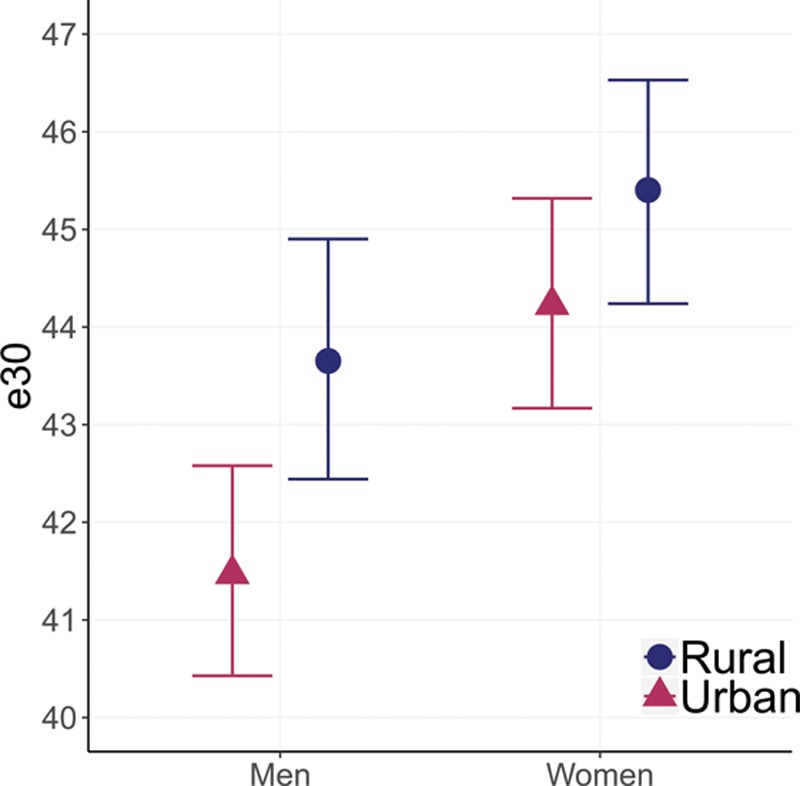
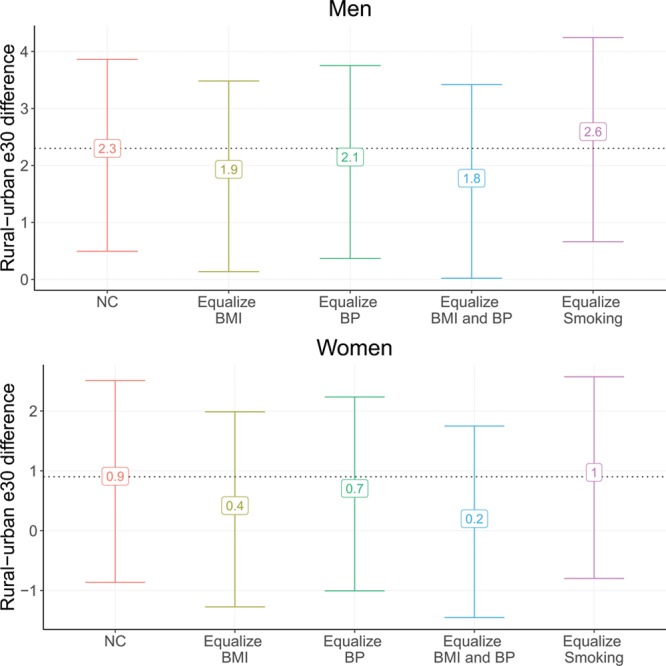
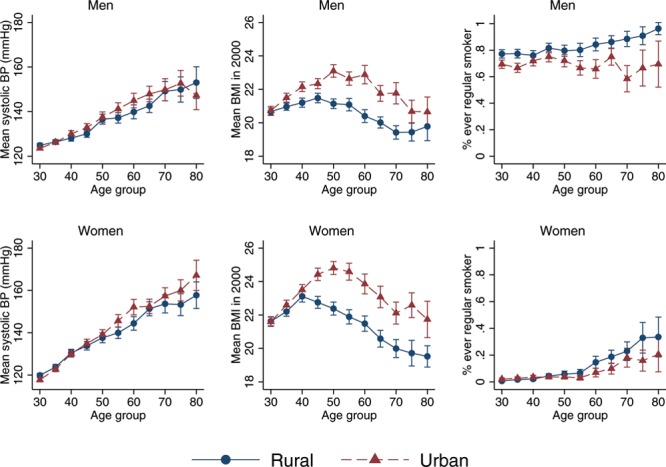
Compared with urban adults, life expectancy at age 30 was 2.2 (95% confidence interval [CI] = 0.4, 3.9) years higher for rural men and 1.2 (95% CI = -0.4, 2.7) years higher for rural women. Setting the BMI and systolic BP distribution equal in urban and rural adults reduced the urban mortality penalty by 22% for men and 78% for women, with the majority of this reduction coming from the contribution of rural-urban differences in BMI. Smoking did not contribute to the urban mortality penalty for either men or women.
Adult life expectancy is lower in urban than in rural areas in Indonesia and we estimate that this difference is partly related to differences in BMI and systolic BP.
关于中低收入国家(LMICs)成年人死亡率的城乡差异的证据有限且混杂。我们研究了印度尼西亚(人口第三大国,属于 LMICs)成年人的城乡预期寿命差异的大小及其影响因素。
数据来自于 2000 年、2007 年和 2014/2015 年的印度尼西亚家庭生活调查(一项具有死亡率随访的代表性纵向研究)的三个波次。我们使用泊松回归和生命表来估计在 18867 名 30 岁以上成年受访者中城乡预期寿命的差异。然后,我们使用一种新的基于 g 公式的分解方法来量化血压(BP)、体重指数(BMI)和吸烟导致的城乡差异对预期寿命差异的贡献。
与城市成年人相比,农村男性在 30 岁时的预期寿命高 2.2 岁(95%置信区间[CI] = 0.4,3.9),农村女性高 1.2 岁(95% CI = -0.4,2.7)。假设城市和农村成年人的 BMI 和收缩压分布相等,男性的城市死亡率惩罚降低了 22%,女性降低了 78%,其中大部分归因于 BMI 的城乡差异。对于男性和女性,吸烟都没有导致城市死亡率惩罚。
印度尼西亚城市地区成年人的预期寿命低于农村地区,我们估计这种差异部分与 BMI 和收缩压差异有关。