The Neuromodulation Foundation, Inc., Baltimore, MD, USA.
International Spine, Pain & Performance Center and George Washington University Medical Center, Washington, DC, USA.
Neuromodulation. 2020 Jul;23(5):620-625. doi: 10.1111/ner.13141. Epub 2020 Apr 8.
In the PROMISE study, a multinational randomized controlled trial (RCT) of the effectiveness of spinal cord stimulation (SCS) with multicolumn surgical leads as a treatment of low back pain, clinicians followed their usual practice. An early, unplanned safety analysis revealed that the infection rate in Belgium (5/23), where trial duration was a median 21.5 days, was significantly higher than the 1/64 rate observed in the other study countries (median 5.8 days, p < 0.01). This report reviews infections observed in the PROMISE study after study completion.
For all infections related to SCS, we used descriptive statistics and tests of independent variables to analyze potentially contributing factors (age, sex, coexisting medical conditions, tobacco use, lead type, and trial duration) between subjects with infections versus those without. Cumulative incidence curves were created using the Kaplan-Meier method and compared between the two strata using a log-rank test.
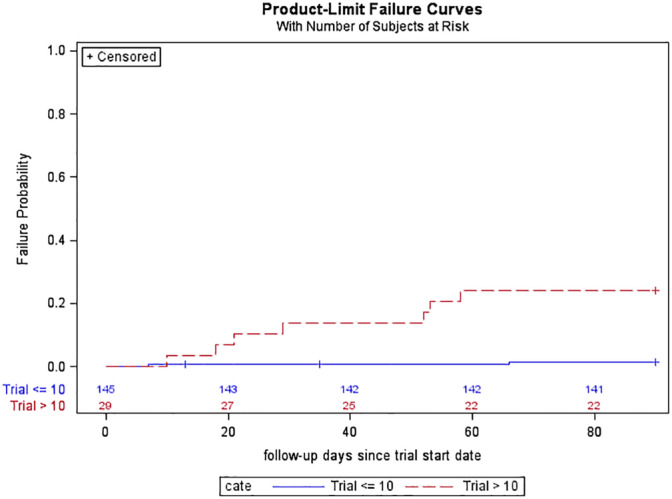
Among nine (5.2%) infections in 174 subjects trialed, the only significant contributing factor to infection was trial duration: median 21 days (range 3-56) for those with infection vs. six days (1-41) for those without (p = 0.001; Wilcoxon rank-sum test). The cumulative incidence of infection for subjects trialed >10 days was 24.1% vs. 1.4% for subjects trialed ≤10 days (p < 0.001). After the protocol was amended to limit trial duration to 10 days, 14 infection-free trials were performed in Belgium.
Although not part of the preplanned analysis, our observation supports the hypothesis of a cause-effect relationship between trial duration and the risk of infection and the conclusion that prolonged SCS trials should be avoided.
在 PROMISE 研究中,一项多国随机对照试验(RCT)评估了多柱式脊髓刺激(SCS)作为治疗腰痛的有效性,临床医生遵循了他们的常规实践。一项早期的、计划外的安全性分析显示,在比利时(23 例中有 5 例)的感染率显著高于其他研究国家(64 例中有 1 例),研究持续时间中位数为 21.5 天,为 5.8 天(p<0.01)。本报告回顾了研究完成后 PROMISE 研究中观察到的感染。
对于所有与 SCS 相关的感染,我们使用描述性统计和独立变量检验来分析感染患者与无感染患者之间可能存在的影响因素(年龄、性别、并存的医疗状况、吸烟状况、导联类型和研究持续时间)。使用 Kaplan-Meier 方法创建累积发病率曲线,并使用对数秩检验比较两种分层之间的差异。
在 174 例接受试验的患者中,有 9 例(5.2%)发生感染,唯一与感染显著相关的因素是试验持续时间:感染患者的中位数为 21 天(范围为 3-56),无感染患者为 6 天(范围为 1-41)(p=0.001;Wilcoxon 秩和检验)。试验持续时间>10 天的患者的感染累积发病率为 24.1%,而试验持续时间≤10 天的患者为 1.4%(p<0.001)。在将方案修订为限制试验持续时间至 10 天后,在比利时又进行了 14 次无感染的试验。
尽管这不是预先计划的分析的一部分,但我们的观察结果支持试验持续时间与感染风险之间存在因果关系的假设,并得出结论,应避免延长 SCS 试验。