Njiomegnie Gaitan Fabrice, Read Scott A, Fewings Nicole, George Jacob, McKay Fiona, Ahlenstiel Golo
Blacktown Clinical School and Research Centre, Western Sydney University, Blacktown, NSW 2148, Australia.
Storr Liver Centre, Westmead Institute for Medical Research, University of Sydney, Westmead, NSW, 2145, Australia.
J Clin Med. 2020 Apr 6;9(4):1030. doi: 10.3390/jcm9041030.
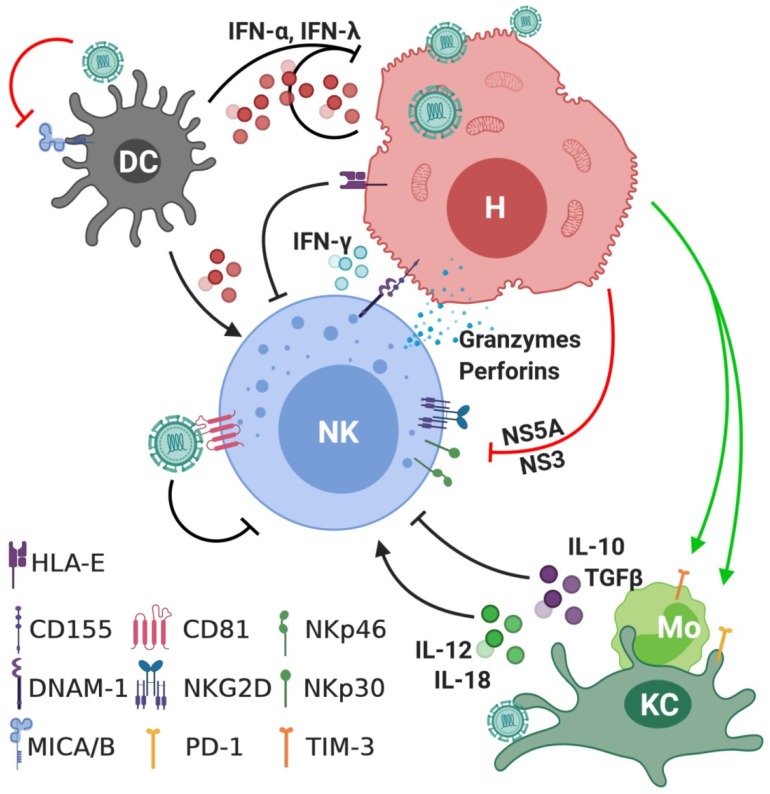
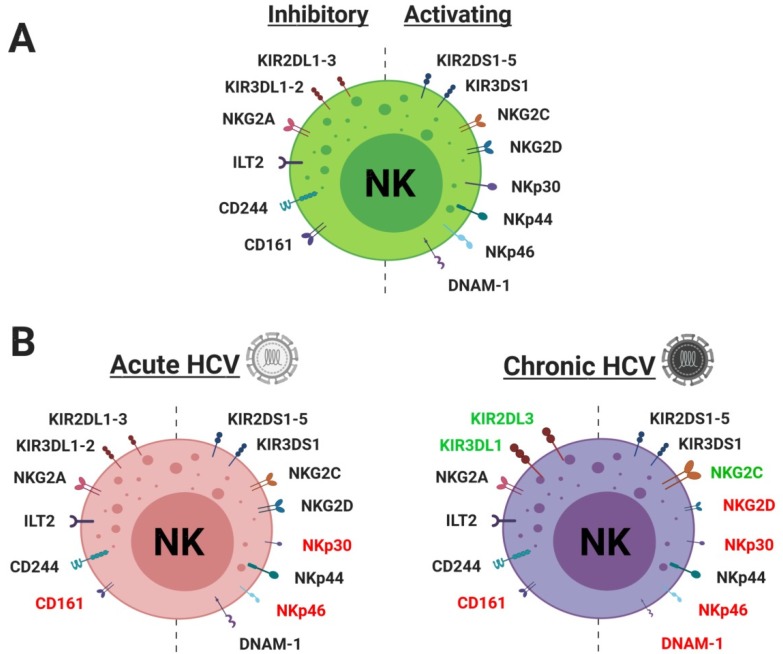
Hepatitis C virus (HCV) infection develops into chronic hepatitis in over two-thirds of acute infections. While current treatments with direct-acting antivirals (DAAs) achieve HCV eradication in >95% of cases, no vaccine is available and re-infection can readily occur. Natural killer (NK) cells represent a key cellular component of the innate immune system, participating in early defence against infectious diseases, viruses, and cancers. When acute infection becomes chronic, however, NK cell function is altered. This has been well studied in the context of HCV, where changes in frequency and distribution of NK cell populations have been reported. While activating receptors are downregulated on NK cells in both acute and chronic infection, NK cell inhibiting receptors are upregulated in chronic HCV infection, leading to altered NK cell responsiveness. Furthermore, chronic activation of NK cells following HCV infection contributes to liver inflammation and disease progression through enhanced cytotoxicity. Consequently, the NK immune response is a double-edged sword that is a significant component of the innate immune antiviral response, but persistent activation can drive tissue damage during chronic infection. This review will summarise the role of NK cells in HCV infection, and the changes that occur during HCV therapy.
丙型肝炎病毒(HCV)感染在超过三分之二的急性感染中会发展为慢性肝炎。虽然目前使用直接作用抗病毒药物(DAA)进行治疗在超过95%的病例中可实现HCV清除,但尚无可用疫苗,且很容易再次感染。自然杀伤(NK)细胞是固有免疫系统的关键细胞组成部分,参与对传染病、病毒和癌症的早期防御。然而,当急性感染转变为慢性感染时,NK细胞功能会发生改变。这在HCV感染的背景下已得到充分研究,其中已报道了NK细胞群体频率和分布的变化。虽然在急性和慢性感染中NK细胞上的激活受体均下调,但NK细胞抑制受体在慢性HCV感染中上调,导致NK细胞反应性改变。此外,HCV感染后NK细胞的慢性激活通过增强细胞毒性促进肝脏炎症和疾病进展。因此,NK免疫反应是一把双刃剑,它是固有免疫抗病毒反应的重要组成部分,但持续激活会在慢性感染期间导致组织损伤。本综述将总结NK细胞在HCV感染中的作用以及HCV治疗期间发生的变化。