Astbury Centre for Structural Molecular Biology, Faculty of Biological Sciences, University of Leeds, Leeds, United Kingdom.
Department of Biology, Massachusetts Institute of Technology, Cambridge, Massachusetts, USA.
mSphere. 2020 Apr 8;5(2):e00144-20. doi: 10.1128/mSphere.00144-20.
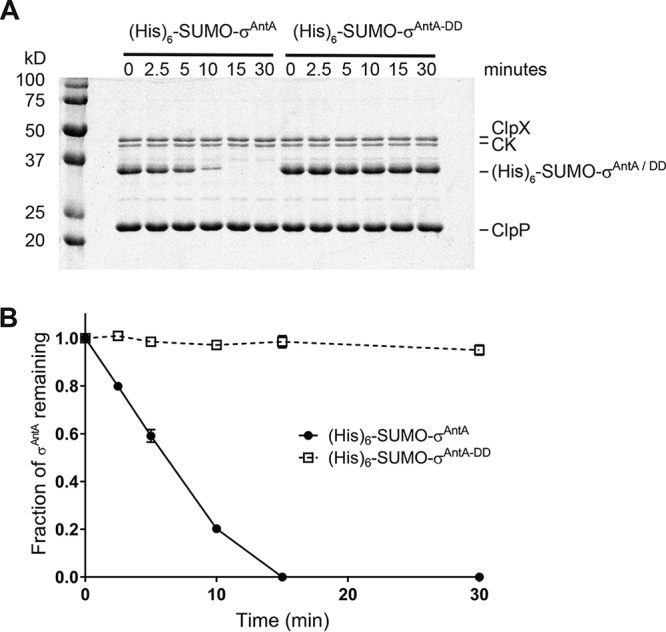
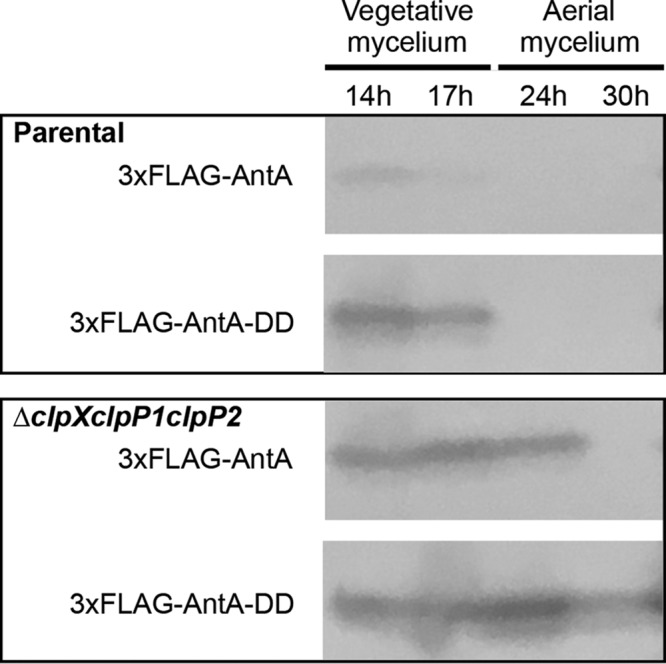
The survival of any microbe relies on its ability to respond to environmental change. Use of xtraytoplasmic unction (ECF) RNA polymerase sigma (σ) factors is a major strategy enabling dynamic responses to extracellular signals. species harbor a large number of ECF σ factors, nearly all of which are uncharacterized, but those that have been characterized generally regulate genes required for morphological differentiation and/or response to environmental stress, except for σ, which regulates starter-unit biosynthesis in the production of antimycin, an anticancer compound. Unlike a canonical ECF σ factor, whose activity is regulated by a cognate anti-σ factor, σ is an orphan, raising intriguing questions about how its activity may be controlled. Here, we reconstituted ClpXP proteolysis of σ but not of a variant lacking a C-terminal di-alanine motif. Furthermore, we show that the abundance of σ was enhanced by removal of the ClpXP recognition sequence and that levels of the protein rose when cellular ClpXP protease activity was abolished. These data establish direct proteolysis as an alternative and, thus far, unique control strategy for an ECF RNA polymerase σ factor and expands the paradigmatic understanding of microbial signal transduction regulation. Natural products produced by species underpin many industrially and medically important compounds. However, the majority of the ∼30 biosynthetic pathways harbored by an average species are not expressed in the laboratory. This unrevealed biochemical diversity is believed to comprise an untapped resource for natural product drug discovery. Major roadblocks preventing the exploitation of unexpressed biosynthetic pathways are a lack of insight into their regulation and limited technology for activating their expression. Our findings reveal that the abundance of σ, which is the cluster-situated regulator of antimycin biosynthesis, is controlled by the ClpXP protease. These data link proteolysis to the regulation of natural product biosynthesis for the first time to our knowledge, and we anticipate that this will emerge as a major strategy by which actinobacteria regulate production of their natural products. Further study of this process will advance understanding of how expression of secondary metabolism is controlled and will aid pursuit of activating unexpressed biosynthetic pathways.
任何微生物的生存都依赖于其应对环境变化的能力。利用细胞质功能 (ECF) RNA 聚合酶 σ (σ) 因子是一种主要策略,能够对细胞外信号做出动态响应。种含有大量的 ECF σ 因子,几乎所有的 ECF σ 因子都没有被描述过,但已经被描述的 ECF σ 因子通常调节形态分化和/或对环境压力的反应所需的基因,除了 σ,它调节在生产抗霉素(一种抗癌化合物)中起始单元的生物合成。与活性受同源抗 - σ 因子调节的典型 ECF σ 因子不同,σ 是一个孤儿,这引发了关于其活性如何可能被控制的有趣问题。在这里,我们重建了 ClpXP 对 σ 的蛋白水解,但不能对缺乏 C 末端二丙氨酸基序的变体进行蛋白水解。此外,我们表明,去除 ClpXP 识别序列可增强 σ 的丰度,并且当细胞 ClpXP 蛋白酶活性被废除时,蛋白质水平上升。这些数据确立了直接蛋白水解作为一种替代策略,并且迄今为止,这是一种独特的 ECF RNA 聚合酶 σ 因子的控制策略,并扩展了微生物信号转导调控的范例性理解。种产生的天然产物是许多工业和医学上重要化合物的基础。然而,在平均每个种中大约有 30 个生物合成途径,其中只有少数在实验室中表达。这种未揭示的生化多样性被认为是天然产物药物发现的未开发资源。阻止未表达生物合成途径利用的主要障碍是对其调节缺乏了解和激活其表达的技术有限。我们的发现表明,σ 的丰度受到 ClpXP 蛋白酶的控制,σ 是抗霉素生物合成的簇定位调节剂。这些数据首次将蛋白水解与天然产物生物合成的调节联系起来,据我们所知,我们预计这将成为放线菌调节其天然产物产生的主要策略。对这一过程的进一步研究将增进对次生代谢物表达调控的理解,并有助于探索激活未表达的生物合成途径。