Wong Tzu Lin, Huang Chen Fu, Chen Po Chieh
Department of Physical Education, National Taipei University of Education, Taipei, Taiwan.
Department of Physical Education, National Taiwan Normal University, Taipei, Taiwan.
J Hum Kinet. 2020 Mar 31;72:5-13. doi: 10.2478/hukin-2019-0122. eCollection 2020 Mar.
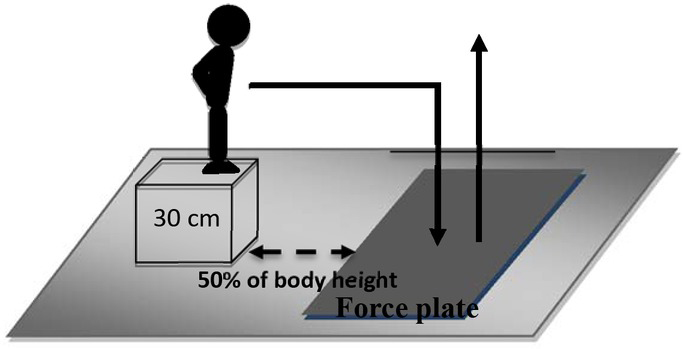
The aim of this study was to examine changes in the kinematic and kinetic parameters of female athletes performing a forward drop jump to a vertical jump under muscle fatigue condition. Twelve female college athletes performed a forward drop jump to a vertical jump with and without muscle fatigue conditions. A motion capture system and two AMTI force plates were used to synchronously collect kinematic and kinetic data. Inverse dynamics were implemented to calculate the participant's joint loading, joint moment, and energy absorption. A paired sample t-test was used to compare statistical differences between pre-fatigue and post-fatigue conditions (α = .05). The forward trunk lean angle at initial foot contact, as well as the knee range of motion, total negative work and energy absorption contribution of the knee joint during the landing phase were significantly decreased under post-fatigue condition. The increased peak vertical ground reaction force and peak tibial anterior shear forces were also found under post-fatigue condition. These results indicated that muscle fatigue caused participants to change their original landing posture into stiff landing posture and decrease the energy absorption ability, which increased the tibial anterior shear forces. Therefore, female athletes should appropriately increase the knee flexion angle under muscle fatigue condition to reduce the risk of anterior cruciate ligament injuries.
本研究的目的是考察女性运动员在肌肉疲劳状态下从向前纵跳转换为垂直纵跳时运动学和动力学参数的变化。12名女大学生运动员在有和没有肌肉疲劳的条件下进行了从向前纵跳转换为垂直纵跳的动作。使用动作捕捉系统和两个AMTI测力台同步采集运动学和动力学数据。采用逆动力学方法计算参与者的关节负荷、关节力矩和能量吸收。使用配对样本t检验比较疲劳前和疲劳后条件之间的统计学差异(α = 0.05)。在疲劳后条件下,初始足接触时的前躯干倾斜角度以及着陆阶段膝关节的运动范围、总负功和膝关节的能量吸收贡献均显著降低。在疲劳后条件下还发现垂直地面反作用力峰值和胫骨前剪切力峰值增加。这些结果表明,肌肉疲劳导致参与者将原来的着陆姿势转变为僵硬的着陆姿势,并降低了能量吸收能力,从而增加了胫骨前剪切力。因此,女性运动员在肌肉疲劳状态下应适当增加膝关节屈曲角度,以降低前交叉韧带损伤的风险。