Key Laboratory of Protein and Peptide Pharmaceuticals, Institute of Biophysics, Chinese Academy of Sciences, Beijing 100101, China.
Molecular Biology Laboratory, Zhengzhou Normal University, Zhengzhou 450044, China.
Sci Adv. 2020 Apr 1;6(14):eaaz7825. doi: 10.1126/sciadv.aaz7825. eCollection 2020 Apr.
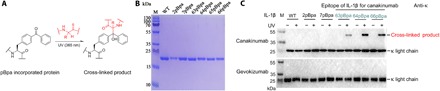
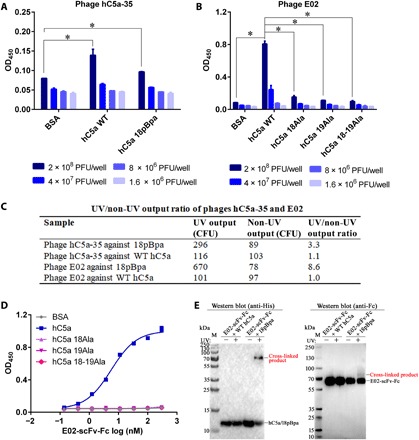
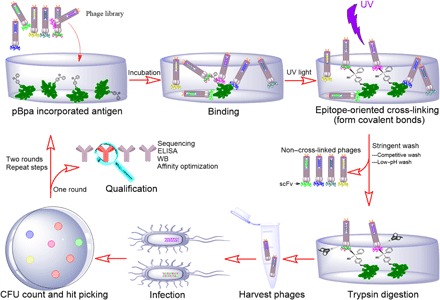
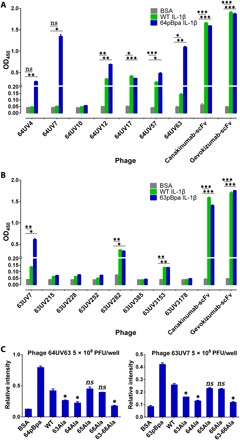
Currently, there are no methods available offering solutions to select and identify antibodies binding to a specific conformational epitope of an antigen. Here, we developed a method to allow epitope-directed antibody selection from a phage display library by photocrosslinking bound antibodies to a site that specifically incorporates a noncanonical amino acid, -benzoyl-l-phenylalanine (pBpa), on the target antigen epitope. By one or two rounds of panning against antibody phage display libraries, those hits that covalently bind to the proximity site of pBpa on specific epitopes of target antigens after ultraviolet irradiation are enriched and selected. This method was applied to specific epitopes on human interleukin-1β and complement 5a. In both cases, more than one-third of hits identified bind to the target epitopes, demonstrating the feasibility and versatility of this method.
目前,尚无方法可用于选择和鉴定与抗原特定构象表位结合的抗体。在这里,我们开发了一种方法,通过将结合的抗体光交联到靶抗原表位上特异性掺入非典型氨基酸 - 苯甲酰基-L-苯丙氨酸(pBpa)的位置,从噬菌体展示文库中允许针对表位的抗体选择。通过一轮或两轮针对抗体噬菌体展示文库的淘选,在紫外线照射后,那些与靶抗原特定表位上 pBpa 的近邻位点共价结合的噬菌体得到了富集和选择。该方法应用于人白细胞介素-1β和补体 5a 的特定表位。在这两种情况下,超过三分之一的鉴定出的噬菌体结合到靶表位上,证明了该方法的可行性和通用性。